
Why Do I Overthink Everything?
Have you ever replayed the same conversation so many times that you could practically recite it word for word?
You decide you’ve finally figured it out.
Ten minutes later, another possibility pops into your mind.
But what if I forgot something? What about this?
Before you know it, you’re right back where you started.
Many people describe this experience as “overthinking.” They often wonder:
Why can’t I stop thinking about this?
Why do I analyze everything so much?
Why can’t I just let things go?
Overthinking can feel productive because it seems like you’re working toward an answer. In reality, it often leaves people feeling more uncertain, more anxious, and mentally exhausted than when they started.
What Is Overthinking?
Although overthinking isn’t a clinical diagnosis, it’s a term people commonly use to describe becoming stuck in repetitive thinking that doesn’t seem to lead anywhere.
A man may spend an hour replaying a conversation, trying to decide whether he offended someone. A woman may repeatedly compare two job offers long after she’s listed every possible pro and con. Someone else may mentally rehearse an upcoming conversation dozens of times before it happens.
In both cases, the mind keeps searching for certainty, reassurance, or the “right” answer, but the thinking rarely feels finished.
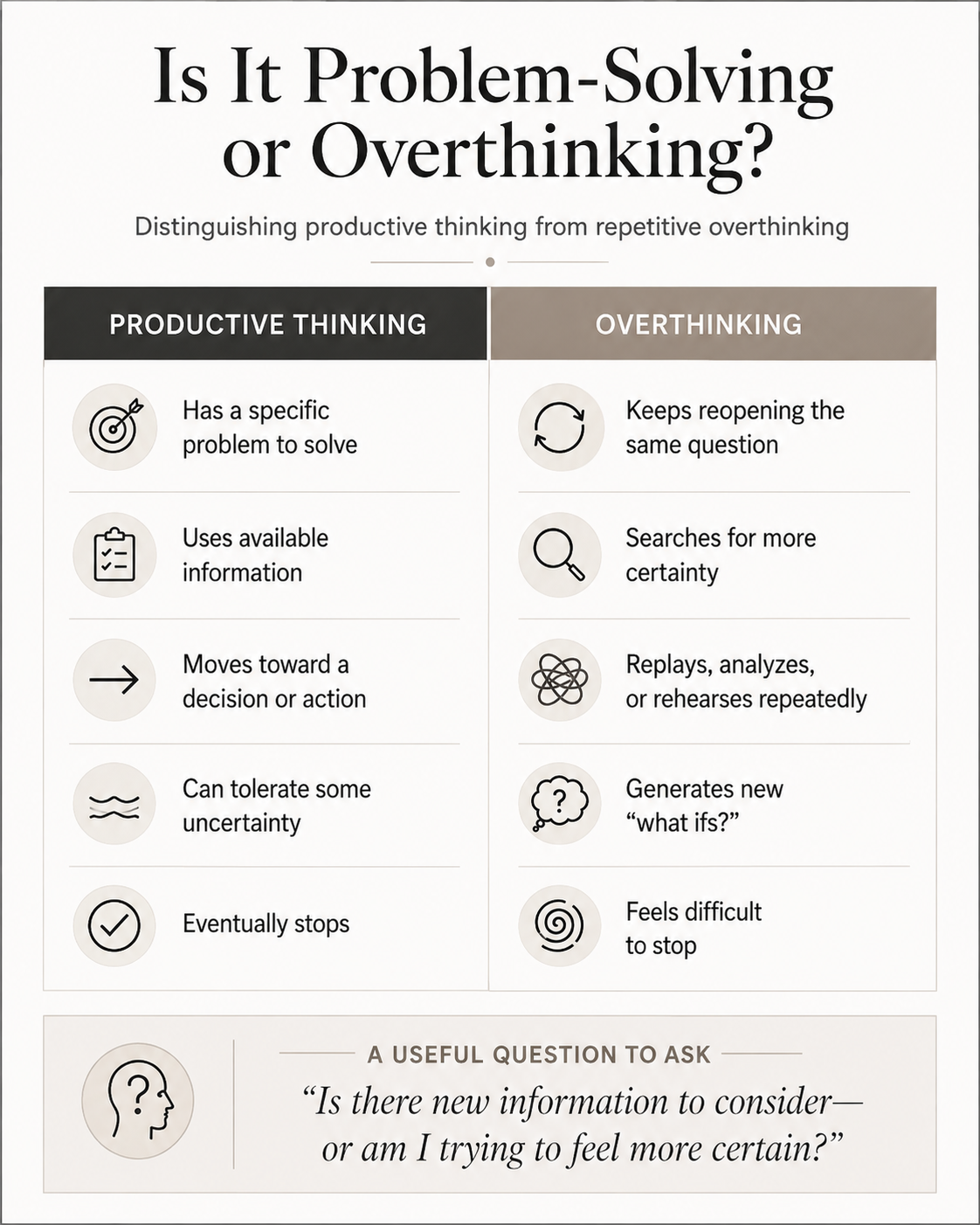
When Does Thinking Become Overthinking?
Overthinking often feels like problem-solving, but instead of moving us toward a decision, it keeps us mentally circling the same questions.
Productive thinking usually ends with a plan or decision. Overthinking often ends with another “What if?”
Why Does Overthinking Feel So Hard to Stop?
Overthinking usually begins with a reasonable goal. Someone wants to make the best decision, avoid making a mistake, understand what happened, or prevent something bad from occurring.
The difficulty is that the mind starts treating more thinking as the solution. Instead of recognizing that it’s reached the limits of what thinking can accomplish, it keeps searching for certainty.
When Thinking Becomes a Cycle
Imagine someone wondering whether he offended a friend.
He replays the conversation and decides it probably went fine. A few minutes later, another thought appears:
But what if I missed something?
So he reviews the conversation again. For a brief moment, he feels reassured.
Then another possibility appears.
Maybe she was just being polite.
The cycle starts again.
Some people also seek reassurance from friends, family members, or the internet, hoping someone else can finally provide the certainty that their own thinking hasn’t.
Each round of thinking feels like another attempt to solve the problem, but it often strengthens the urge to keep analyzing.
Overthinking Can Look Different in Different Conditions
Overthinking isn’t a diagnosis itself and can occur in a number of different conditions.
Someone with generalized anxiety may repeatedly think through future possibilities in an effort to prevent mistakes or prepare for the worst.
A person with depression may become caught in repetitive thoughts about past events, perceived failures, or self-criticism.
In obsessive-compulsive disorder (OCD), overthinking often takes the form of compulsive mental reviewing, rumination, or attempts to answer questions that can’t be answered with complete certainty. Someone may repeatedly analyze what a thought means, whether a memory is accurate, or whether enough has been done to prevent harm.
Although these experiences differ, they share one important feature: the thinking often feels necessary, even when it isn’t helping.
More Thinking Doesn’t Always Lead to More Clarity
One of the biggest misconceptions about overthinking is that the solution is simply finding the right answer.
In reality, many people already have enough information to make a decision or move forward. Often, the problem isn’t a lack of information. It’s the belief that one more round of thinking will finally produce certainty.
Unfortunately, certainty is often exactly what the mind can’t provide.
How Do You Stop Overthinking?
The goal usually isn’t to stop thinking altogether.
Instead, treatment often focuses on changing the relationship with repetitive thinking. Depending on the underlying problem, this may involve learning to tolerate uncertainty, reducing rumination, practicing more flexible responses to anxious thoughts, or resisting the urge to mentally solve questions that have no definitive answer.
For people with OCD, Exposure and Response Prevention (ERP) helps reduce compulsive mental rituals and reassurance-seeking rather than trying to eliminate uncertainty. For anxiety and related concerns, cognitive behavioral approaches often help people recognize when thinking has shifted from productive problem-solving into repetitive mental loops.
One of the reasons overthinking persists is that it feels useful. If it felt pointless, people would stop. The challenge is that what feels like solving the problem often becomes part of the problem itself.
Therapy for Anxiety, OCD, and Rumination in Arlington, VA
I provide therapy for adults and adolescents experiencing anxiety, OCD, excessive worry, rumination, perfectionism, and related concerns. Services are available in person and through teletherapy.
If overthinking is leaving you feeling stuck, exhausted, or unable to move forward, reach out to learn more about evidence-based treatment.
Related Articles
What Is Exposure and Response Prevention (ERP) Therapy?
What Is Cognitive Behavioral Therapy (CBT)?
Understanding False Memory OCD
Understanding Moral Scrupulosity: When OCD Targets Morality and Responsibility