
“What If This Isn’t Really OCD?” Understanding Meta OCD
Sometimes one of the most distressing features of obsessive-compulsive disorder is that sometimes OCD begins targeting the disorder itself.
Many people with OCD eventually find themselves caught in a painful and confusing loop:
What if this isn’t actually OCD?
What if I’m just making excuses?
What if I’m in denial?
What if ERP is making me worse?
What if I convinced myself I have OCD when I really don’t?
What if my thoughts mean something important?
This is sometimes referred to as meta OCD - OCD becoming focused on OCD.
Instead of focusing primarily on a specific feared outcome, OCD shifts toward uncertainty about the disorder itself, the treatment process, one’s motives, one’s insight, or whether the symptoms are “real enough” to count as OCD. For many people, this can feel especially destabilizing because OCD starts attacking the very framework they’ve been using to understand their experiences.
Meta OCD is one of many OCD themes. Although the obsessions focus on obsessive compulsive disorder itself, the same OCD cycle can attach itself to many different topics, including harm, contamination, relationships, health, morality, or past events. Learn more in Types of OCD: Understanding Different OCD Themes.
Why Meta OCD Feels So Convincing
Meta OCD often feels uniquely convincing because it attaches itself to insight, self-awareness, and reflection.
People with OCD are often highly analytical and introspective. They may spend enormous amounts of time examining whether their fears are genuine, whether they’re responding correctly in ERP, whether they secretly want the feared outcome, whether they’re using OCD as an excuse, whether they’re “doing compulsions on purpose,” or whether they’re “too aware” for it to really be OCD.
The mind begins treating certainty about OCD itself as something that must be solved before moving forward.
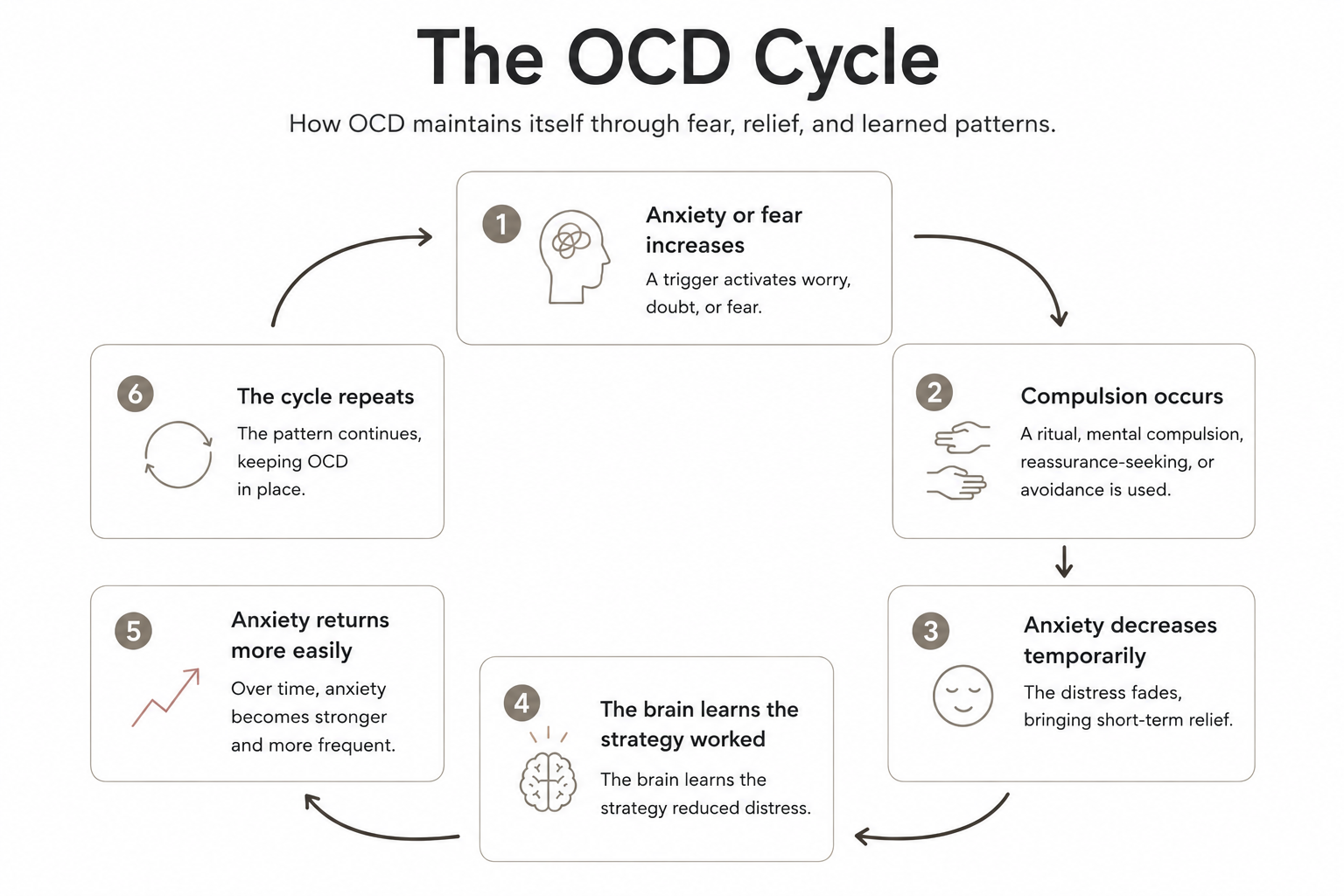
Unfortunately, this becomes another version of the same OCD process. A distressing uncertainty appears, the person tries to analyze or resolve it, temporary relief occurs, and then the doubt returns. The cycle starts over again with more mental checking and analysis.
The content changes, but the mechanism remains remarkably similar.
Common Signs of Meta OCD
Meta OCD can look different from person to person, but common signs include seeking reassurance about whether something is “really OCD,” comparing oneself to other people with OCD, obsessing about whether ERP is being done correctly, and repeatedly wondering whether this situation is somehow different.
Many people with meta OCD become trapped in endless self-monitoring, constantly evaluating their thoughts, feelings, reactions, and treatment efforts in an attempt to finally determine whether their experience is “really OCD.”
The Problem With Trying to Figure It Out
People with OCD often assume relief will come once they finally determine whether something is “really OCD.”
Unfortunately, OCD is rarely satisfied with answers for very long. Even if reassurance temporarily helps, the mind often generates a new angle, a new exception, or a new reason to question the answer that was just provided.
The search for certainty gradually becomes the problem itself.
This is one reason OCD can feel so relentless. OCD is remarkably good at finding new areas of uncertainty. Once one doubt begins to feel resolved, the mind often shifts toward questioning the resolution itself.
“But What If It Isn’t Really OCD?”
This question is often where people feel stuck.
Many people with OCD want definitive proof that their fear is unfounded, that their symptoms are truly OCD, or that they can safely stop worrying. But OCD tends to demand a level of certainty that doesn’t actually exist in human experience.
Treatment involves learning a different relationship with uncertainty rather than finally achieving perfect certainty. Paradoxically, people often become less trapped by obsessions when they stop trying to fully disprove them.
Meta OCD Can Feel Especially Isolating
People with meta OCD are often afraid others will misunderstand them. Some worry that they’re manipulating others, seeking attention, exaggerating symptoms, or avoiding responsibility. Because the obsession focuses on self-awareness and authenticity, people may feel ashamed discussing it openly. These fears are common among people struggling with OCD. The fact that the doubts focus on OCD itself doesn’t change the underlying pattern of obsessive doubt and compulsive attempts to achieve certainty.
Treatment for Meta OCD
Treatment for meta OCD typically involves the same evidence-based approaches used for other forms of obsessive compulsive disorder. This often includes reducing reassurance-seeking, identifying mental compulsions, reducing rumination and self-monitoring, increasing willingness to tolerate uncertainty, and learning to disengage from endless internal analysis.
Importantly, treatment usually isn’t focused on arguing someone into certainty that the experience is “really OCD.” Instead, the focus is on changing the compulsive relationship to doubt itself.
Meta OCD and Exposure and Response Prevention (ERP)
Exposure and Response Prevention (ERP) is considered the gold standard treatment for obsessive compulsive disorder, including meta OCD. Rather than trying to become completely certain that a thought is or isn’t OCD, ERP helps people gradually resist compulsions while learning that uncertainty can be tolerated.
People with meta OCD frequently worry that they’re “doing ERP wrong.”
They may analyze whether exposures are genuine, monitor whether anxiety decreased “correctly,” compulsively evaluate treatment progress, seek certainty that a thought is OCD before resisting compulsions, or worry that they are accidentally suppressing something important.
Ironically, the attempt to become perfectly certain about treatment can become another compulsion.
ERP isn’t about proving with certainty that thoughts are meaningless. It’s about learning to tolerate uncertainty without compulsively trying to resolve it.
That includes uncertainty about OCD itself.
OCD Treatment in Arlington, VA
I provide therapy for OCD and anxiety disorders in Arlington, including treatment for obsessive doubt, reassurance-seeking, rumination, and meta OCD themes. Services are available in person and through teletherapy.
Treatment focuses on helping people step out of compulsive cycles of analysis and develop a different relationship with uncertainty, intrusive thoughts, and fear over time.
If OCD keeps finding new ways to pull you back into doubt, treatment can help. Reach out to learn more.
Related Articles
Types of OCD: Understanding Different OCD Themes
What Is Exposure and Response Prevention (ERP) Therapy?
Do Only People With OCD Have Intrusive Thoughts?
Why Is Uncertainty So Hard to Tolerate?
Why Can’t I Stop Thinking About It? Understanding Rumination in OCD