
What’s Existential OCD?
Existential OCD is a subtype of obsessive-compulsive disorder involving repetitive, distressing questions about existence, reality, consciousness, identity, or the meaning of life. The problem isn’t philosophical curiosity itself, but the compulsive need to reach certainty, resolution, or complete understanding.
Someone with existential OCD might become preoccupied with whether anything is truly real, whether life has meaning, or how he can know that other people actually exist. Another person may become consumed by questions about consciousness or fear that she will never be able to feel certain about reality. Rather than leading to interesting reflection, these questions tend to become intrusive, distressing, repetitive, and difficult to disengage from.
Existential OCD is one of many OCD themes. Although the obsessions revolve around questions of existence, reality, or meaning, obsessive-compulsive disorder can focus on many other topics as well. Learn more in Types of OCD: Understanding Different OCD Themes.
Why Existential OCD Can Feel So Sticky
Existential obsessions can feel especially consuming because many existential questions genuinely don’t have fully provable answers.
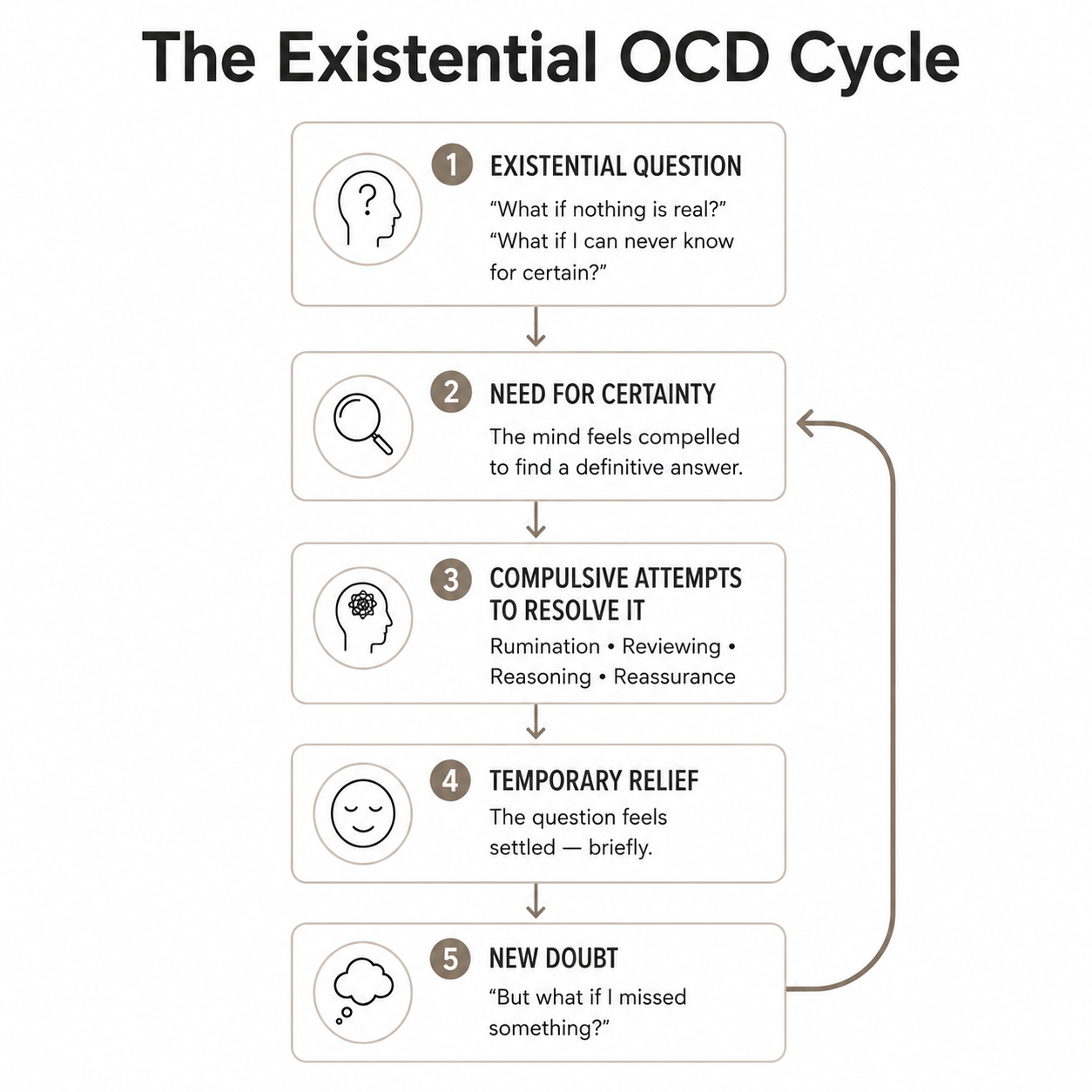
OCD tends to struggle intensely with uncertainty. The mind may keep searching for complete certainty, total reassurance, perfect understanding, or absolute resolution. But existential topics rarely provide the kind of certainty OCD demands.
When a distressing existential thought appears, a person may begin analyzing it, reviewing it mentally, or trying to arrive at a definitive answer. That effort may provide temporary relief, but eventually another doubt appears. The person begins analyzing again, and the cycle continues.
Over time, life can become increasingly narrowed around compulsive attempts to mentally resolve the unresolvable.
Common Symptoms of Existential OCD
Existential OCD symptoms can vary from person to person, but often include:
fear of unreality or losing touch with reality
hyperawareness of thoughts or consciousness
compulsive mental checking
difficulty tolerating uncertainty
excessive self-monitoring
intrusive questions about existence, identity, or reality
Many people with existential OCD recognize that the thinking feels excessive or unproductive, but still feel pulled to continue analyzing the questions.
Derealization and Existential OCD
Some people with existential OCD also experience derealization or depersonalization, particularly during periods of intense anxiety or hypervigilance.
They may feel detached from their surroundings, emotionally numb, unreal or disconnected, overly aware of consciousness, or hyperfocused on the experience of existing.
These experiences can themselves become the focus of obsessions. Someone may begin worrying that she will never feel normal again, that something has happened to her brain, or that the sensation means she is losing touch with reality. Trying to determine what the experience “means” can then lead to even more monitoring and analysis.
Anxiety itself can intensify feelings of unreality, particularly when attention becomes excessively focused inward and the mind begins continuously monitoring thoughts, sensations, and consciousness.
The Goal Isn’t Perfect Certainty
People with existential OCD often believe relief will come once they finally “figure it out.”
Unfortunately, OCD tends to keep moving the goalpost. A question may seem resolved temporarily, only for the person to wonder whether he overlooked something, whether certainty itself is impossible, or whether distracting himself from the question means he is avoiding an important truth. Each attempted answer creates an opportunity for another doubt.
Instead of focusing on answering existential questions, treatment focuses on changing the compulsive relationship to uncertainty, rumination, and mental analysis.
Treatment for Existential OCD
Treatment for existential OCD may involve identifying mental compulsions, reducing compulsive philosophical analysis and reassurance-seeking, and practicing allowing uncertainty to exist without trying to resolve it. People may also work on reducing excessive monitoring of thoughts and consciousness and learning to disengage from obsessive mental loops.
Importantly, treatment isn't about proving existential fears false or achieving perfect certainty.
The goal is to help people stop organizing their lives around compulsive attempts to eliminate uncertainty completely.
Existential OCD Treatment in Arlington, VA
I provide OCD therapy in Arlington, VA, including treatment for existential OCD, intrusive thoughts, rumination, reassurance-seeking, obsessive doubt, and anxiety disorders. Services are available in person and, when appropriate, through teletherapy. Treatment focuses on helping people gradually step out of compulsive cycles of mental analysis and develop a different relationship with uncertainty, intrusive thoughts, and fear over time.
If OCD is taking up more of your time and energy than you’d like, reach out to schedule a consultation.
Related Articles
Types of OCD: Understanding Different OCD Themes
What Is Exposure and Response Prevention (ERP) Therapy?
How Reassurance Makes Anxiety Worse
Why Is Uncertainty So Hard to Tolerate?
Understanding Moral Scrupulosity: When OCD Targets Morality and Responsibility