
Understanding Real Event OCD
Real event OCD is a form of obsessive-compulsive disorder in which obsessions focus on something the person believes they did wrong in the past.
The person may become consumed by questions such as:
What if I traumatized someone?
What if I’m going to be publicly shamed?
What if I’m going to be arrested someday?
What if I’d lose my friends and family if they knew?
Although the specific fears vary, the underlying questions are similar: What does this mean about me? Am I responsible for more harm than I realize? Do I deserve forgiveness? Can I ever move on?
Unfortunately, OCD isn’t satisfied by answers for long. The mind becomes trapped trying to answer questions that may not have clear answers: Was I a bad person? Did I cause harm? Have I suffered enough? Do I deserve forgiveness?
Real event OCD is one of many OCD themes. Although the obsessions focus on something that actually happened, obsessive compulsive disorder can also involve contamination, harm, relationships, health, or many other topics. Learn more in Types of OCD: Understanding Different OCD Themes.
Common Themes in Real Event OCD
Real event OCD can focus on many different experiences, including:
past relationship behavior and sexual experiences
dishonesty
perceived moral failures
mistakes made during adolescence or childhood
fears of having emotionally harmed someone
incidents involving alcohol or impaired memory
parenting concerns
academic or workplace mistakes.
Instead, the reviewing creates more doubt and shame.
The Event Is Real. But OCD Changes the Relationship to It.
Real event OCD can be especially confusing because the feared event isn’t imaginary. Something actually happened.
The problem isn’t the existence of the event itself. The problem is that OCD transforms it into an ongoing source of doubt, guilt, shame, and self-evaluation. The person may spend hours reviewing memories, analyzing intentions, seeking reassurance, confessing, comparing themselves to others, or trying to determine what the event says about their character.
Many people with real event OCD fear that letting go would be irresponsible or morally wrong. Continuing to think about the event can feel like proof that they care, are taking responsibility, or are trying to be a good person.
The mind becomes trapped in questions that may not have clear answers: Was I a bad person? Did I cause harm? Have I suffered enough? Do I deserve forgiveness? Real life rarely provides the kind of certainty OCD demands. Human behavior is complicated, and intentions, consequences, and responsibility aren’t always perfectly clear.
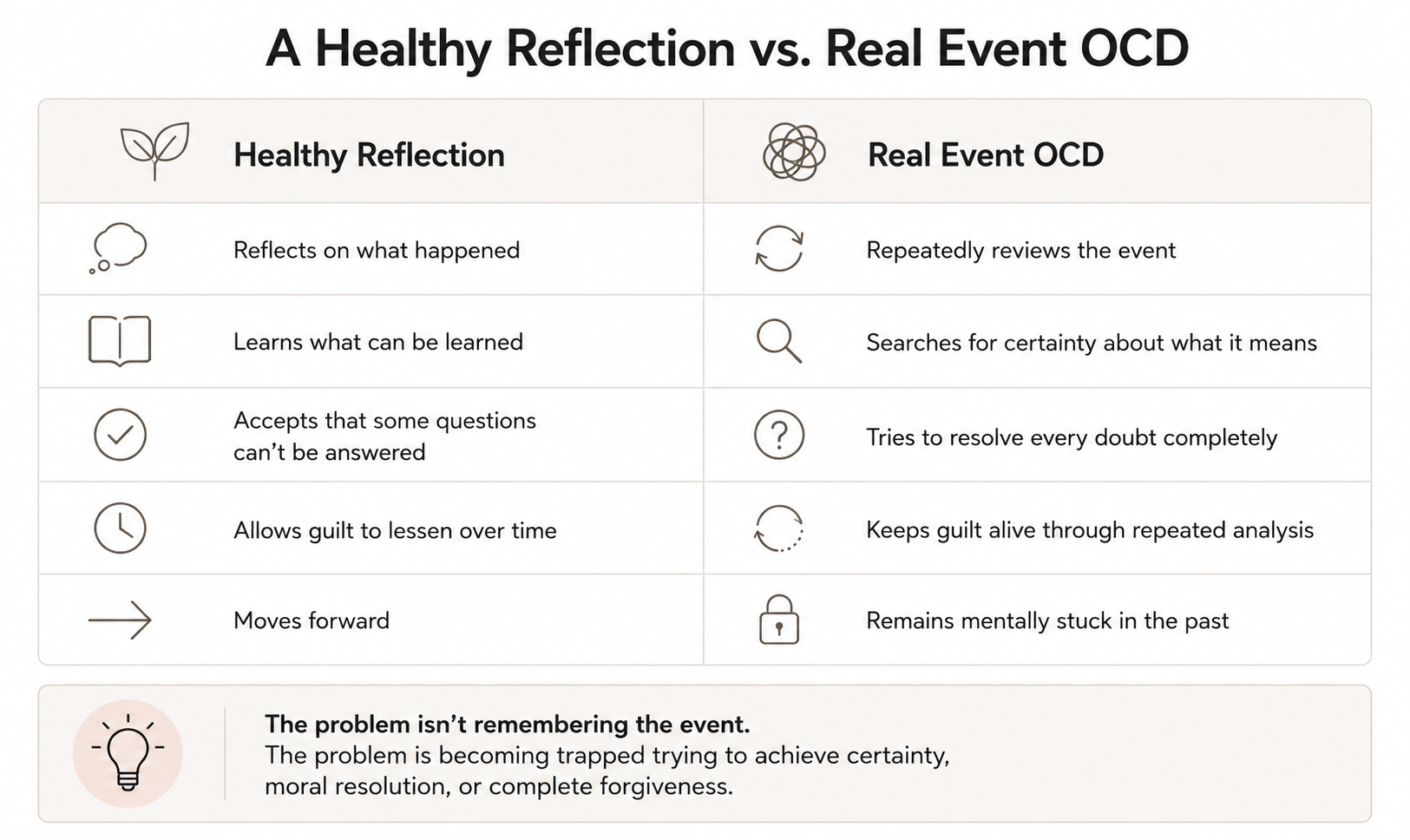
Instead of creating resolution, the reviewing creates more doubt, shame, and emotional exhaustion. Some people begin organizing their entire identity around the feared mistake.
Treatment Doesn’t Mean Saying the Event “Didn’t Matter”
People sometimes worry that treatment means denying responsibility, excusing harmful behavior, pretending mistakes never happened, or “getting away with” something.
Treatment focuses on helping people step out of cycles of compulsive reviewing, reassurance-seeking, confession, self-punishment, and attempts to achieve moral certainty. The goal isn’t to determine whether someone is perfectly good or perfectly bad. The goal is to help people develop a more flexible and humane relationship with guilt, imperfection, uncertainty, and the past.
ERP for Real Event OCD
The most effective treatment for OCD is Exposure and Response Prevention (ERP), a specialized form of Cognitive Behavioral Therapy. ERP helps people gradually face distressing thoughts, memories, guilt, uncertainty, and self-doubt without engaging in compulsions such as reviewing, reassurance-seeking, confession, researching, or repeated attempts to determine what the event means about them.
ERP isn’t about proving someone is innocent or that the event didn’t matter. It’s about helping people stop organizing their lives around compulsive attempts to achieve certainty, moral resolution, or emotional relief. Over time, many people find that the event becomes less emotionally consuming when they stop trying to solve it.
OCD Treatment in Arlington, VA
I provide therapy for OCD and anxiety disorders in Arlington, including treatment for real event OCD, false memory OCD, intrusive thoughts, compulsions, reassurance-seeking, and obsessive doubt. Services are available in person and through teletherapy.
Treatment focuses on helping people step out of compulsive cycles of guilt, reviewing, and certainty-seeking while developing a more flexible relationship with imperfection, uncertainty, memory, and self-evaluation over time.
If OCD is getting in the way of the life you want to live, I’d be happy to discuss how treatment can help.
Related Articles
Types of OCD: Understanding Different OCD Themes
What Is Exposure and Response Prevention (ERP) Therapy?
Why Is Uncertainty So Hard to Tolerate?