
Understanding False Memory OCD
Most people occasionally wonder whether they remembered something correctly.
Did I lock the door?
Did I send that email?
Did I say something embarrassing?
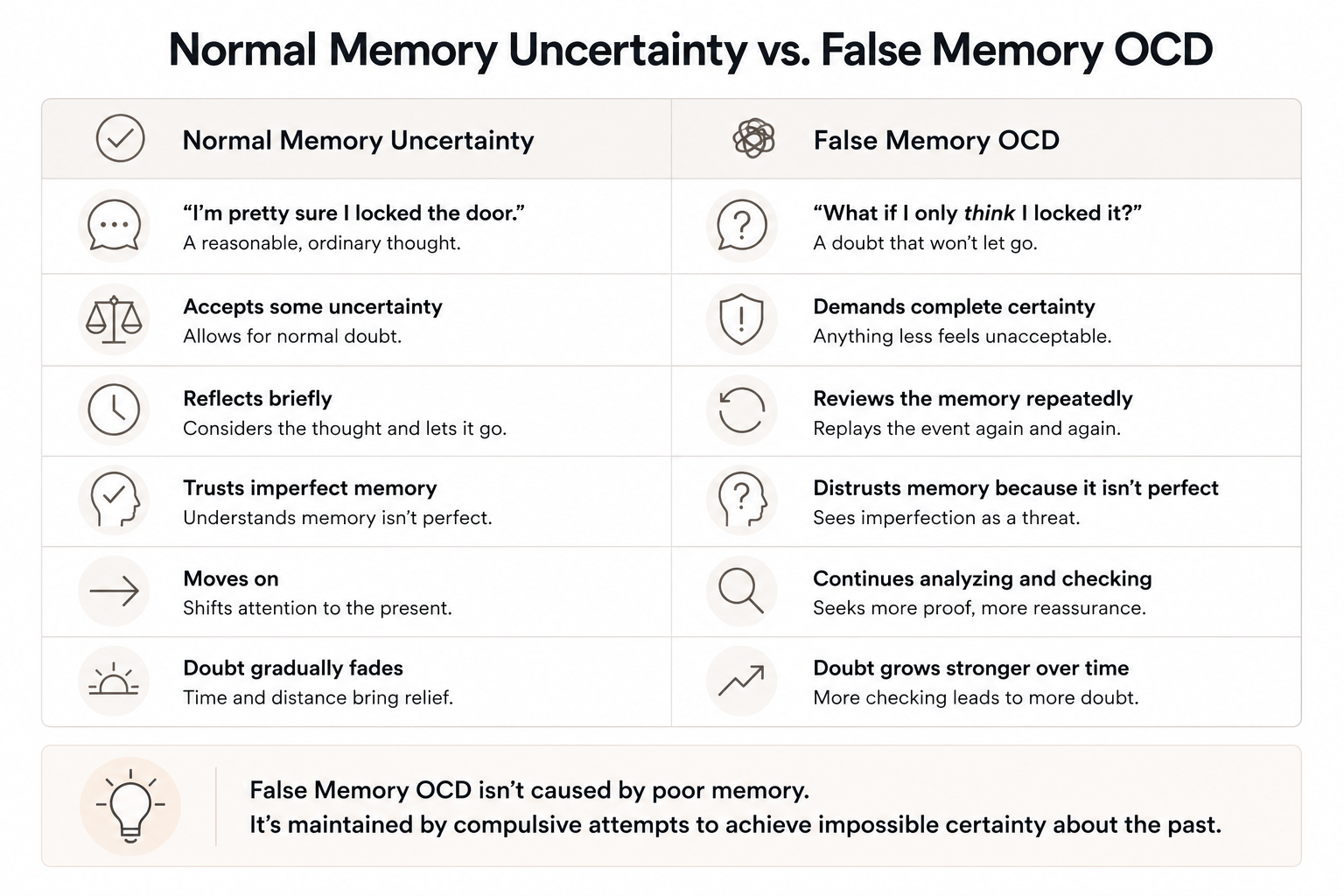
Usually, people tolerate some uncertainty, make their best judgment, and move on.
In false memory OCD, however, those doubts don’t fade. Instead, they become obsessive, emotionally consuming, and increasingly difficult to resolve.
What Is False Memory OCD?
False memory OCD is a form of obsessive-compulsive disorder involving obsessive doubt about past events, actions, or memories.
The person becomes preoccupied with the possibility that they forgot something terrible, misremembered events, caused harm unknowingly, behaved immorally, or committed a serious mistake without realizing it. The fears often feel vivid and emotionally convincing, even when objective evidence is limited or absent.
False memory OCD is one of many OCD themes. Although the doubts focus on events that may never have happened, obsessive compulsive disorder can also center on harm, contamination, relationships, health, morality, or many other concerns. Learn more in Types of OCD: Understanding Different OCD Themes.
OCD Exploits the Limits of Memory
Human memory is naturally imperfect. People forget details. Memories change over time. Confidence in memory fluctuates. Most people can tolerate this uncertainty and move forward.
In false memory OCD, however, uncertainty about memories becomes intolerable. The brain begins treating incomplete memory as evidence of possible danger: “If I can’t remember with complete certainty, maybe something terrible happened.”
Common Themes in False Memory OCD
Obsessions may involve fears such as:
acting inappropriately socially or sexually
saying something offensive
cheating or lying unknowingly
committing a crime
forgetting an important action
causing emotional harm
behaving immorally or irresponsibly
The feared event may be recent, years old, vague, partially remembered, or even entirely hypothetical. Often, the uncertainty itself becomes the obsession.
Mental Reviewing Becomes a Major Compulsion
People with false memory OCD often spend enormous amounts of time mentally replaying events and trying to reconstruct exactly what happened. They may analyze conversations, review memories repeatedly, check details, reconstruct timelines, examine emotional reactions, and search for some piece of information that will finally provide certainty.
The person may believe:
If I think about it enough, I’ll finally know for sure.
Unfortunately, compulsive reviewing usually increases confusion rather than resolving it.
Why Mental Reviewing Backfires
This happens for several reasons:
Memory is reconstructive rather than perfectly accurate.
Repeated checking tends to increase doubt.
OCD treats uncertainty as danger.
The brain continues searching for absolute certainty.
False Memory OCD Often Involves Guilt and Responsibility
Many people with false memory OCD are highly conscientious and deeply afraid of causing harm. People may believe that a good person would know for sure, that even a tiny possibility of wrongdoing must be investigated, or that uncertainty itself is irresponsible.
These beliefs can drive compulsive confession, reassurance-seeking, repeated checking of evidence, contacting others for validation, researching memories online, and avoiding situations that trigger doubt.
Real Event OCD and False Memory OCD
False memory OCD sometimes overlaps with what people call “real event OCD.” In real event OCD, a person becomes obsessively focused on something that genuinely happened — often something minor, ambiguous, or long in the past.
The problem isn’t simply that something happened. The problem is the compulsive reviewing, guilt, certainty-seeking, self-punishment, and inability to allow uncertainty or imperfection to exist. False memory OCD and real event OCD often share similar compulsive processes.
The Feelings Can Become Extremely Convincing
One painful aspect of false memory OCD is that the emotional intensity can make the feared event feel increasingly real.
People may think:
Why does this feel so real?
What if anxiety means the memory is true?
Why can’t I stop thinking about it?
What if I’m just trying to escape responsibility?
The stronger the emotion becomes, the more convincing the feared memory may seem.
OCD frequently confuses emotional intensity with factual certainty.
Reassurance Doesn’t Last
People with false memory OCD often seek reassurance from others. They may ask questions such as, Do you think I’d know if this happened? or Does this sound realistic?
Reassurance may reduce anxiety briefly, but the relief rarely lasts. New doubts quickly emerge: What if this situation is different? What if I forgot something important?
The cycle of doubt, reassurance, temporary relief, and renewed uncertainty then repeats.
Treatment for False Memory OCD
Treatment for False Memory OCD often involves Exposure and Response Prevention (ERP).
Treatment may focus on reducing compulsive reviewing, reassurance-seeking, checking behaviors, and confession rituals while helping people tolerate uncertainty about memory and develop a different relationship with intrusive doubt. Treatment isn’t usually about proving with complete certainty that feared events never happened. Instead, treatment focuses on helping people stop organizing their lives around compulsive attempts to achieve impossible certainty about the past.
Memory Is Never Perfectly Certain
One difficult reality is that human memory is never completely flawless or absolute.
Recovery often involves accepting several difficult realities:
Human memory is never perfectly certain.
Absolute certainty about the past is usually impossible.
Compulsive reviewing doesn’t create genuine safety.
Intrusive doubt isn’t evidence that something happened.
Thoughts and feelings aren’t always reliable evidence.
OCD Treatment in Arlington, VA
I provide therapy for OCD and anxiety disorders in Arlington, including treatment for false memory OCD, real event OCD, intrusive thoughts, compulsions, reassurance-seeking, and obsessive doubt. Services are available in person and through teletherapy.
Treatment focuses on helping people step out of compulsive cycles of reviewing, reassurance-seeking, guilt, and certainty-seeking while developing a healthier relationship with uncertainty and memory. If OCD is interfering with your life and you’d like to learn more about treatment, reach out to schedule a consultation.
Related Articles
Types of OCD: Understanding Different OCD Themes
What Is Exposure and Response Prevention (ERP) Therapy?
How Reassurance Makes Anxiety Worse