
What Is OCD?
It starts with a question that feels impossible to answer with complete certainty.
What if I hit someone with my car and don’t know it?
What if I lose control and hurt my baby?
What if I scream an obscenity in a work meeting?
What if I didn’t wash my hands well enough and I got salmonella?
Most people can tolerate not knowing the answer with complete certainty. Someone with obsessive compulsive disorder feels driven to eliminate that uncertainty.
Obsessive compulsive disorder (OCD) affects millions of children and adults. Understanding how obsessions and compulsions work can help explain why OCD feels so convincing and why effective treatment focuses on changing the cycle rather than eliminating every intrusive thought.
What Is Obsessive Compulsive Disorder?
Obsessive compulsive disorder (OCD) is a mental health condition characterized by two connected experiences: obsessions and compulsions.
Obsessions are unwanted, intrusive thoughts, images, or urges that repeatedly enter a person’s mind and create significant anxiety, disgust, guilt, or uncertainty. Compulsions are the behaviors or mental acts someone performs to reduce that distress, prevent a feared outcome, or gain certainty.
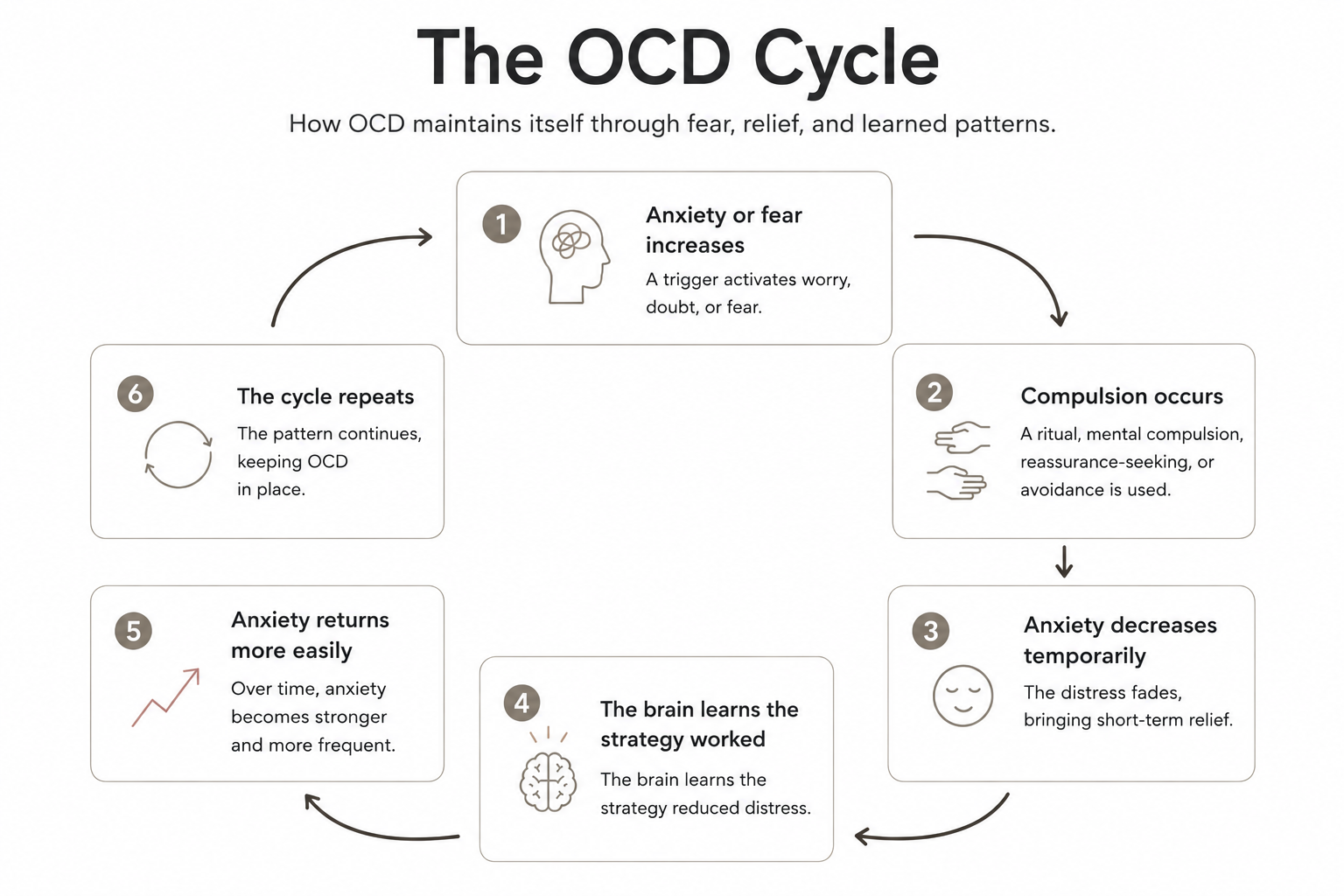
The relief from a compulsion is usually temporary. That brief reduction in anxiety teaches the brain that the ritual “worked,” making it even more likely that the compulsion will happen again the next time doubt appears. Before long, the doubt returns, another intrusive thought appears, or the feeling that something isn’t quite right comes back. The person performs another compulsion, and the cycle continues.
Understanding this cycle is one of the most important parts of understanding OCD. Compulsions reduce anxiety briefly, but they also teach the brain that the obsession was important, making future intrusive thoughts feel even more convincing.
What Are Obsessions?
Everyone experiences odd or disturbing thoughts from time to time.
Most people dismiss them and move on. Someone with OCD has much more difficulty doing that. Instead, the thought feels important, dangerous, or worthy of careful analysis, even when it is completely inconsistent with the person’s values, intentions, or character.
Obsessions can involve many different themes, including:
health concerns
making a serious mistake
offending other people
religious or moral concerns
needing things to feel “just right”
The content of the obsession varies from person to person, but the underlying experience is remarkably similar. An intrusive thought creates uncertainty, and the mind demands certainty before it can move on.
What Are Compulsions?
Compulsions are repetitive behaviors or mental acts performed to reduce anxiety, gain certainty, or prevent something feared from happening.
Some compulsions are visible, such as checking locks, washing hands, arranging objects, or seeking reassurance from family members.
Others happen entirely inside the mind. A person may mentally review memories, repeat certain words or prayers, analyze the meaning of a thought, compare feelings, or try to convince himself that everything is okay. Because many compulsions occur entirely in the mind, OCD often goes unrecognized for years.
Although compulsions provide short-term relief, they strengthen OCD over time. Each time a person performs a ritual, the brain learns that the obsession required a response and that the uncertainty couldn’t be tolerated without it. As a result, future intrusive thoughts become even more difficult to dismiss.
Avoidance can become part of the cycle as well. Someone may stop driving, avoid using knives, refuse to read certain news stories, or stay away from situations that trigger intrusive thoughts. Although avoidance reduces anxiety in the moment, it prevents the person from learning that the feared outcome can remain uncertain without requiring compulsions.
Why Can’t Someone Just Ignore the Thoughts?
People with OCD generally recognize that repeatedly checking, seeking reassurance, or mentally reviewing situations isn’t actually solving the problem. The difficulty isn’t a lack of insight or willpower.
Instead, OCD convinces people that uncertainty is dangerous.
Imagine receiving a smoke alarm that occasionally goes off when you’re making toast. Most people would eventually learn that the alarm is overly sensitive. OCD treats every alarm as though it could signal a real fire. Even if the odds are extremely small, the possibility feels too important to ignore.
The more someone tries to eliminate uncertainty, the stronger OCD becomes.
What Causes OCD?
Researchers don’t believe OCD has a single cause. Instead, it appears to result from a combination of genetic, biological, psychological, and environmental factors.
OCD tends to run in families, suggesting that genetics play a role. Brain imaging studies have identified differences in networks involved in habit learning, error detection, and cognitive control, although these findings aren’t used to diagnose individual patients.
Stressful life events don’t cause OCD by themselves, but they may trigger symptoms or make existing symptoms more noticeable in someone who is already vulnerable. Many people can identify a stressful event that seemed to coincide with the onset of symptoms, but that doesn’t necessarily mean the event caused the disorder.
What Does OCD Look Like in Everyday Life?
Many people picture OCD as someone who washes his hands repeatedly or keeps everything perfectly organized.
Those experiences certainly occur, but OCD can affect almost any area of life.
A college student may spend hours rewriting papers because they never feel “quite right.” A father may repeatedly seek reassurance that he didn’t accidentally hit someone while driving. A teenager may avoid knives because she fears she could suddenly lose control, even though she has no desire to hurt anyone. A professional may spend an entire afternoon rereading an email before sending it because he worries about making a mistake.
From the outside, these behaviors can look cautious, perfectionistic, or conscientious. Internally, they’re often driven by persistent doubt and an overwhelming need for certainty.
Is OCD More Than Cleaning and Checking?
Yes. Although contamination and checking symptoms are well known, OCD can center on almost any topic that matters deeply to the individual.
Someone may become consumed by doubts about her relationship, repeated fears of offending other people, unwanted violent images, intrusive sexual thoughts, religious concerns, or endless questions about whether she made the right decision.
The specific fear changes from person to person, but the underlying cycle of obsessions, anxiety, compulsions, temporary relief, and renewed doubt remains remarkably consistent.
How Is OCD Diagnosed?
There isn’t a blood test or brain scan that diagnoses OCD.
Diagnosis is based on a careful clinical evaluation that examines the person’s symptoms, developmental history, and the impact those symptoms have on everyday functioning. An experienced clinician also considers other conditions that can produce similar symptoms or occur alongside OCD, such as anxiety disorders, depression, autism, tic disorders, and body dysmorphic disorder.
Because compulsions are often mental rather than behavioral, many people live with OCD for years before receiving an accurate diagnosis.
How Is OCD Treated?
The treatment with the strongest scientific support is Exposure and Response Prevention (ERP), a specialized form of cognitive behavioral therapy.
ERP helps people gradually face situations that trigger obsessions while resisting the compulsions that normally follow. Over time, the brain learns that anxiety and uncertainty can be tolerated without performing compulsions and that certainty isn’t required in order to move forward.
Many people also benefit from medication, particularly Selective Serotonin Reuptake Inhibitors (SSRIs). Treatment depends on the severity of symptoms, the person’s goals, and any co-occurring conditions.
When Should You Seek Help?
If intrusive thoughts, repetitive behaviors, or mental rituals are consuming large amounts of time, interfering with work or school, straining relationships, or causing significant distress, it’s worth seeking an evaluation.
Many people spend years believing they simply need more self-control or discipline. Understanding what’s driving the symptoms is often the first step toward effective treatment.
OCD Therapy in Arlington, VA
I provide evidence-based therapy for adolescents and adults with obsessive compulsive disorder and related conditions. Treatment is individualized and typically incorporates Exposure and Response Prevention (ERP), along with other evidence-based approaches tailored to each person’s needs. Services are available in person and through teletherapy.
If you’d like to better understand whether OCD may be contributing to your symptoms or you’re ready to begin treatment, contact me to schedule a consultation.
Related Articles
Types of OCD: Understanding Different OCD Themes
What Is Exposure and Response Prevention (ERP)?
How Reassurance Makes OCD Worse
Why Can’t I Stop Thinking About It? Understanding Rumination in OCD