
What Is Relationship OCD (ROCD)?
People with relationship OCD (ROCD) often feel trapped in an endless search for certainty about their relationship. Many find themselves repeatedly questioning the relationship, doubting their feelings, or wondering whether they are with the right person. They may spend hours analyzing their feelings, reviewing interactions, comparing their relationship to others, seeking reassurance, or trying to determine whether they’re truly in love. No answer feels completely satisfying. No amount of analysis feels like enough.
The question isn’t simply whether the relationship is right. The questions often extend beyond whether the relationship is right and into fears about attraction, compatibility, commitment, or making the wrong decision. In many cases, the more someone tries to resolve the doubt, the stronger and more persistent it becomes.
What Is Relationship OCD?
Relationship OCD (ROCD) is a form of obsessive-compulsive disorder in which obsessions and compulsions focus on romantic relationships. People with ROCD often become preoccupied with questions about their feelings, their partner, or the relationship itself, such as:
What if I don’t really love my partner?
What if I’m settling?
What if he’s not attractive enough?
What if there’s someone better?
What if my feelings aren’t strong enough?
Some people focus primarily on their feelings toward their partner, while others become preoccupied with their partner’s perceived flaws, level of attraction, compatibility, or whether the relationship feels “right.”
These thoughts are experienced as intrusive, unwanted, and difficult to resolve. People with relationship OCD often find themselves returning to the same relationship doubts repeatedly, even after spending hours trying to answer them. Like other forms of OCD, the problem isn’t the presence of uncertainty. The problem is the compulsive attempts to eliminate uncertainty completely.
Relationship OCD is one of many OCD themes. Although the doubts focus on romantic relationships, obsessive compulsive disorder can also center on contamination, harm, health, morality, memories, or many other concerns. Learn more in Types of OCD: Understanding Different OCD Themes.
Why ROCD Feels So Convincing
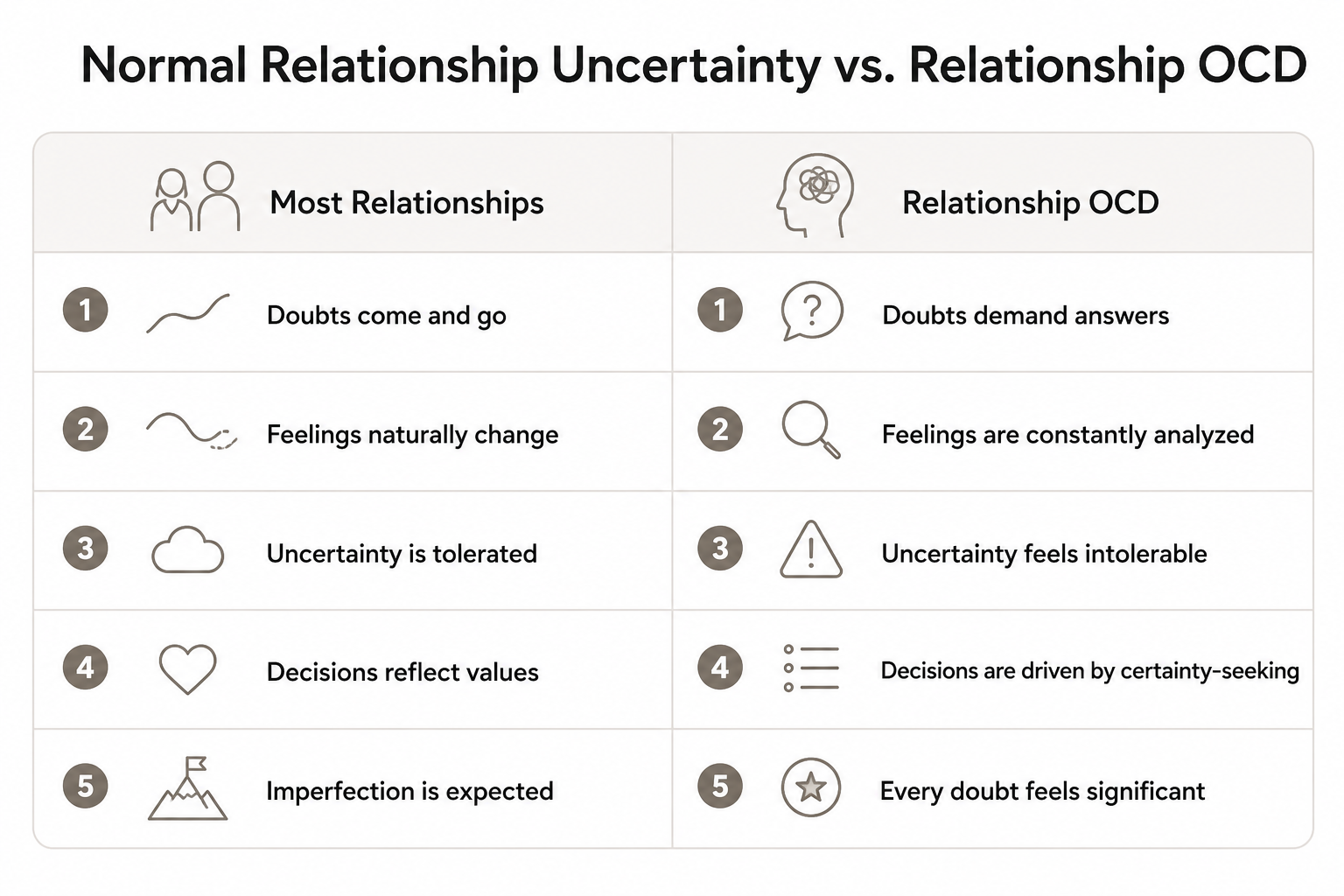
No one can have complete certainty about a relationship. Most people live with that uncertainty without giving it much thought. For people with relationship OCD, however, uncertainty can feel intolerable, creating a powerful urge to analyze, check, and seek reassurance in an attempt to feel sure.
The mind begins treating certainty as a problem that must be solved. A person may spend hours analyzing feelings, comparing relationships, reviewing interactions, searching online, seeking reassurance, or monitoring their emotional reactions in an attempt to finally feel sure.
What feels like problem-solving often becomes fuel for more doubt.
Common Compulsions in Relationship OCD
While the specific concerns vary from person to person, many people with Relationship OCD engage in compulsions aimed at determining whether the relationship is “right.” Relationship doubts become the focus of repeated checking, reassurance-seeking, and analysis.
Common compulsions include:
repeatedly analyzing feelings
comparing the relationship to other relationships
seeking reassurance from friends, family members, therapists, or AI chatbots
reviewing memories for evidence
testing emotional reactions
checking whether they feel “in love enough”
Many of these compulsions occur entirely in the person’s mind, which can make them difficult to recognize.
ROCD Isn’t the Same as Relationship Problems
One of the most confusing aspects of relationship OCD is that relationships are inherently complicated. Unlike some OCD fears, relationships involve questions that genuinely matter and often don’t have clear or permanent answers.
Most people experience occasional uncertainty about attraction, compatibility, commitment, conflict, or the future of a relationship. Feelings fluctuate. Relationships have strengths and weaknesses. People change over time. There is no test that can provide absolute certainty that a relationship is perfect or guaranteed to last.
For people with relationship OCD, however, this normal uncertainty can become difficult to tolerate. The mind becomes preoccupied with trying to determine whether the relationship is “right,” whether feelings are strong enough, whether doubts mean something important, or whether a mistake is being made.
Because relationships are complex and imperfect, OCD can always find another question to analyze.
Many people with ROCD become trapped trying to determine whether their concerns reflect genuine relationship issues or OCD. Unfortunately, that question can itself become part of the obsessive cycle.
The goal of treatment isn’t determining whether every concern is valid or invalid. Instead, treatment focuses on changing the compulsive relationship to doubt, uncertainty, and reassurance-seeking.
ROCD and Reassurance
Many people with ROCD seek reassurance in an effort to feel certain about the relationship, their feelings, or whether they are with the right person.
They may ask friends for opinions, repeatedly discuss the relationship with loved ones, search online for signs of compatibility, or seek confirmation that their feelings are normal.
While reassurance often provides temporary relief, the relief rarely lasts. Before long, a new question appears, a new exception is identified, or a new source of uncertainty emerges. Over time, reassurance becomes part of the cycle that keeps OCD going.
ERP for Relationship OCD
Exposure and Response Prevention (ERP) is one of the most effective treatments for OCD, including ROCD.
Rather than trying to achieve certainty about the relationship, ERP helps people practice responding differently to uncertainty. Treatment often involves reducing reassurance-seeking, mental checking, compulsive analysis, and other attempts to resolve doubts completely.
The goal isn’t achieving certainty about the relationship. The goal is helping people stop treating uncertainty as a problem that must be solved before they can move forward. Over time, people learn to make decisions based on their values and lived experiences rather than compulsive attempts to eliminate doubt.
OCD Treatment in Arlington, VA
I provide therapy for OCD and anxiety disorders in Arlington, including treatment for relationship OCD (ROCD), intrusive thoughts, reassurance-seeking, rumination, and obsessive doubt. Services are available in person and through teletherapy.
Treatment focuses on helping people step out of compulsive cycles of fear, analysis, and certainty-seeking while developing a more flexible relationship with uncertainty and valued relationships over time.
If you’re exhausted by constant overthinking and doubt, contact me to schedule a consultation.
Related Articles
Types of OCD: Understanding Different OCD Themes
What Is Exposure and Response Prevention (ERP) Therapy?
Do Only People With OCD Have Intrusive Thoughts?
How to Support a Loved One With OCD Without Accidentally Reinforcing It
Understanding Moral Scrupulosity: When OCD Targets Morality and Responsibility