
How to Support a Loved One With OCD Without Accidentally Reinforcing It
Watching someone you care about struggle with obsessive-compulsive disorder (OCD) can feel confusing, painful, and exhausting.
Loved ones often find themselves trying to balance compassion with uncertainty about how to help. They may wonder:
Should I reassure them?
Should I answer the question one more time?
Am I helping or making it worse?
What should I do when they are panicking?
How do I support them without becoming part of OCD?
These questions are extremely common.
One of the more difficult aspects of obsessive compulsive disorder is that the things people do out of love and reassurance can sometimes unintentionally strengthen the disorder over time.
What OCD Often Looks Like From the Outside
Many people think OCD only involves visible compulsions such as handwashing or checking. In reality, OCD can also involve reassurance-seeking, repeated questioning, mental rituals, confession, avoidance, rumination, and a persistent need for certainty.
Loved ones may become drawn into these cycles gradually. For example, someone with OCD may repeatedly ask whether they did something wrong, whether they are a bad person, whether a feared outcome will occur, what a particular thought means, or whether something can be checked “just one more time.” Although the specific questions vary, they are often attempts to obtain certainty and relief from anxiety.
Because the distress is real and intense, loved ones naturally want to help.
Why Reassurance Doesn’t Last
Reassurance often sounds like telling someone they’re fine, that nothing bad is going to happen, or that their fears aren’t realistic. While these responses may reduce anxiety temporarily, the relief rarely lasts.
The problem is that OCD rarely stays satisfied for long. The relief fades, and doubt returns:
But what if you’re wrong?
What if this situation is different?
What if I forgot something important?
What if this time is real?
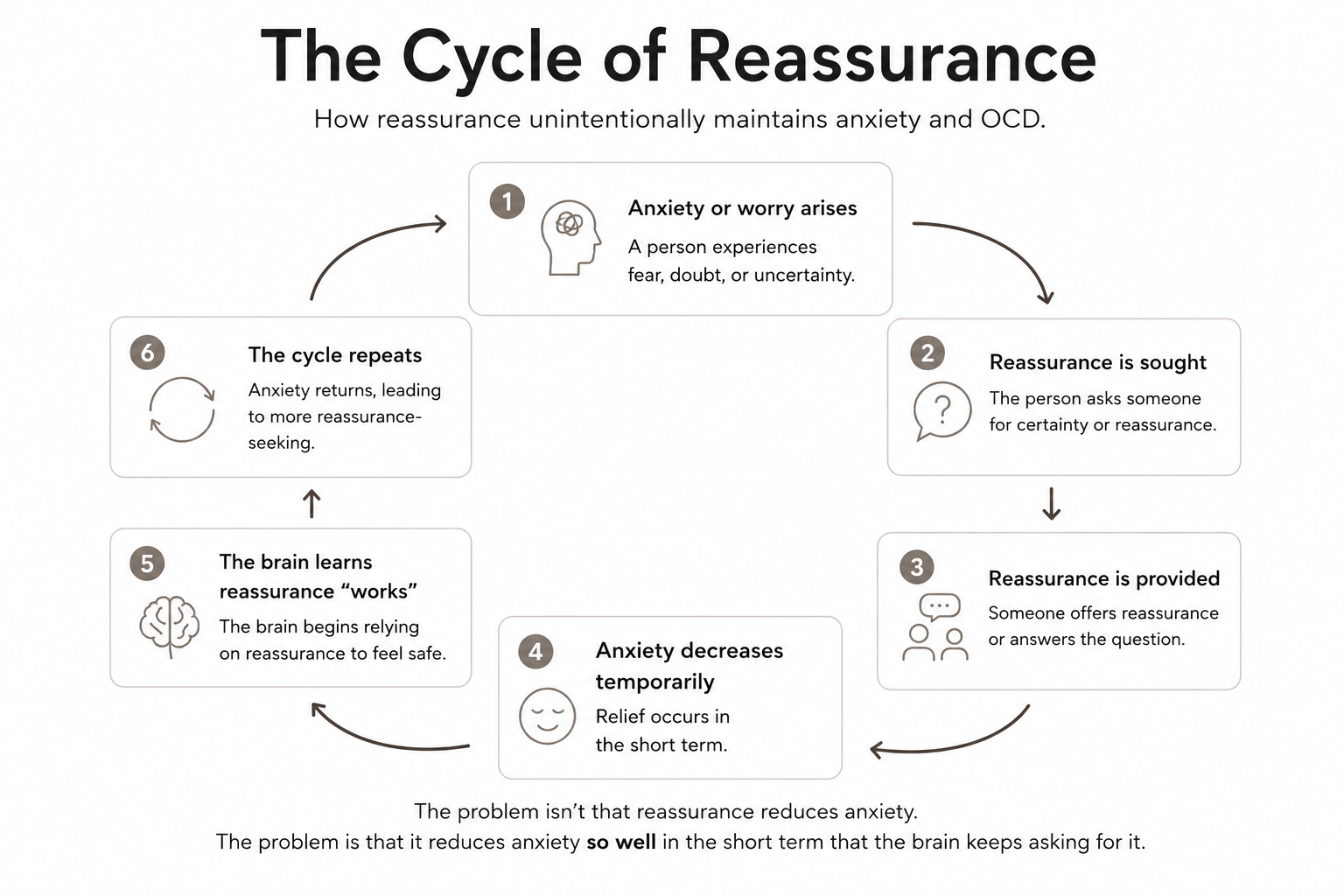
Over time, reassurance can begin to feel necessary in order to reduce anxiety and uncertainty. This is one reason reassurance can unintentionally reinforce OCD even when it comes from a caring place.
Supporting Someone Doesn’t Mean Agreeing With OCD
One of the most important distinctions is the difference between supporting the person and supporting the OCD. Loved ones sometimes feel trapped between participating in compulsions or seeming cold and uncaring. In reality, there is a middle ground. Supportive responses often sound different from reassurance.
For example, instead of:
I promise nothing bad will happen.
Someone might say:
I can see this is really distressing.
I know OCD wants certainty right now.
I believe you can handle this.
I don’t want to feed the OCD by answering this again.
The goal isn’t to invalidate the person’s feelings. The goal is to avoid reinforcing the compulsive cycle.
Family Members Often Become Part of OCD Gradually
Loved ones don’t intentionally reinforce OCD. These patterns usually develop slowly over time because people are trying to reduce distress, conflict, fear, or emotional suffering.
In reality, OCD can involve reassurance-seeking, repeated questioning, mental rituals, confession, avoidance, rumination, a need for certainty, asking others to participate in rituals, or seeking repeated validation about fears, morality, relationships, memories, or intentions.
Over time, family members may find themselves changing routines, providing repeated reassurance, participating in rituals, helping a loved one avoid feared situations, or otherwise accommodating OCD symptoms in an effort to help.
OCD can affect entire family systems, especially when symptoms become severe. Treatments such as Supportive Parenting for Anxious Childhood Emotions (SPACE) and family-based approaches to OCD often focus on helping loved ones reduce accommodations while remaining supportive and connected.
It’s Okay to Set Limits
Many loved ones worry that setting boundaries will feel cruel. However, constantly participating in OCD can become emotionally exhausting for everyone involved and may strengthen the disorder over time.
Compassionate limit-setting may involve declining to answer the same reassurance question repeatedly, refusing to participate in rituals, encouraging the use of therapy skills, reducing accommodation gradually, and remaining calm during periods of distress.
Boundaries are usually most effective when they are predictable, calm, consistent, and collaborative, rather than punitive. The goal isn’t punishment. The goal is reducing OCD’s control over relationships and daily life.
Avoid Arguing With OCD Logic
Loved ones often try to reason someone out of OCD fears. This rarely works for long. OCD generates endless counterarguments:
But what if?
How can you be sure?
This situation is different.
What if there’s a chance?
The problem isn’t lack of intelligence or logic. OCD involves difficulty tolerating uncertainty and resisting compulsive attempts to resolve it. Trying to “win” the argument with OCD often pulls everyone deeper into the cycle.
Encourage Treatment Without Forcing Perfection
Treatment for OCD often involves Exposure and Response Prevention (ERP), which helps people gradually face fears and reduce compulsions over time.
Loved ones can often help by encouraging treatment participation, supporting ERP goals, reinforcing effort rather than perfect outcomes, understanding that progress is often gradual, and recognizing that setbacks are normal. Recovery from OCD is rarely linear. Someone may intellectually understand OCD while still struggling emotionally to resist compulsions in difficult moments.
Loved Ones Need Support Too
Living with or caring about someone with OCD can be emotionally draining. Family members and partners may experience frustration, burnout, guilt, resentment, helplessness, or fear of making things worse. These reactions are common and rational. Remember, supporting someone with OCD doesn’t mean ignoring your own emotional limits or needs.
OCD Treatment in Arlington, VA
I provide therapy for OCD and anxiety disorders in Arlington, including treatment involving family members and partners. I also provide SPACE treatment for families affected by anxiety, OCD, avoidance, reassurance-seeking, and related concerns. Services are available in person and through teletherapy.
Treatment focuses on helping people step out of compulsive cycles while also helping loved ones respond in ways that are supportive without unintentionally reinforcing OCD over time.
Anxiety doesn’t have to make your decisions for you and your family. If you’d like support, schedule a consultation.
Related Articles
What Is Exposure and Response Prevention (ERP) Therapy?
Types of OCD: Understanding Different OCD Themes