
What Is SPACE Treatment? A Parent’s Guide to Helping Children Without Reinforcing Anxiety and Avoidance
Parents often come to SPACE treatment because they feel stuck.
They’ve tried reassuring, checking, explaining, negotiating, accommodating, and problem-solving. They want to help their child, but anxiety, avoidance, emotional outbursts, or dependence seem to be taking up more and more space in family life.
Many parents don’t realize how much they have begun accommodating anxiety. They may answer the same reassurance questions over and over, avoid situations that trigger distress, change family routines, speak for their child, or take over responsibilities that have become sources of anxiety or conflict.
These accommodations usually come from love and a desire to help. In the moment, they often reduce distress and make life easier for everyone. The problem is that accommodations can unintentionally teach a child that anxiety is something that must be avoided rather than faced.
Over time, families can find themselves caught in patterns where more and more energy is spent managing anxiety, while the anxiety itself continues to grow.
SPACE treatment was developed to help families change those patterns.
What Does SPACE Stand For?
SPACE stands for Supportive Parenting for Anxious Childhood Emotions. It is an evidence-based treatment developed at the Yale Child Study Center for children and adolescents struggling with anxiety and related difficulties.
Unlike many therapies, SPACE works through parents rather than through the child. The goal is to help parents change patterns that may be unintentionally reinforcing anxiety, avoidance, or dependence.
This often surprises families because children do not attend the sessions.
Does the Child Attend Sessions?
No. Sessions are conducted with parents or caregivers.
Many families initially assume treatment can’t work unless their child is motivated or actively participating in therapy. SPACE is based on a different idea: when parents change the way they respond to anxiety and avoidance, children often become more flexible, confident, and independent over time.
This approach can be especially helpful when:
a child refuses therapy
a teen is resistant to treatment
parents feel stuck
accommodations have become deeply ingrained
anxiety is affecting the entire household
Many parents find this aspect of SPACE empowering because it allows them to begin making meaningful changes immediately rather than waiting for their child to engage in treatment.
What Problems Can SPACE Help With?
SPACE was originally developed for childhood anxiety, but it has been applied to a wide range of situations involving anxiety, avoidance, and dependence.
Families often seek SPACE when a child or adolescent is struggling with:
generalized anxiety
separation anxiety
social anxiety
school refusal
panic symptoms
selective mutism
difficulty with independence
The common thread isn’t a specific diagnosis. The common thread is that anxiety or avoidance has begun affecting how the family functions.
What Are Accommodations?
A central concept in SPACE treatment is accommodation.
Accommodation refers to changes family members make to help a child avoid anxiety, distress, uncertainty, or discomfort.
Examples include:
repeatedly answering reassurance questions
checking things for a child
speaking for a socially anxious child
modifying routines around anxiety
helping a child avoid feared situations
participating in OCD rituals
taking over responsibilities the child could potentially handle independently
Most accommodations develop for understandable reasons. Parents are trying to reduce distress, prevent conflict, or help their child succeed.
In the short term, accommodations often work. Anxiety decreases, conflict is avoided, and everyone feels some relief. The difficulty is that anxiety often learns from these experiences. When accommodations happen repeatedly, children may begin receiving the message:
This must be dangerous if everyone keeps helping me avoid it.
Over time, anxiety and avoidance can become stronger rather than weaker.
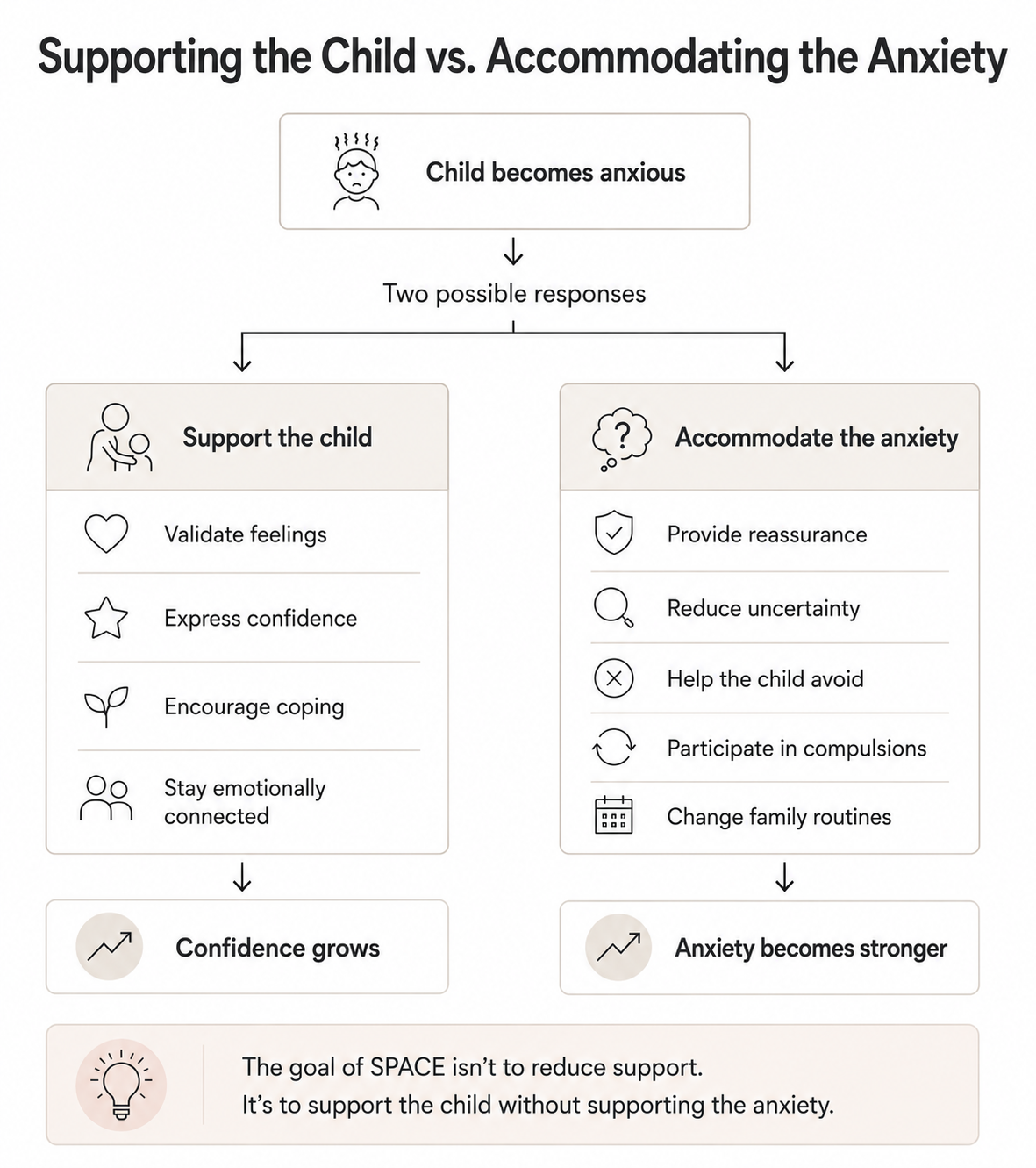
The Difference Between Support and Accommodation
One of the most important ideas in SPACE is that support and accommodation are not the same thing.
Accommodation attempts to reduce or eliminate distress. Support communicates confidence in a child’s ability to handle distress.
Accommodation often sounds like, “Nothing bad will happen,” “I’ll take care of it,” or “I’ll check one more time.”
Support, by contrast, sounds more like, “I can see this is hard,” “I believe you can handle it,” “It’s okay to feel anxious,”and “We’ll get through this together.”
The goal isn’t to remove empathy or become less supportive. The goal is to help children face challenges while knowing they have support.
How SPACE Treatment Works
In SPACE treatment, parents learn to identify accommodations, understand patterns of anxiety and avoidance, communicate support more effectively, reduce accommodations gradually, respond more consistently, tolerate distress without immediately trying to fix it, and encourage confidence and independence.
Changes are made thoughtfully and gradually. Parents aren’t blamed for their child’s struggles. Most accommodations develop from love, concern, exhaustion, or attempts to keep family life functioning.
SPACE helps families make changes in a way that is supportive, realistic, and sustainable.
When Families Consider SPACE
Families often seek SPACE treatment when they notice:
anxiety dominating family life
escalating reassurance-seeking
increasing avoidance
growing dependence on parents
conflict around fears, rituals, or responsibilities
emotional exhaustion within the household
feeling trapped between setting limits and preventing meltdowns
These patterns are common, and they are treatable.
SPACE Treatment in Arlington, VA
I provide SPACE treatment for children, adolescents, young adults, and families dealing with anxiety, OCD, avoidance, and independence-related concerns in Arlington, VA. Services are available in person and through teletherapy. Treatment focuses on helping families reduce patterns that unintentionally reinforce anxiety and avoidance while building resilience, flexibility, confidence, and independence over time.
If you’re ready to spend less time managing anxiety and more time focusing on what matters to you, let’s talk.
Related Articles
How Reassurance Can Reinforce Anxiety and OCD in Children
Why Is Uncertainty So Hard to Tolerate?
10 Signs Anxiety Is Running Your Family Instead of Your Family Running Anxiety