
What Is Contamination OCD?
A person touches a public door handle and immediately begins wondering what else they may have touched afterward.
Their phone. Their keys. Their steering wheel. Their kitchen counter. Their child.
Within minutes, what began as a brief moment of uncertainty can turn into a chain of questions that feels impossible to answer completely.
For people with contamination OCD, the problem is often not the object itself. The problem is the persistent doubt that contamination may have occurred and the overwhelming urge to become certain that it didn’t.
What’s Contamination OCD?
Contamination OCD is a form of obsessive-compulsive disorder involving intrusive fears about contamination and compulsive attempts to eliminate, remove, prevent, or neutralize it.
People with contamination OCD worry about germs, illness, viruses, bacteria, bodily fluids, chemicals, toxins, allergens, or environmental contaminants. Some fear becoming ill themselves. Others are more concerned about accidentally exposing loved ones to contamination or causing harm through carelessness.
The specific trigger varies from person to person. The underlying pattern is often the same: intrusive doubt, anxiety, and repeated attempts to achieve certainty that contamination has not occurred or has been completely removed.
Contamination OCD is one of the most well-known OCD themes, but it’s only one way obsessive compulsive disorder can present. Other people experience intrusive doubts about harm, relationships, health, morality, memories, or many other topics. Learn more in Types of OCD: Understanding Different OCD Themes.
More Than a Fear of Germs
People sometimes assume Contamination OCD is simply an extreme concern about cleanliness. In reality, the central problem is uncertainty.
A person may know they washed their hands. But the question becomes:
OCD keeps introducing new possibilities that make certainty feel just out of reach.
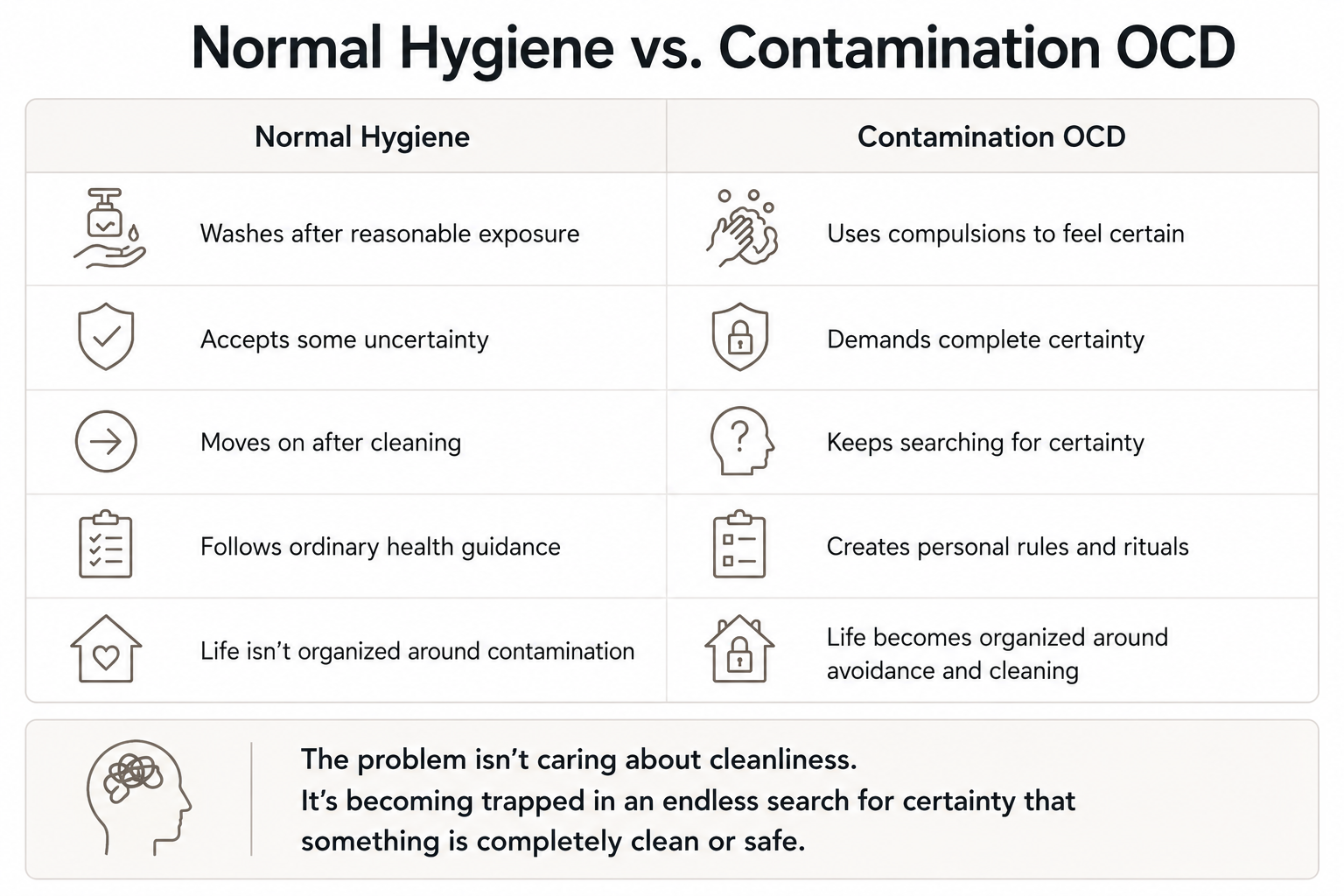
Why Contamination OCD Can Become So Consuming
Many people with contamination OCD spend significant amounts of time trying to determine whether something is truly safe. A person may wash their hands but continue wondering whether they washed thoroughly enough. They may question whether an object is contaminated, whether they were exposed to illness, whether a substance is dangerous, or whether they could accidentally cause harm to themselves or someone else.
The problem is that OCD continually introduces new possibilities and new doubts. Just when one question seems resolved, another appears. The person may find themselves repeatedly cleaning, checking, researching, seeking reassurance, avoiding situations, or mentally reviewing what happened in an attempt to achieve certainty. Over time, these efforts can become increasingly time-consuming and disruptive, even when the person recognizes that the level of concern exceeds the actual risk.
Common Compulsions in Contamination OCD
People with contamination OCD often engage in compulsions designed to reduce anxiety or achieve certainty.
Common compulsions include:
excessive handwashing
repeated showering or cleaning
avoiding certain places, objects, or people
changing clothes repeatedly
seeking reassurance
using cleaning products excessively
throwing items away
creating elaborate cleaning rituals
mentally reviewing possible exposures to contamination
Some people spend hours each day engaged in washing, cleaning, checking, avoidance, or mental review.
Why Cleaning Doesn’t Solve the Problem
People with contamination OCD often feel compelled to clean, wash, sanitize, or check in order to feel safe. The difficulty is that OCD doesn’t accept the answer. A person may wash their hands and feel relief briefly. Soon afterward, a new doubt appears. What if they missed something? What if they touched a contaminated surface after washing? What if the contamination spread before they cleaned?
The problem is that OCD keeps moving the goalposts. What feels “clean enough” or “safe enough” for a moment may no longer feel sufficient once the next doubt appears.
Avoidance Often Expands Over Time
Many people begin by avoiding a specific trigger. Over time, avoidance may grow to include additional objects, locations, activities, or situations.
Someone who initially avoids one public restroom may begin avoiding many public restrooms. Someone concerned about illness exposure may gradually reduce social activities, travel, public transportation, restaurants, or other everyday experiences.
Life can become increasingly organized around preventing contamination.
Why Reassurance Doesn’t Work
People with Contamination OCD often seek reassurance from family members, partners, friends, therapists, online forums, or AI chatbots.
They may ask:
Is this clean enough?
Can I get sick from this?
Would you touch this?
Do you think I’m overreacting?
Reassurance may provide relief briefly.
Then the doubt returns.
What if it’s different this time?
What if I forgot something?
What if contamination spread?
What if I should check one more time?
And the cycle starts again.
Treatment for Contamination OCD
Treatment often involves Exposure and Response Prevention (ERP). This includes gradually approaching feared situations, reducing compulsive washing and cleaning, decreasing reassurance-seeking, reducing avoidance, and learning to tolerate uncertainty.
The goal isn’t to prove that nothing bad could ever happen. Rather, the goal is to stop organizing life around compulsive attempts to eliminate uncertainty completely.
Recovery Doesn’t Mean Becoming Careless
Lots of people worry that treatment means ignoring legitimate health concerns or becoming reckless about hygiene. But that’s not the goal. ERP helps people respond more flexibly to uncertainty while continuing to engage in reasonable health and safety behaviors. Over time, many people find themselves spending less time washing, checking, avoiding, and seeking reassurance, and more time focused on the things that matter to them.
OCD Treatment in Arlington, VA
I provide therapy for OCD and anxiety disorders in Arlington, including treatment for contamination OCD, intrusive thoughts, compulsions, reassurance-seeking, and obsessive doubt. Services are available in person and through teletherapy.
Treatment focuses on helping people step out of compulsive cycles of fear, washing, checking, avoidance, and certainty-seeking while developing a different relationship with uncertainty and intrusive thoughts over time.
If OCD is interfering with your life and you’d like to learn more about treatment, contact me to schedule a consultation.
Related Articles
Types of OCD: Understanding Different OCD Themes
What Is Exposure and Response Prevention (ERP) Therapy?