
Understanding Harm OCD
Many people with obsessive-compulsive disorder (OCD) experience intrusive thoughts, images, or urges involving harm. These thoughts are often deeply unwanted and frightening. People may become terrified that having the thought means they are dangerous, secretly want to harm someone, or could lose control.
This presentation is commonly referred to as harm OCD.
Individuals with harm OCD often ask themselves:
What if I lose control?
What if I hurt someone?
What if having the thought means I secretly want to do it?
What if I snap suddenly?
What if I can’t trust myself?
Because the thoughts feel so disturbing, many people suffer silently for years before realizing this can be a form of OCD.
What’s Harm OCD?
Harm OCD is a form of OCD involving intrusive fears, images, urges, or doubts related to causing harm.
Common fears include:
harming loved ones
stabbing someone impulsively
causing accidental injury
losing control violently
harming children or vulnerable people
hurting oneself unintentionally
causing catastrophic mistakes
becoming dangerous “without warning”
The intrusive thoughts are experienced as unwanted, distressing, and inconsistent with the person’s values.
Harm OCD is one of many OCD themes, alongside presentations such as existential OCD, scrupulosity, false memory OCD, and contamination OCD. While the content of the fear varies, the underlying OCD process is often very similar. Learn more in Types of OCD: Understanding Different OCD Themes.
Intrusive Thoughts Are Part of Being Human
One of the most important things to understand is that intrusive thoughts themselves are part of normal human experience.
People occasionally experience strange, unwanted, or disturbing thoughts.
For example:
imagining swerving a car unexpectedly
picturing accidental injury
thinking something violent briefly
noticing an intrusive impulse during moments of stress or overwhelm
The difference in OCD isn’t simply the presence of the thought.
The difference is the meaning the person assigns to the thought and the compulsive attempts to eliminate uncertainty about it.
Why Harm OCD Feels So Convincing
People with harm OCD often believe:
If I’m having this thought, it must mean something.
The mind begins monitoring thoughts, emotions, intentions, bodily sensations, and reactions around sharp objects or vulnerable people. Ordinary experiences become evidence to analyze rather than experiences to simply notice and let pass.
The questions become increasingly specific: What if I lose control and kill someone? Did I run someone over without realizing it? What if I yell something offensive in public? Do these thoughts mean I’m actually dangerous?
The more attention and analysis the thoughts receive, the more alarming and emotionally significant they become.
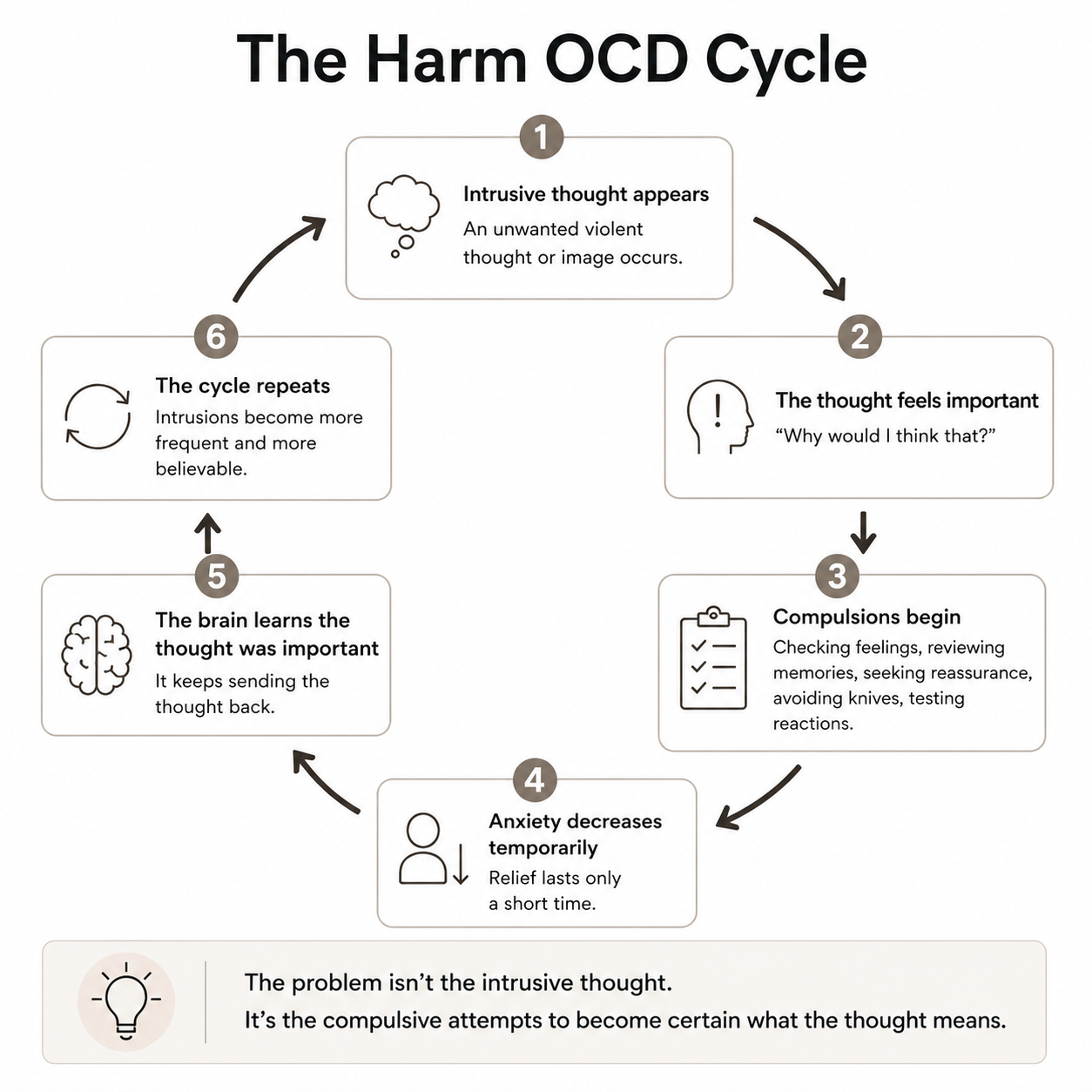
Common Compulsions in Harm OCD
Many compulsions in harm OCD are mental and invisible.
These may include:
mentally reviewing past behavior
checking whether one feels dangerous
avoiding knives or sharp objects
avoiding being alone with children
researching violent behavior online
repeatedly testing emotional reactions
confessing intrusive thoughts
trying to prove certainty
monitoring one’s intentions constantly
Some individuals repeatedly replay interactions to determine:
Did I almost lose control?
Did I feel aggressive?
What if I missed a warning sign?
The goal of these compulsions is to achieve certainty that the person is safe or not dangerous.
Unfortunately, OCD rarely stays satisfied for long.
Avoidance Can Become Extensive
Many people begin avoiding activities such as cooking, driving, handling sharp objects, being alone with children or other vulnerable people, watching violent media, or even certain parenting tasks. Although avoidance often reduces anxiety in the moment, it also teaches the brain that these situations are genuinely dangerous.
These avoidance behaviors often reduce anxiety temporarily, but they also reinforce the belief that the feared danger is meaningful and requires constant prevention.
Over time, life can become increasingly restricted.
Harm OCD Isn’t the Same as Violent Intent
One of the most painful aspects of harm OCD is that people often fear being misunderstood.
Many individuals are terrified to disclose their thoughts because they fear:
being judged
being seen as dangerous
being hospitalized
losing relationships
confirming their worst fears
Because the thoughts feel so disturbing, many people never tell anyone about them. Some spend years believing they may be dangerous or that disclosing the thoughts could lead others to misunderstand them. Many people also begin to wonder whether having the thought says something about who they are. They may worry that if they can imagine harming someone, perhaps they secretly want to do it or are capable of acting on it. This misunderstanding is one reason harm OCD can feel so frightening. As a result, many people suffer in silence before learning that these experiences can be part of OCD.
Many people with harm OCD are relieved to learn that therapists who specialize in OCD hear these kinds of fears regularly.
Importantly, intrusive thoughts in harm OCD are ego-dystonic, meaning they conflict strongly with the person’s values, desires, and sense of self.
In fact, the thoughts are often so distressing precisely because the person cares deeply about not causing harm.
Why Reassurance Doesn’t Solve the Problem
People often seek reassurance by asking whether they’re safe, whether others think they’re dangerous, or whether the thoughts “mean something.”
Reassurance may reduce anxiety briefly.
But OCD quickly returns with:
What if this case is different?
What if I fooled myself?
What if I’m just really good at hiding this from everyone?
The disorder keeps demanding more certainty.
Treatment for Harm OCD
Treatment for harm OCD typically involves Exposure and Response Prevention (ERP), which helps people gradually reduce compulsions, reassurance-seeking, avoidance, and compulsive analysis.
It focuses on identifying compulsions, reducing mental reviewing, reassurance-seeking, and avoidance, learning to tolerate uncertainty, and developing a different relationship with intrusive thoughts.
Importantly, treatment isn’t about proving with absolute certainty that feared outcomes are impossible.
Instead, treatment focuses on helping people stop organizing their lives around compulsive attempts to eliminate doubt completely.
Recovery Doesn’t Mean Never Having Intrusive Thoughts Again
People often assume recovery means:
never having violent thoughts again
feeling perfectly certain forever
never experiencing anxiety again
In reality, recovery looks more like:
less fear of intrusive thoughts
reduced compulsive responding
less avoidance
less time spent analyzing
greater willingness to tolerate uncertainty
improved functioning and freedom
The goal isn’t perfect certainty. The goal is becoming less trapped by OCD’s demands for certainty and control.
OCD Treatment in Arlington, VA
I provide therapy for OCD and anxiety disorders in Arlington, including treatment for harm OCD, intrusive thoughts, compulsions, reassurance-seeking, and obsessive doubt. Services are available in person and, when appropriate, through teletherapy. Treatment focuses on helping people step out of compulsive cycles of fear, avoidance, and mental checking while developing a different relationship with uncertainty, intrusive thoughts, and anxiety over time.
If you’re ready to take your life back from OCD, I’d love to help.
Related Articles
Types of OCD: Understanding Different OCD Themes
What Is Exposure and Response Prevention (ERP) Therapy?
How Reassurance Makes Anxiety Worse