
What Is POCD? Understanding Pedophilia-Themed OCD
One of the most distressing and misunderstood forms of obsessive-compulsive disorder (OCD) involves intrusive fears about being sexually attracted to children or becoming a danger to children.
This is commonly referred to as POCD (pedophilia-themed OCD or pedophile OCD).
People experiencing POCD are often terrified by their thoughts and may spend enormous amounts of time trying to figure out:
What does this mean about me?
What if I secretly want this?
What if I lose control?
What if I’m in denial?
What if I’m dangerous?
These fears are experienced as deeply unwanted, frightening, and inconsistent with the person’s values and identity
Because the topic itself feels so taboo and horrifying, many people with POCD suffer silently for years before seeking help.
What Is POCD?
Pedophile OCD (POCD) is a form of obsessive-compulsive disorder related to the possibility of being sexually attracted to children, becoming a danger to children, or having hidden desires that the person finds horrifying.
The core problem in OCD isn’t the presence of the thoughts themselves, but the compulsive attempts to achieve certainty, eliminate fear, or prove something with absolute confidence.
People with POCD often become trapped in cycles of fear, hypervigilance, mental checking, reassurance-seeking, avoidance, self-monitoring, and compulsive analysis. The experience is often emotionally consuming and profoundly isolating.
Pedophilia-themed OCD is one of many OCD themes. Although the intrusive thoughts focus on a specific feared possibility, obsessive compulsive disorder can center on many other topics, including harm, contamination, relationships, health, morality, and past events. Learn more in Types of OCD: Understanding Different OCD Themes.
Intrusive Thoughts Aren’t Intentions
One of the most important things to understand about OCD is that intrusive thoughts aren’t the same as desires, intentions, plans, or identity.
In POCD, the thoughts feel especially disturbing because they conflict so strongly with the person’s sense of self and morality.
Why POCD Feels So Convincing
OCD often attacks the things people care about most.
People with pedophilia OCD often become hyperfocused on:
bodily sensations
emotional reactions
thoughts that “feel wrong”
whether they noticed someone attractive
whether anxiety decreased or increased
whether certainty is possible
They may ask themselves:
Why did I notice that?
What if I reacted the wrong way?
What if anxiety means denial?
What if I didn’t feel disgusted enough?
The mind then treats uncertainty itself as evidence of danger. The mind begins treating uncertainty itself as evidence of danger.
Groinal Responses and Misinterpreted Body Sensations
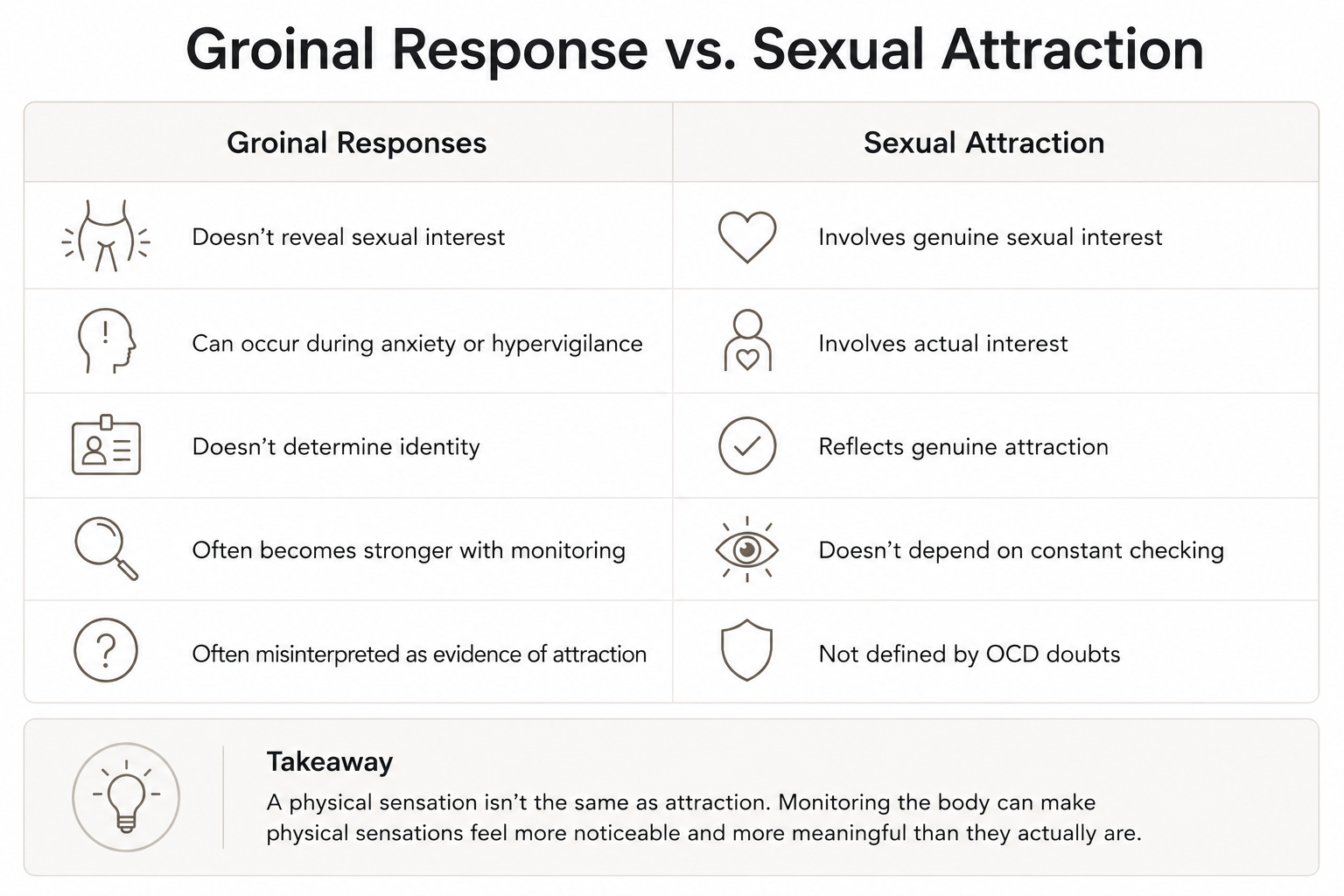
Many individuals with POCD become intensely focused on physical sensations, including what’s called a “groinal response.” A groinal response is a physical sensation, not evidence of desire, attraction, intent, or identity.
Anxiety, hypervigilance, and focused attention can produce automatic physical sensations that people then misinterpret as evidence of attraction. This can become extremely distressing.
The person may repeatedly monitor bodily sensations, test reactions, compare responses, analyze arousal, and seek certainty about what those sensations mean. Unfortunately, the more attention someone directs toward monitoring sensations, the more noticeable and confusing those sensations often become.
Some people also become preoccupied with memories, repeatedly reviewing childhood, adolescent, or adult experiences in an attempt to determine whether they missed evidence of attraction or risk.
Common Compulsions in POCD
Compulsions in POCD may include mentally reviewing past experiences, checking emotional reactions, avoiding children, comparing reactions to adults versus children, researching online excessively, seeking reassurance, testing arousal responses, confessing fears to others, and repeatedly analyzing whether thoughts felt wanted or unwanted. Some people become especially focused on reviewing childhood, adolescent, or adult memories in an attempt to determine whether they missed evidence of attraction, intent, or risk. Rather than creating certainty, this reviewing typically increases doubt and fuels further analysis.
Some compulsions are entirely mental and invisible from the outside.
Shame and Isolation in POCD
POCD is often associated with intense shame.
Many people are terrified to tell anyone about their thoughts because they fear:
being misunderstood
being judged
being reported
being seen as dangerous
losing relationships
confirming their worst fears
As a result, people frequently suffer in silence and avoid seeking treatment. But importantly, having intrusive thoughts doesn’t make someone dangerous. One of the defining features of POCD is that the thoughts are experienced as unwanted, distressing, and inconsistent with the person’s values.
Why Reassurance Doesn’t Work
People with POCD desperately want certainty:
Tell me I’m not a monster.
Tell me this is definitely OCD.
Tell me I’d never hurt a child.
While reassurance may reduce distress briefly, OCD tends to return quickly:
But what if this time it’s different?
What if I’m fooling everyone (and myself)?
What if I’m in denial?
The disorder keeps demanding greater and greater certainty. OCD is rarely satisfied for long.
Treatment for POCD
Treatment for POCD often involves Exposure and Response Prevention (ERP), which helps people gradually reduce compulsions, reassurance-seeking, avoidance, and compulsive self-monitoring.
Treatment focuses on:
reducing compulsive checking
decreasing reassurance-seeking
reducing mental reviewing
addressing hypervigilance to bodily sensations
tolerating uncertainty
changing the relationship to intrusive thoughts
Treatment isn’t about achieving certainty about the thoughts. Instead, treatment focuses on helping people respond differently to intrusive thoughts without getting pulled into compulsions.
Recovery Doesn’t Mean Never Having Intrusive Thoughts Again
Many people believe recovery means:
never having another intrusive thought
feeling certain forever
never experiencing anxiety again
In reality, recovery often involves experiencing less fear of intrusive thoughts, spending less time responding compulsively, analyzing less, tolerating uncertainty more effectively, and regaining freedom in daily life. The goal isn’t certainty. The goal is becoming free from OCD’s demands for certainty.
OCD Treatment in Arlington, VA
I provide therapy for OCD and anxiety disorders in Arlington, including treatment for intrusive thoughts, reassurance-seeking, rumination, compulsions, and obsessive doubt. Services are available in person and through teletherapy. Treatment focuses on helping people step out of compulsive cycles of fear, shame, and avoidance while developing a different relationship with uncertainty, intrusive thoughts, and anxiety over time.
If you’re exhausted by constant overthinking and doubt, contact me to schedule a consultation.
Related Articles
Types of OCD: Understanding Different OCD Themes
What Is Exposure and Response Prevention (ERP) Therapy?
What Is Thought-Action Fusion?