
What Is Thought-Action Fusion?
Many people with obsessive compulsive disorder (OCD) become frightened not only by what they think, but by what they believe their thoughts mean.
A person may experience an intrusive thought and immediately wonder:
Why would I think that?
What if having the thought means I want it?
What if thinking it makes it more likely to happen?
What if the thought says something important about who I am?
This tendency is often referred to as thought-action fusion.
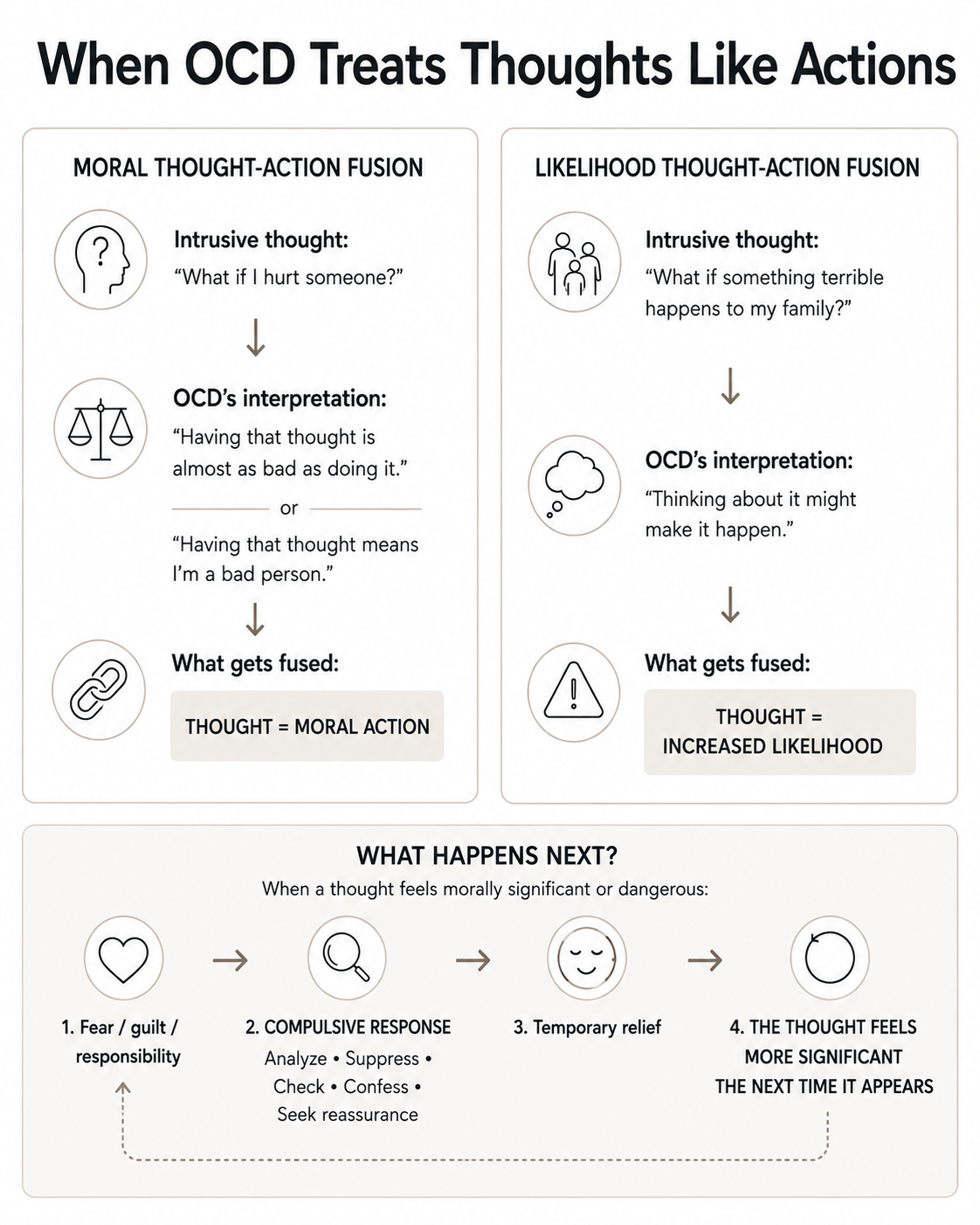
Thought-action fusion is a common cognitive process in OCD in which people begin treating thoughts as though they are morally equivalent to actions or capable of causing events to occur.
The result is often increased fear, guilt, responsibility, and compulsive attempts to control thoughts.
What Is Thought-Action Fusion?
Thought-action fusion generally refers to two related beliefs:
Moral thought-action fusion involves the belief that having a thought is morally similar to carrying out the action.
For example:
Thinking about harming someone is almost as bad as actually harming them.
Having this thought says something terrible about my character.
A good person would not think this.
Likelihood thought-action fusion involves the belief that having a thought somehow increases the probability that the event will occur, even when there is no realistic causal connection between the thought and the outcome.
For example:
If I think about a loved one dying, maybe it will happen.
If I imagine causing an accident, perhaps I am making it more likely.
If I think about something bad repeatedly, I might somehow cause it.
While most people occasionally experience these concerns, they can become especially powerful in OCD.
Why Thought-Action Fusion Feels So Convincing
Thoughts can feel emotionally significant.
When an intrusive thought produces fear, disgust, guilt, or anxiety, many people naturally assume the thought must mean something important.
The reasoning often sounds like this:
If the thought upset me this much, there must be a reason.
Or:
Why would I think this if it were not true in some way?
OCD often encourages the person to search for certainty about what the thought means. Unfortunately, the search rarely ends.
Common Examples of Thought-Action Fusion
A parent has the intrusive thought, “What if I dropped my baby?” and worries that having the thought means they are dangerous.
Someone with harm OCD thinks, “What if I stabbed someone?” and worries that the thought reflects a hidden desire or intention. A person with religious scrupulosity experiences a blasphemous thought and fears they have committed a serious moral violation simply by thinking it. Someone with moral scrupulosity worries that having an unkind thought means they are secretly a bad person. In each case, the problem is not the presence of the thought itself. The problem is the meaning attached to it.
How Thought-Action Fusion Fuels OCD
Once thoughts begin feeling dangerous or morally significant, people often try to neutralize them.
Common compulsions include:
mental reviewing
analyzing intentions
thought suppression
checking emotional reactions
confessing thoughts
seeking certainty about character or risk
These behaviors may provide temporary relief, but they also reinforce the belief that the thought required a response in the first place. Over time, the thought often becomes more frightening and more difficult to dismiss.
Thoughts Are Not Actions
One of the central ideas in OCD treatment is that thoughts are mental events, not actions. Thoughts are mental events. They can be voluntary or involuntary, meaningful or meaningless, welcome or unwanted, realistic or unrealistic. Having a thought does not automatically reveal a person’s intentions, desires, character, or future behavior. In fact, many intrusive thoughts are disturbing because they conflict with a person’s values.
Treatment for Thought-Action Fusion
Treatment often involves helping people develop a different relationship with intrusive thoughts. Exposure and Response Prevention (ERP) may involve reducing compulsive attempts to analyze, suppress, neutralize, or gain certainty about thoughts.
Rather than asking, “What does this thought mean?” people gradually learn to ask, “Do I need to solve this thought at all?”
Over time, many individuals become less fearful of intrusive thoughts and less likely to treat them as evidence of danger, morality, or identity.
OCD Treatment in Arlington, VA
I provide therapy for OCD and anxiety disorders in Arlington, including treatment for intrusive thoughts, reassurance-seeking, compulsions, rumination, and obsessive doubt. Services are available in person and through teletherapy.
Treatment focuses on helping people step out of compulsive cycles of fear, certainty-seeking, and self-analysis while developing a different relationship with intrusive thoughts and uncertainty over time. Taking the first step can feel difficult. If you’re ready to learn more, contact me to schedule a consultation.
Related Articles
Types of OCD: Understanding Different OCD Themes
What Is Exposure and Response Prevention (ERP) Therapy?