
What Is Family Accommodation?
Many parents eventually reach a point where they wonder, “When did everything start revolving around my child’s anxiety?”
What began as a few small adjustments, staying a little longer at bedtime, answering one more reassurance question, skipping one stressful activity, can gradually become a pattern in which anxiety influences family routines, relationships, and decisions. Psychologists call this family accommodation.
Family accommodation refers to the ways parents and other family members change their own behavior to reduce a child’s anxiety, prevent distress, or help them avoid feared situations, reduce a child’s anxiety, prevent distress, provide reassurance, or help them avoid feared situations. It’s one of the most important concepts in understanding how anxiety and obsessive-compulsive disorder can affect not only a child, but the entire family.
Why Family Accommodation Happens
It’s surprisingly easy for family accommodation to become part of everyday life.
Watching your child experience intense anxiety can be heartbreaking. When you discover that a particular response calms them down, it’s natural to keep doing it. Most parents aren’t thinking, “I’m reinforcing anxiety.” They’re thinking, “My child is suffering, and I want to help.”
In fact, accommodations often work, at least in the short term. A child who receives reassurance may feel calmer. A child who avoids a feared situation may experience immediate relief. A bedtime routine may become peaceful once a parent agrees to stay in the room.
The challenge is that what helps in the moment doesn’t always help in the long run.
Common Examples of Family Accommodation
Family accommodation can look different from one family to another. Some common examples include:
answering the same reassurance questions repeatedly
checking things for your child
participating in OCD compulsions or rituals
changing family routines to avoid anxiety
allowing a child to avoid feared situations
sleeping with a child because they’re afraid to sleep alone
speaking for a socially anxious child
researching fears or looking up answers for your child
providing repeated reminders because your child feels uncertain
Many parents recognize several of these examples. Others notice more subtle accommodations that have gradually become part of everyday family life.
How Does Family Accommodation Maintain Anxiety?
One reason family accommodation can become such a powerful pattern is that anxiety often centers on uncertainty.
Children understandably want certainty that nothing bad will happen, that they won’t make a mistake, or that a feared outcome won’t occur. Accommodation frequently reduces uncertainty, or at least creates the feeling of greater certainty, for a short time.
For example, imagine a child repeatedly asks whether they’ll get sick after eating a particular food. Each time a parent reassures them, anxiety decreases briefly. Unfortunately, the next time the fear appears, the child often feels the same need for reassurance again.
Over time, children may begin to rely on someone else to reduce uncertainty before they can feel safe. Instead of learning, “I can handle this feeling,” the anxious brain may learn, “I need someone else to help me feel okay.”
The same process can occur when parents repeatedly check things, help children avoid feared situations, or participate in OCD compulsions. These responses are completely understandable, but they can unintentionally make anxiety or OCD more persistent by reducing opportunities for children to discover that they can tolerate uncertainty and cope with distress.
Family Accommodation Is Different From Support
Learning about family accommodation sometimes leaves parents feeling guilty.
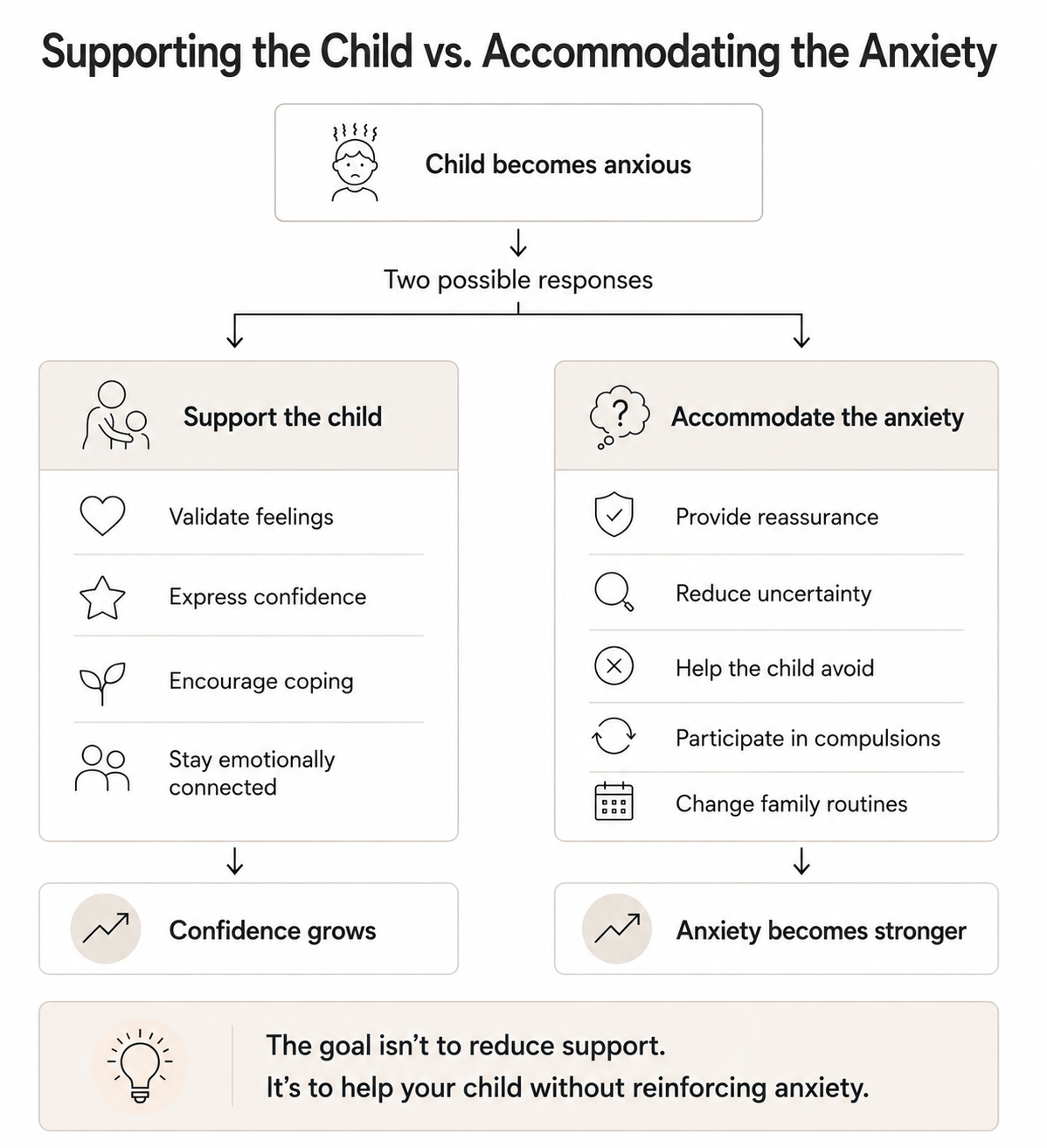
It’s important to distinguish accommodation from support. Support means acknowledging your child’s distress, listening with empathy, and communicating confidence in their ability to cope. Accommodation means changing your own behavior in ways that reduce anxiety temporarily but may unintentionally keep it going.
For example, a supportive response might be:
I know this feels really hard right now, and I believe you can handle it.
An accommodating response might be:
I’ll check one more time so you don’t have to worry.
The goal isn’t to become less supportive. In fact, reducing accommodation often allows parents to provide support in ways that promote long-term resilience rather than short-term relief. It’s to become supportive in ways that help children build confidence rather than dependence on reassurance or avoidance.
Does This Mean Parents Should Stop Accommodating Immediately?
No.
Reducing family accommodation is rarely an all-or-nothing process. Abruptly refusing every request for reassurance or suddenly eliminating all accommodations can be overwhelming for both children and parents.
Instead, evidence-based approaches such as Supportive Parenting for Anxious Childhood Emotions (SPACE) help parents make thoughtful, gradual changes while maintaining a warm, supportive relationship with their child.
The goal isn’t to increase distress for its own sake or force children into overwhelming situations. It’s on helping families respond differently so children have more opportunities to develop confidence in their ability to manage anxiety and uncertainty.
When Should Families Consider Help?
You may benefit from professional support if:
reassurance no longer seems to help for very long
anxiety or OCD increasingly affects family routines
accommodations continue to expand over time
family members are participating in OCD compulsions
siblings or parents are significantly affected
you feel caught between wanting to help and wondering whether your responses are maintaining the problem
These patterns are common, and they’re treatable.
SPACE Therapy in Arlington, VA
I provide SPACE (Supportive Parenting for Anxious Childhood Emotions) treatment for families of children and adolescents with anxiety and OCD in Arlington, Virginia. Services are available in person and through teletherapy.
Treatment focuses on helping parents understand and gradually reduce family accommodation while preserving a warm, supportive relationship with their child. If your child’s anxiety or OCD has begun affecting your family’s daily life, relationships, or routines, I’d be happy to discuss whether SPACE treatment may be a good fit. Feel free to reach out to learn more or schedule a consultation.
Related Articles
What Is Exposure and Response Prevention (ERP) Therapy?
My Child Refuses Therapy. Can SPACE Still Help?
How Reassurance Can Reinforce Anxiety in Children
10 Signs Anxiety Is Running Your Family Instead of Your Family Running Anxiety