
Is My Child’s Anxiety Running Our Family?
Your daughter asks whether she’ll be okay before school. You reassure her, and she seems calmer. Ten minutes later, she asks the same question again.
Or maybe bedtime has stretched from fifteen minutes to an hour because your son can’t fall asleep unless you’re sitting beside him. Family vacations require careful planning to avoid anxiety triggers. Siblings have started asking why everything seems to revolve around one child’s worries.
If any of this sounds familiar, you’re not alone.
These situations don’t develop because parents are doing something wrong. They develop because families naturally adapt to reduce a child’s distress. Over time, those well-intentioned adjustments can gradually allow anxiety to play a larger role in family life.
How Anxiety Gradually Shapes Family Life
Families rarely wake up one morning and realize that everything revolves around anxiety. Instead, the changes are usually so gradual that they’re easy to miss.
You answer an extra reassurance question because your son is distressed. You stay in his room a little longer at bedtime because everyone is exhausted. You decide to skip one activity because it feels too overwhelming.
Each decision makes sense in the moment. Each comes from love and a desire to help your child. Over weeks or months, however, these adjustments can accumulate until anxiety begins influencing more and more of your family’s daily life.
Psychologists use the term family accommodation to describe the ways parents and other family members change their own behavior to reduce a child’s anxiety, prevent distress, or help them avoid feared situations. Family accommodation is one of the central concepts in SPACE because reducing these patterns can help children gradually build confidence in their ability to cope with anxiety.
Signs That Anxiety May Be Affecting the Whole Family
Every family is different, but you might notice that:
You answer the same reassurance questions repeatedly.
Bedtime or morning routines have become increasingly lengthy.
Family outings or vacations are planned around avoiding anxiety.
You check things repeatedly to help your child feel certain.
Family members participate in OCD rituals.
Your child avoids situations that cause anxiety, and the family adjusts accordingly.
Siblings receive less attention because anxiety requires so much time and energy.
You feel guilty whenever you try to set reasonable limits.
You and your partner spend a great deal of time discussing how to prevent your child’s anxiety from escalating.
These patterns are common in families affected by anxiety and OCD. They aren’t a sign of poor parenting.
Why Family Accommodation Can Keep Anxiety Going
One of the most challenging aspects of anxiety is that the things that provide immediate relief don’t always help in the long run.
Imagine your daughter repeatedly asks whether she’ll get sick from eating a particular food. You reassure her, and her anxiety decreases almost immediately.
The problem is that the relief doesn’t usually last.
The next time the worry appears, your child feels the same need for reassurance. Over time, children may begin to rely on someone else to reduce uncertainty before they can feel safe.
The same pattern can happen with other accommodations, such as checking, avoiding situations, changing routines, or participating in OCD rituals. These responses are completely understandable, but they can unintentionally strengthen anxiety by preventing children from learning that they can tolerate uncertainty and cope with difficult feelings.
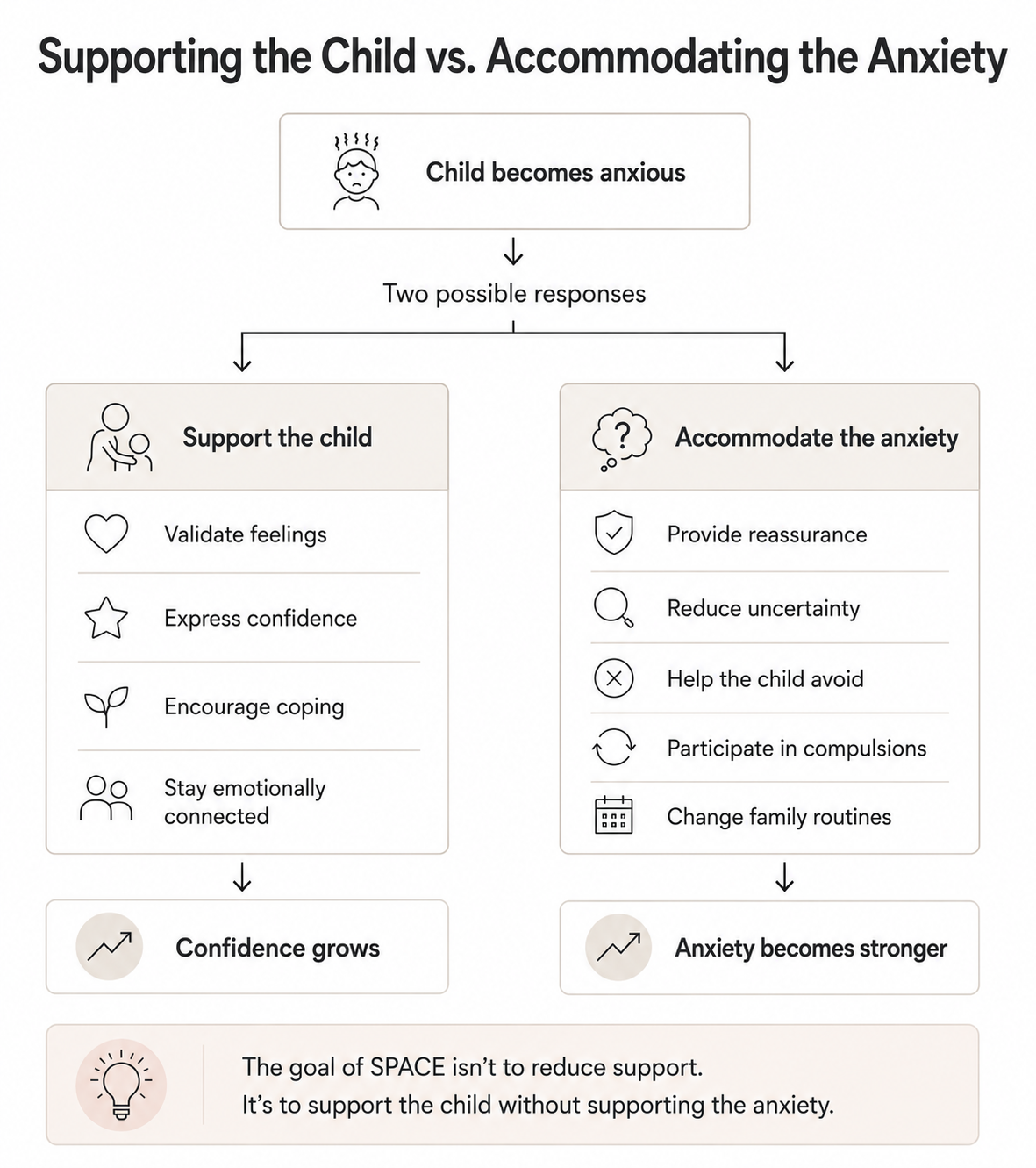
Supporting Your Child Doesn’t Mean Eliminating Their Anxiety
Many parents worry that reducing accommodation means becoming less supportive. In reality, the opposite is true.
Support means acknowledging that your child’s distress is real while communicating confidence that they can learn to handle it.
Rather than trying to eliminate every uncomfortable feeling, supportive responses help children gradually build confidence in their ability to tolerate anxiety, uncertainty, and fear. That confidence develops through experience, not through repeated reassurance.
How SPACE Treatment Helps
Helping children build confidence often requires parents to change their own responses to anxiety. That’s exactly what SPACE was designed to teach.
Supportive Parenting for Anxious Childhood Emotions (SPACE) is an evidence-based treatment developed at the Yale Child Study Center for children and adolescents with anxiety and OCD.
Unlike many treatments, SPACE works primarily with parents. Parents learn how to recognize patterns of family accommodation and make gradual, supportive changes that reduce those accommodations over time while preserving a warm and compassionate relationship with their child.
The goal isn’t to force children into overwhelming situations or ignore their distress. It’s to help parents respond in ways that support long-term resilience rather than anxiety itself.
When Should You Seek Help for Your Child’s Anxiety?
You may benefit from professional support if:
reassurance no longer seems to help for very long
anxiety increasingly dictates family routines
your child is avoiding school, social activities, or other important parts of daily life
OCD rituals involve other family members
siblings or parents are being significantly affected
you feel trapped between wanting to help and wondering whether your efforts are making anxiety worse
These patterns are common, and they are treatable.
SPACE Therapy in Arlington, VA
I provide SPACE (Supportive Parenting for Anxious Childhood Emotions) treatment for families of children and adolescents with anxiety and OCD in Arlington, VA. Services are available in person and through teletherapy.
Treatment focuses on helping parents understand and gradually reduce family accommodation while preserving a warm, supportive relationship with their child. The goal isn’t simply to reduce anxiety in the moment, but to help children build lasting confidence in their ability to handle uncertainty and face feared situations over time. If your child’s anxiety is affecting the entire family, treatment can help. Reach out to learn more.
Related Articles
What Is SPACE Treatment? A Parent’s Guide to Helping Children Without Reinforcing Anxiety and Avoidance
How Reassurance Can Reinforce Anxiety and OCD in Children
Why Is Uncertainty So Hard to Tolerate?
10 Signs Anxiety Is Running Your Family Instead of Your Family Running Anxiety