
What Is Trichotillomania?
Maybe you notice yourself reaching for your hair without realizing it. You tell yourself you’ll stop after one strand, but a few minutes later you’re still pulling. Perhaps you spend time searching for hairs that feel “just right” to remove, or you find yourself pulling while reading, watching television, studying, or lying in bed.
You may have tried to stop dozens of times. You may ask yourself “Why do I pull out my own hair,” but can’t find an answer. You wear hats, keep your hands busy, throw away tweezers, or promise yourself each morning that today will be different. Yet somehow the pulling keeps happening.
Trichotillomania is much more than a habit, and understanding how it works is often the first step toward effective treatment.
What Is Trichotillomania?
Trichotillomania, also called hair-pulling disorder, is a condition in which a person repeatedly pulls out his own hair despite wanting to stop or reduce the behavior. Hair pulling most commonly affects the scalp, eyebrows, and eyelashes, although it can involve almost any area of the body.
The pulling often causes noticeable hair loss, emotional distress, or interference with daily life. Many people also experience embarrassment, shame, or frustration because they don’t understand why they continue pulling despite repeated efforts to stop.
Trichotillomania is classified as a body-focused repetitive behavior (BFRB), along with conditions such as skin picking disorder (excoriation disorder). Although it appears in the same section of the Diagnostic and Statistical Manual of Mental Disorders (DSM-5-TR) as obsessive-compulsive disorder, it isn’t simply another form of OCD.
Hair Pulling Isn’t Always Conscious
One of the most confusing aspects of trichotillomania is that pulling doesn’t always happen the same way.
Sometimes the pulling is highly focused. A woman may search for a coarse, gray, or uneven hair and feel a strong urge to remove it. She may examine the hair afterward or continue searching until it feels “right.” Some people become especially focused on hairs that feel different from the surrounding hair. Some people also roll the hair between their fingers, inspect the root, or engage in other rituals after pulling. Removing hairs may create a brief sense that something has been “fixed,” even though the urge soon returns.
Other times, pulling happens with very little awareness. A man may realize he’s been pulling for several minutes while watching television, reading, talking on the phone, or working at his computer.
Many people experience both patterns.
Why Is It So Hard to Stop?
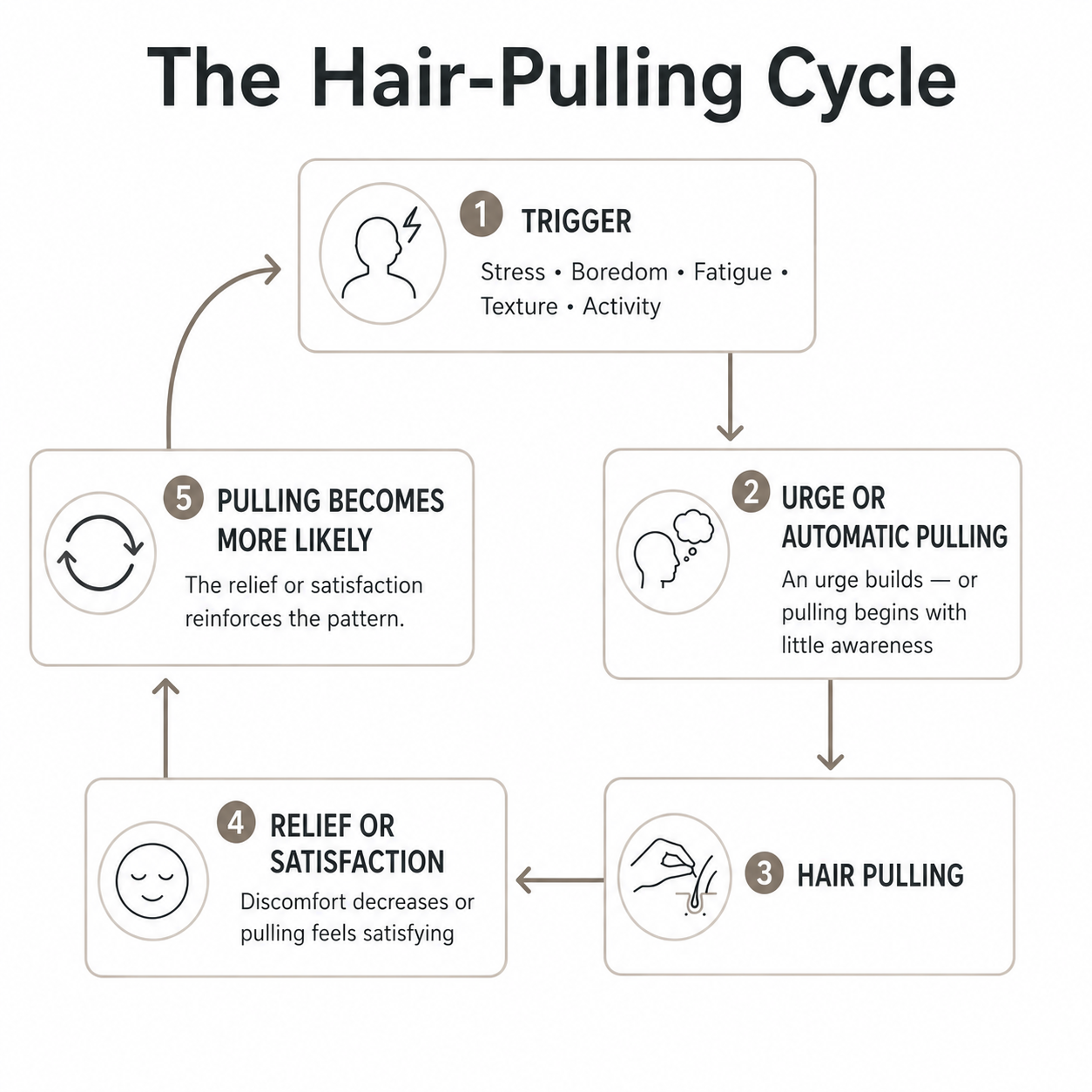
Hair pulling often provides something in the moment, even though the person wishes it didn’t. Researchers recognize that pulling isn’t motivated by the same experience for everyone. Some people pull primarily in response to uncomfortable urges or emotions, while others describe it as automatic or even pleasurable in the moment.
Some people describe a growing sense of tension, discomfort, or an urge that builds until they pull. Others experience pulling as soothing, satisfying, or temporarily relieving. Still others pull automatically without noticing much tension beforehand.
Because pulling can temporarily reduce discomfort or provide a brief sense of relief or satisfaction, it often becomes more likely to occur again. Over time, it can become linked to particular emotions, situations, environments, or routines, making it feel increasingly automatic.
Common Triggers
Many people eventually notice that pulling isn’t completely random. It often happens during certain emotions, activities, or times of day.
Common triggers include:
boredom
fatigue
reading or studying
watching television
using a computer
talking on the phone
lying in bed
noticing hairs that feel coarse, uneven, or “out of place”
Recognizing these patterns is an important part of treatment because it helps identify when and where pulling is most likely to occur.
Trichotillomania Is More Than a Cosmetic Problem
Hair pulling can affect much more than appearance.
Some people spend significant time trying to hide thinning hair, missing eyelashes, or missing eyebrows. A woman may avoid windy days, swimming, hair appointments, or bright lighting. A teenager may worry that classmates will notice bald spots. Someone else may avoid dating or social events because of embarrassment.
The emotional impact can become just as significant as the physical effects.
How Is Trichotillomania Treated?
One of the most effective psychological treatments for trichotillomania is Habit Reversal Training (HRT), often combined with other cognitive behavioral strategies.
Treatment typically begins by helping people become more aware of when pulling occurs. Many episodes happen so automatically that a person doesn’t notice the behavior until several hairs have already been pulled.
Once patterns become clearer, treatment focuses on identifying triggers, developing competing responses that make hair pulling less likely, modifying the environment to reduce opportunities for pulling, and learning strategies to manage urges without acting on them.
The goal isn’t simply to rely on willpower. It’s to understand the factors maintaining the behavior and develop practical ways to interrupt the cycle.
Recovery Is Possible
Many people living with trichotillomania have spent years believing they “should” be able to stop if they just tried harder. Unfortunately, that belief often leads to shame rather than change.
Hair pulling is a treatable condition. Although progress is rarely perfectly linear, many people are able to reduce pulling, better understand their triggers, and regain a greater sense of control with evidence-based treatment.
Trichotillomania Treatment in Arlington, VA
I provide therapy for trichotillomania and other body-focused repetitive behaviors, including hair pulling and skin picking. Treatment focuses on Habit Reversal Training (HRT), increasing awareness of pulling patterns, developing competing responses, identifying triggers, and building practical strategies for managing urges. Services are available in person and through teletherapy.
If hair pulling has become a source of frustration, embarrassment, or distress, contact me to learn more about evidence-based treatment.