
My Child Refuses Anxiety or OCD Treatment. What Can I Do?
Many parents feel relieved when they finally find an effective treatment for obsessive compulsive disorder or anxiety. They learn about Exposure and Response Prevention (ERP), a type of therapy that helps people gradually face fears rather than avoid them. They read that it’s considered one of the most effective treatments for OCD and many anxiety disorders.
Then they bring up the idea with their child.
And their child says no.
Sometimes the refusal is immediate. Other times a child agrees to attend therapy but refuses to participate in exposures, won’t practice skills between sessions, or shuts down whenever fears are discussed.
Parents often wonder:
What if my child refuses treatment?
What if they won’t participate in therapy?
Should I wait until they’re more motivated?
Are we stuck?
The good news is that a child’s refusal to participate in treatment doesn’t necessarily mean nothing can be done.
Why Children Refuse Treatment
From a parent’s perspective, treatment often seems like the obvious solution. From a child’s perspective, it can feel very different.
Obsessive compulsive disorder and anxiety spend a great deal of time convincing children that feared situations are dangerous, overwhelming, irresponsible, or best avoided. Treatment asks them to do exactly the opposite.
A child who refuses treatment isn’t necessarily being defiant, stubborn, or unmotivated. More often, they’re responding the way anxiety or OCD has taught them to respond.
The refusal itself is often part of the problem the family is trying to solve.
What Is ERP?
Exposure and Response Prevention (ERP) is a type of therapy that helps people gradually face fears, uncertainty, and discomfort while reducing avoidance, compulsions, and reassurance-seeking.
For example, someone with OCD may practice resisting compulsions. A child with anxiety may gradually face situations they’ve been avoiding. The goal isn’t to eliminate anxiety. The goal is to help children learn that they can tolerate difficult feelings without relying on avoidance, compulsions, or constant reassurance.
ERP is one of the most effective treatments available for OCD and many anxiety disorders. However, knowing that a treatment works doesn’t automatically make a child willing to participate.
The Question Isn’t How Do I Make My Child Do ERP?
When parents encounter resistance, it’s natural to start looking for ways to persuade, pressure, negotiate, reward, or convince. Unfortunately, those approaches often turn treatment into a power struggle. A more helpful question is:
What can we do if my child isn’t ready or willing to engage in ERP right now?
Many parents are surprised to learn that treatment doesn’t always have to begin with changing the child. Sometimes it begins with changing the environment around the anxiety.
Anxiety and OCD Often Affect the Entire Family
Over time, anxiety and OCD often pull family members into patterns that revolve around preventing distress.
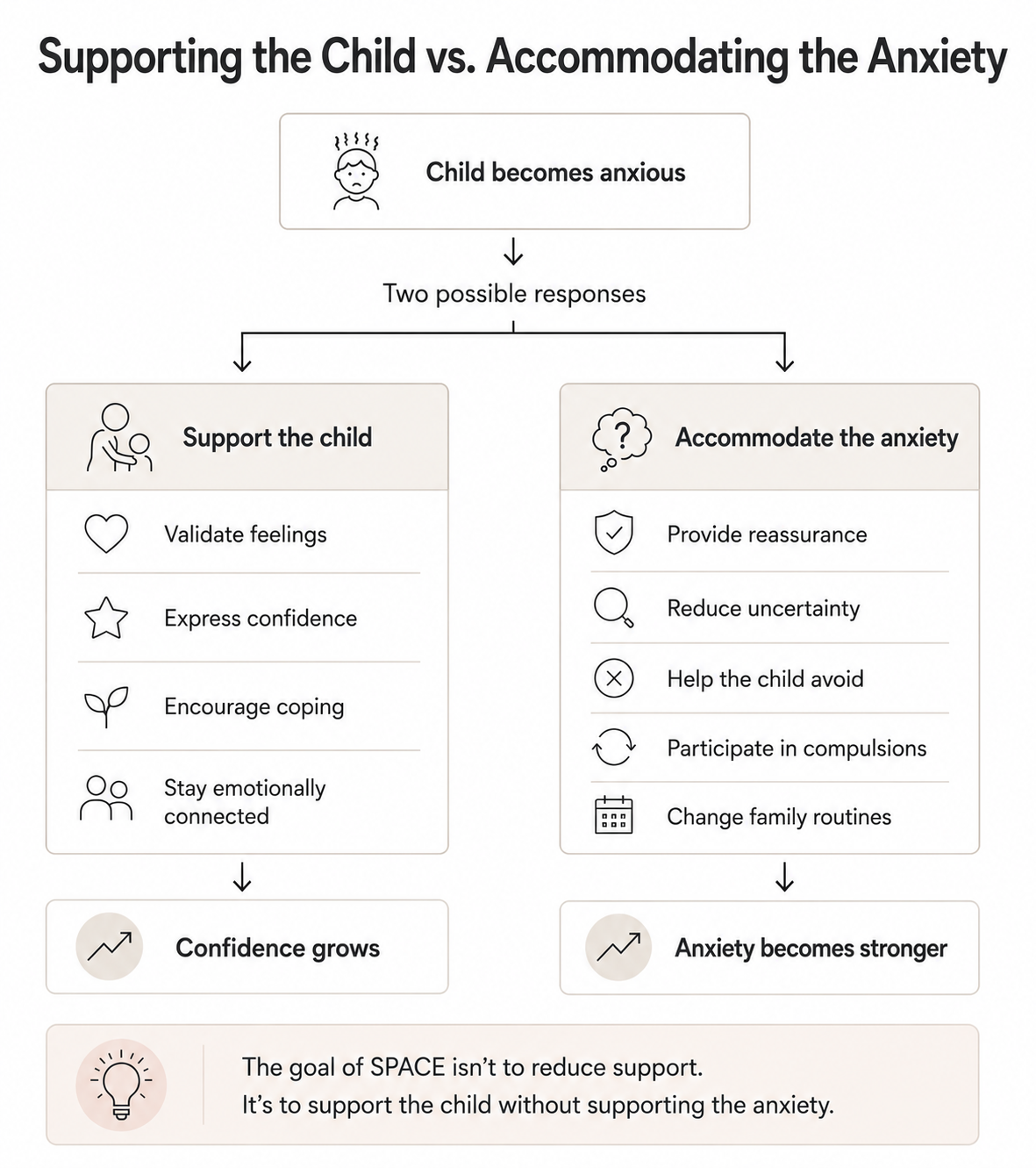
Parents may find themselves answering reassurance questions repeatedly, helping a child avoid feared situations, participating in rituals, modifying family routines, changing plans, speaking on a child’s behalf, or taking over responsibilities that feel overwhelming to the child.
These responses make sense. Most parents are simply trying to help a child who is suffering. The problem is that these accommodations often strengthen anxiety and OCD over time. When anxiety repeatedly leads to avoidance, reassurance, or rescue, children have fewer opportunities to discover that they can handle discomfort, uncertainty, and fear.
How SPACE Treatment Can Help
Supportive Parenting for Anxious Childhood Emotions (SPACE) is a parent-based treatment for childhood anxiety and OCD. Unlike ERP, which focuses directly on helping the child face fears, SPACE helps parents change how they respond to anxiety and OCD.
This can be particularly helpful when a child refuses treatment, won’t participate in exposures, or is resistant to therapy. Rather than trying to force a child to confront fears, parents learn how to reduce accommodations while remaining supportive and emotionally connected.
For example, parents may learn how to stop repeatedly answering reassurance questions, reduce participation in rituals, limit avoidance, and respond differently to anxiety-driven behaviors.
A central idea in SPACE is that parents can support their child without supporting the anxiety or OCD. Instead of trying to eliminate distress, parents learn how to acknowledge their child’s discomfort while communicating confidence in their ability to handle it.
Many parents initially worry that reducing accommodation will damage the relationship or make anxiety worse. SPACE takes the opposite approach: maintaining empathy and support while helping children build greater independence, flexibility, and confidence in their ability to tolerate anxiety, uncertainty, and discomfort.
Parents Can Still Influence Change
One of the most hopeful aspects of SPACE is that parents don’t have to wait for a child to become motivated before treatment can begin. Parents can start making changes in how they respond to anxiety and OCD even when a child is resistant.
As accommodations decrease, anxiety often has fewer opportunities to control family life. Children have more opportunities to practice independence, tolerate discomfort, and develop confidence in their ability to handle difficult situations.
This doesn’t happen overnight. In fact, anxiety and OCD often push back when long-standing patterns begin to change. However, many parents find it empowering to learn that they are not powerless while waiting for their child to become willing to engage in treatment.
What If My Child Eventually Becomes Willing to Try ERP?
SPACE and ERP aren’t competing approaches. Many families use one, the other, or a combination of both.
Often, reducing accommodation through SPACE helps create the conditions that make a child more willing to engage in ERP later. As anxiety becomes less influential and confidence grows, children often become more open to practicing the skills that ERP teaches.
You’re Not Stuck
Parents often fear that a child’s refusal means treatment has reached a dead end. Fortunately, that isn’t true. Even when a child refuses ERP or other anxiety treatment, families can begin making meaningful changes that reduce anxiety’s influence, strengthen independence, and support long-term progress.
Sometimes treatment begins by helping the child change. Sometimes it begins by helping the parents change. Both approaches can move a family forward.
SPACE and ERP Treatment in Arlington, VA
I provide SPACE treatment and ERP for children and adolescents experiencing OCD, OCD-related disorders, and anxiety disorders. I work with parents who are struggling with accommodation, reassurance-seeking, avoidance, and treatment resistance related to anxiety and OCD.
Treatment focuses on helping families reduce anxiety’s influence, build confidence, and respond differently to fear, uncertainty, and distress over time.
Ready to spend less time managing anxiety and more time focusing on what matters to you? Let’s talk.
Related Articles
What Is SPACE Treatment? A Parent’s Guide to Helping Children Without Reinforcing Anxiety and Avoidance
What Is Exposure and Response Prevention (ERP) Therapy?
How Reassurance Can Reinforce Anxiety and OCD in Children
What’s Accommodation in Anxiety and OCD?
10 Signs Anxiety Is Running Your Family Instead of Your Family Running Anxiety