
10 Signs Anxiety Is Running Your Family Instead of Your Family Running Anxiety
When a child struggles with anxiety or OCD, it’s natural for parents to adjust. You might offer extra reassurance, change plans, or step in to help your child avoid situations that feel overwhelming. These responses come from love and a desire to reduce your child’s distress.
Over time, however, those small adjustments can begin to add up. Without anyone intending it, anxiety can start influencing family routines, relationships, and decisions. Psychologists refer to many of these changes as family accommodation - the ways family members modify their own behavior to reduce a child’s anxiety or prevent distress.
Not every accommodation is problematic. The concern is when these patterns become persistent and begin interfering with a child’s opportunities to develop confidence in their ability to cope with anxiety and uncertainty.
Although accommodations often reduce anxiety in the moment, they can also make it harder for children to learn that they can tolerate anxiety and uncertainty without relying on someone else to make them feel safe.
If you’re wondering whether anxiety has started playing a larger role in your family’s life, here are ten common signs.
1. You Answer the Same Questions Over and Over
Your child repeatedly asks questions such as:
Are you sure I’ll be okay?
Did I do anything wrong?
Can you check one more time?
Providing reassurance often reduces anxiety temporarily, but the relief usually doesn’t last. If the same questions keep returning, reassurance may have shifted from comforting your child to unintentionally maintaining the anxiety.
2. Family Plans Revolve Around Avoiding Anxiety
You find yourself choosing restaurants, vacations, sports, birthday parties, sleepovers, family gatherings, or other activities based primarily on what is least likely to trigger your child’s anxiety.
Occasional flexibility is part of parenting, and every family makes adjustments from time to time. When avoiding anxiety consistently begins determining where your family goes, what your child participates in, or what everyone else does, anxiety may be having a greater influence over family life than you intended.
3. Bedtime Has Become Increasingly Complicated
Perhaps your child can’t fall asleep unless you’re in the room, needs repeated reassurance before bed, or follows an increasingly lengthy bedtime routine.
Sleep difficulties are common in anxious children. If bedtime has become a nightly negotiation that consumes significant time and energy, it may be worth considering whether anxiety is driving the routine.
4. Family Members Participate in OCD Rituals
Children with OCD sometimes ask parents to participate in your child’s compulsions by checking, cleaning, answering reassurance questions, repeating phrases, or avoiding certain situations.
These requests are understandable because compulsions temporarily reduce anxiety. Unfortunately, participating in compulsions can unintentionally strengthen OCD by reinforcing the belief that the feared situation can’t be tolerated without completing the ritual.
5. Siblings Are Being Affected
Anxiety rarely affects only one person.
Siblings may miss activities, change their own routines, receive less attention, or feel frustrated that family decisions often revolve around one child’s anxiety. This doesn’t mean parents are doing anything wrong. It simply highlights how anxiety can affect the entire family system.
6. You Feel Guilty Whenever You Set Limits
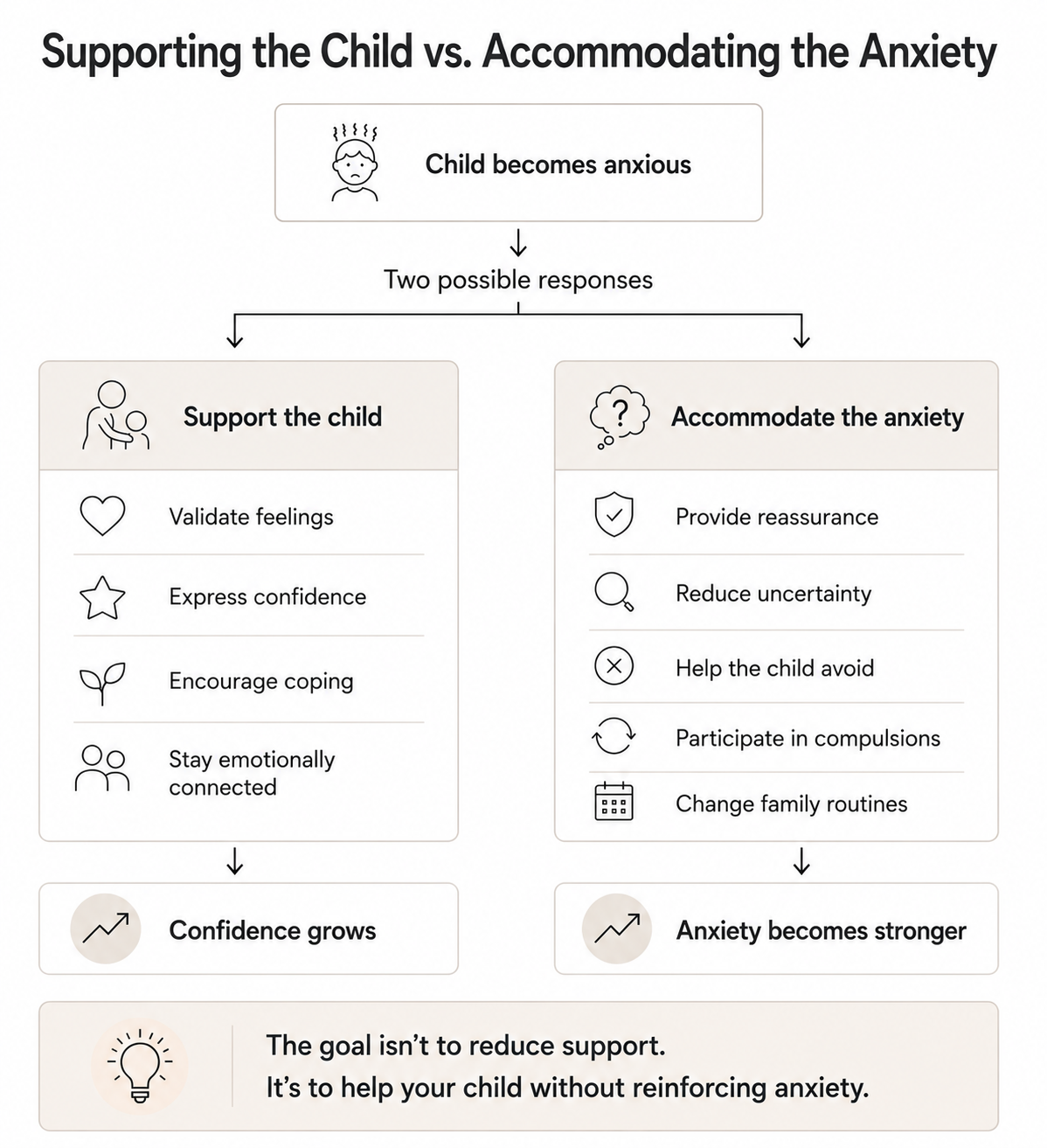
Setting limits around anxiety can feel uncomfortable. Parents often worry they’re being unsupportive or damaging the relationship. In reality, supportive parenting and reducing accommodation aren’t opposites. Children can feel deeply understood while still learning to face anxiety more independently.
In reality, supporting an anxious child doesn’t always mean removing every source of distress. Sometimes the most supportive response is helping a child gradually learn that they can tolerate uncertainty and difficult emotions.
7. You Spend More Time Preventing Anxiety Than Living Your Family’s Life
You may find yourself checking ahead, researching extensively, preparing for every possible problem, or making numerous adjustments in an effort to prevent your child from becoming anxious.
These efforts often come from compassion. At the same time, they can communicate that anxiety signals genuine danger rather than discomfort that can be managed.
8. Everyone Walks on Eggshells
Family members may begin avoiding certain topics, places, or conversations because they’re worried about triggering anxiety.
Over time, this can make anxiety feel increasingly powerful while limiting the family’s ability to live according to their own values and priorities.
9. Anxiety Is Affecting Your Relationships
Parents sometimes find themselves disagreeing about how to respond to anxiety. Couples may argue about reassurance, accommodations, or whether to push their child outside their comfort zone.
It’s also common for parents to feel emotionally exhausted after spending much of the day managing anxiety-related situations.
10. It Feels Like Anxiety Is Making the Decisions
Perhaps the biggest sign is a growing sense that anxiety - not your family’s values - is determining how your household functions.
Instead of asking, What would be best for our family? decisions gradually become, What will cause the least anxiety today?
Over time, decisions become organized around avoiding distress rather than around your family’s goals, values, or priorities. That’s often the point at which parents begin feeling that anxiety - not they - has taken the lead.
That shift often happens so gradually that parents don’t recognize it until they look back and realize how much family life has changed.
There’s Another Way Forward
Recognizing these patterns isn’t about blaming yourself or concluding that you’ve handled things incorrectly. Most accommodations develop because parents are responding thoughtfully and compassionately to a child who is genuinely distressed.
The encouraging news is that families can learn different ways of responding. Parents don’t have to choose between being supportive and helping their child become more independent. Those goals can go hand in hand.
Supportive Parenting for Anxious Childhood Emotions (SPACE) is an evidence-based treatment developed at the Yale Child Study Center that helps parents gradually reduce family accommodation while maintaining a warm, supportive relationship with their child. SPACE helps parents make gradual changes to family accommodation while maintaining a warm, supportive relationship with their child. As parents change their responses to anxiety, children have more opportunities to build confidence in their own ability to cope.
SPACE Therapy in Arlington, VA
I provide SPACE (Supportive Parenting for Anxious Childhood Emotions) treatment for families of children and adolescents with anxiety and OCD in Arlington, Virginia. Services are available in person and through teletherapy.
Treatment focuses on helping parents understand and gradually reduce family accommodation while preserving a warm, supportive relationship with their child. If your child’s anxiety has begun affecting your family’s routines, relationships, or daily life, I’d be happy to discuss whether SPACE may be a good fit. Please reach out to learn more or schedule a consultation.