
What’s Accommodation in Anxiety and OCD?
When someone is struggling with anxiety, OCD, panic, or emotional distress, family members naturally want to help.
Parents, partners, and loved ones often make adjustments in an attempt to reduce distress, prevent conflict, help the person function, avoid emotional meltdowns, or protect them from fear and overwhelm. These adjustments are called accommodations.
Accommodation is extremely common, and it comes from a place of care and compassion. At the same time, accommodations can sometimes unintentionally strengthen anxiety and avoidance over time.
What Is Accommodation?
Accommodation refers to changes other people make in order to help someone avoid distress, anxiety, uncertainty, or emotional discomfort. Accommodation can involve either participating directly in anxiety-driven behaviors or changing routines, expectations, or family activities in response to anxiety.
Examples include repeatedly providing reassurance, helping someone avoid feared situations, changing family routines around anxiety, speaking for someone socially, participating in OCD rituals, answering repetitive anxiety-driven questions, taking over responsibilities the person feels unable to tolerate, or modifying plans to avoid triggers.
Accommodation isn’t inherently bad. In fact, some accommodations are reasonable, temporary, or necessary.
The important question is often Is this helping the person function more effectively long-term, or is it unintentionally reinforcing avoidance and dependence?
Accommodation Usually Develops Gradually
Most accommodations don’t begin dramatically. They often emerge slowly because someone is genuinely distressed, loved ones want to help, avoiding conflict feels easier than facing repeated anxiety, and the accommodation provides temporary relief for everyone involved.
For example, a parent may initially stay with a child briefly at bedtime, a partner may answer reassurance questions “just this once,” a family may temporarily avoid a triggering restaurant, or a parent may start emailing teachers for a teen who feels overwhelmed.
Over time, the accommodations may expand and what began as temporary support can gradually become a long-standing pattern.
Why Accommodation Feels Helpful
Accommodation often works in the short term.
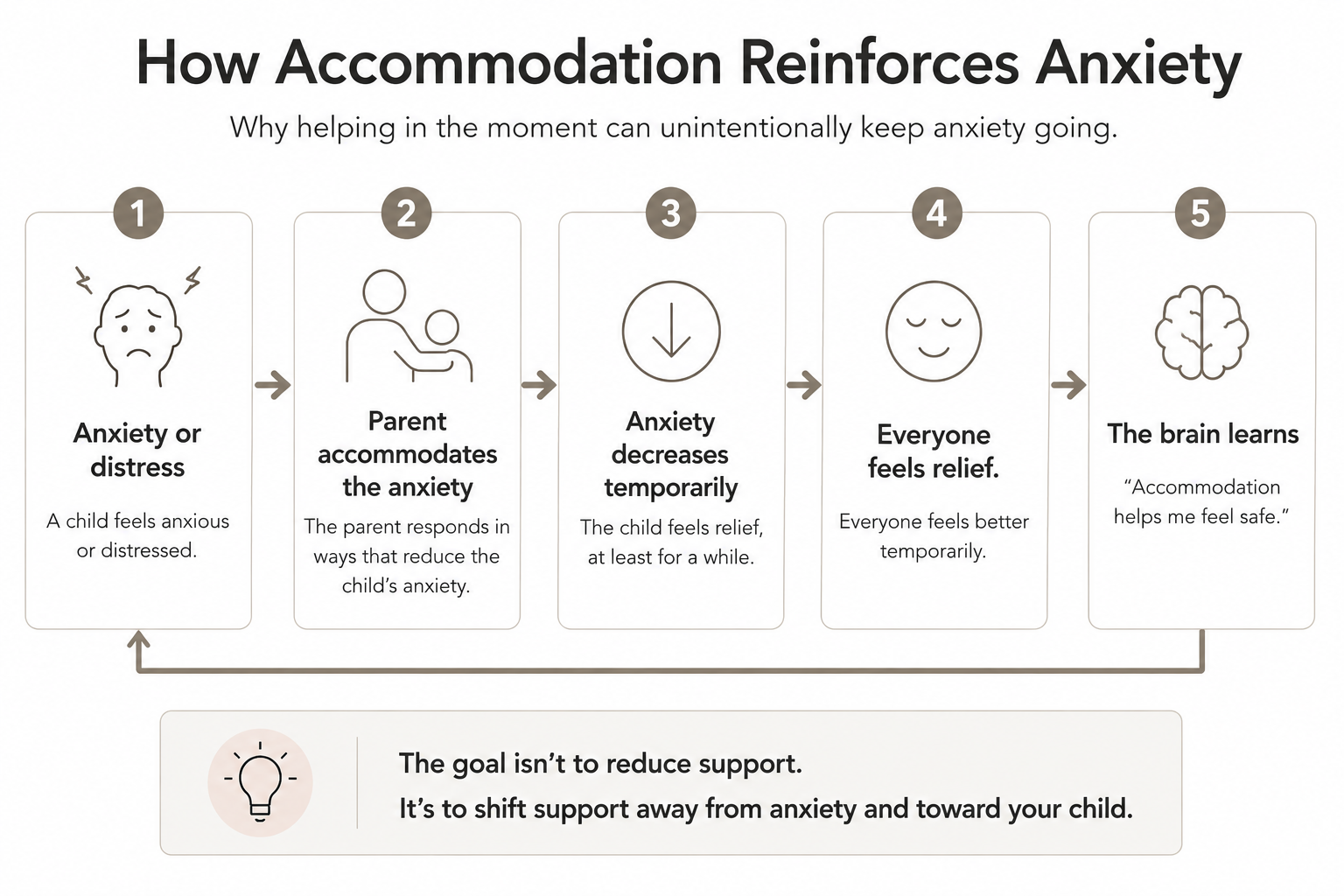
As a result, the fear or avoidance often becomes stronger over time.
Accommodation and OCD
Accommodation is especially common in obsessive-compulsive disorder (OCD).
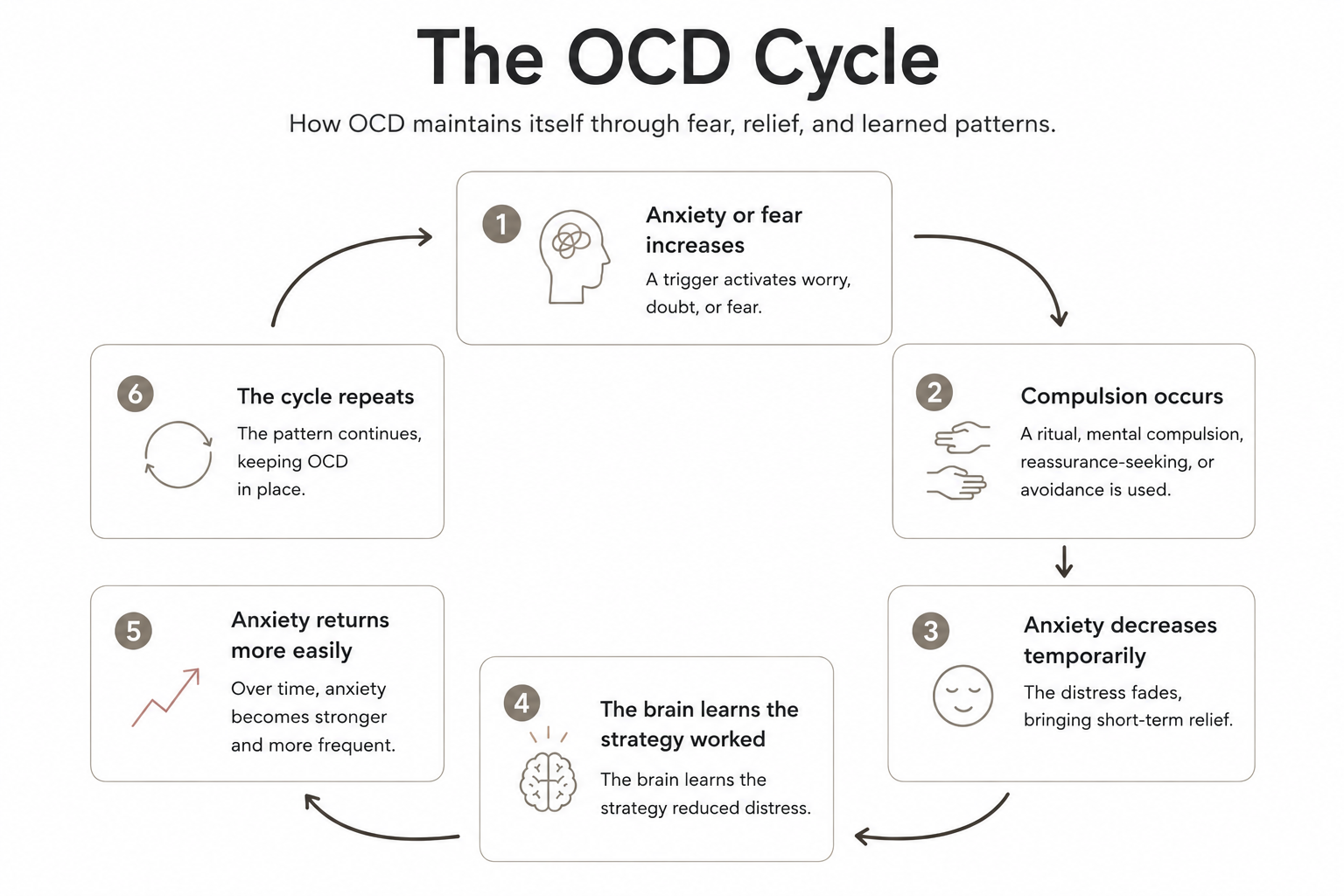
Family members may unintentionally become involved in reassurance rituals, checking behaviors, contamination avoidance, confession cycles, repeated questioning, arranging objects “correctly,” or helping someone avoid feared situations. The reassurance often reduces anxiety temporarily but strengthens OCD over time.
Accommodation and Anxiety
Accommodation also occurs in anxiety disorders.
For example, a parent may speak for a socially anxious child, a partner may repeatedly cancel plans due to panic, a family may avoid travel because of emetophobia, or someone with health anxiety may seek repeated reassurance or medical checking. Again, the intention is usually protection and care.
The difficulty is that avoiding anxiety can interfere with the person’s opportunity to learn that anxiety can decrease naturally, uncertainty can be tolerated, feared outcomes are often survivable, and discomfort does not always require escape.
Accommodation Isn’t the Same as Support
Accommodation attempts to reduce distress in ways that may reinforce avoidance or compulsions.
For example:
Support
I know this situation feels scary, and I believe you can get through it.
Accommodation
Repeatedly rescuing the person from every feared situation
People often worry that reducing accommodation means becoming cold, harsh, or unsupportive.
That’s not the goal. The goal is learning how to remain emotionally supportive without reinforcing anxiety-driven patterns.
Reducing Accommodation Can Feel Difficult at First
Families are often surprised that reducing accommodation may initially increase anxiety or distress temporarily. It makes sense. The accommodation had been functioning as a way to reduce fear or uncertainty.
When accommodations decrease, anxiety often increases at first. The person may seek more reassurance, conflict may temporarily increase, and family members may experience guilt or second-guess themselves.
This is one reason many families find it helpful to approach these changes gradually, consistently, collaboratively, and compassionately.
Accommodation Affects the Entire Family System
Over time, anxiety and OCD can begin organizing the entire household around preventing distress. Families may stop doing certain activities, avoid guests, modify schedules, and gradually become emotionally exhausted. Over time, family members may find themselves walking on eggshells or experiencing resentment and burnout.
Accommodation can become so normalized that family members no longer realize how much life has narrowed around anxiety.
Treatment Often Involves Helping Families Change Patterns
Treatment often involves helping individuals and families identify patterns of accommodation and reassurance-seeking, distinguish support from accommodation, reduce avoidance, tolerate distress more effectively, and gradually increase independence and flexibility.
Several evidence-based treatments address these patterns directly. Cognitive Behavioral Therapy (CBT) and Exposure and Response Prevention (ERP) focus on helping individuals respond differently to anxiety and uncertainty. Supportive Parenting for Anxious Childhood Emotions (SPACE) helps parents reduce accommodations that may be unintentionally maintaining anxiety while continuing to provide support and connection.
Therapy for Anxiety and OCD in Arlington, VA
I provide therapy in Arlington for OCD, anxiety disorders, panic, perfectionism, reassurance-seeking, and related concerns. I also provide SPACE treatment for families struggling with accommodation patterns related to anxiety and avoidance.
Treatment focuses on helping individuals and families step out of cycles of fear, accommodation, and avoidance while building greater flexibility, resilience, and long-term functioning over time.
Anxiety doesn’t have to make your decisions for you. If you’d like support, reach out to schedule a consultation.
Related Articles
Types of OCD: Understanding Different OCD Themes
What Is Exposure and Response Prevention (ERP) Therapy?