
Why Can’t I Stop Thinking About It? Understanding Rumination
You replay the conversation from yesterday for the tenth time, wondering whether you said something wrong.
You keep trying to figure out whether you made the right decision, even though you’ve already thought about it for hours. Every time you think you’ve reached an answer, a new “what if?” appears.
Maybe you’re trying to understand why you’re feeling anxious. Maybe you’re searching for certainty that something bad won’t happen. Or maybe you’re trying to make sense of an intrusive thought that won’t leave you alone.
Instead of feeling closer to an answer, you feel more confused, more uncertain, and mentally exhausted than when you started.
Instead of feeling closer to an answer, you feel more confused, more uncertain, and mentally exhausted than when you started.
If this sounds familiar, you may be wondering, “Why can’t I stop thinking about it?” The answer likely isn’t that you lack willpower or self-control. More often, it’s because your brain has become stuck in a pattern called rumination.
What Is Rumination?
Rumination is repeatedly thinking about the same problem, question, memory, or worry without reaching a satisfying resolution.
Unlike productive problem-solving, rumination tends to go in circles. The mind revisits the same information, considers the same possibilities, and searches for new answers without making meaningful progress.
Many people describe feeling as though they’re mentally “stuck.” They aren’t thinking because they want to. They’re thinking because it feels impossible to stop.
Why Does Rumination Feel So Compelling?
Rumination usually doesn’t feel pointless when it’s happening. It often feels necessary.
You may believe that if you think about something just a little longer, you’ll finally:
understand why something happened
feel certain you made the right decision
find the perfect solution
prevent something bad from happening
prove that a fear isn’t true
The problem is that rumination rarely provides lasting relief.
Sometimes it produces a brief sense of certainty or resolution. Before long, though, doubt returns, and the thinking starts again. This is one reason it can feel so difficult to stop. As long as your brain believes that more thinking will eventually produce certainty, understanding, or relief, it will continue sending the urge to keep analyzing.
Rumination tends to follow a predictable pattern that keeps uncertainty alive over time.
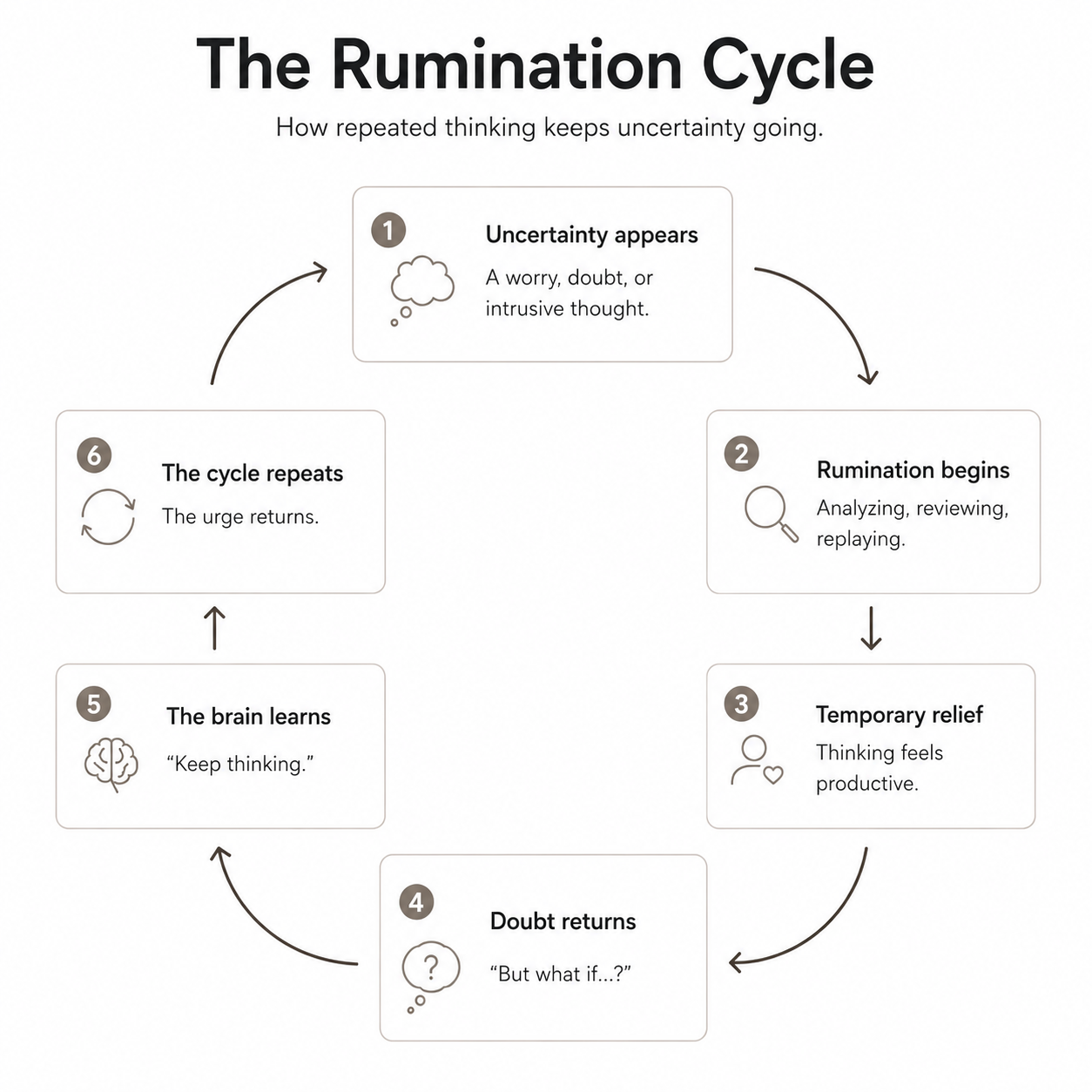
Rumination Is Different From Problem-Solving
Once you’ve gathered enough information to make a reasonable decision, productive problem-solving usually comes to an end.
Rumination is different. It tends to revisit the same questions repeatedly without producing new insight.
For example, someone solving a problem might make a decision after considering the available information.
Someone ruminating may continue asking:
But what if I missed something?
Maybe I’m forgetting an important detail.
I still don’t feel completely sure.
The process begins to serve the search for certainty rather than the search for a practical solution.
Rumination and OCD
Rumination is particularly common in obsessive-compulsive disorder.
Many people think of compulsions as behaviors such as checking, washing, or arranging. But compulsions aren’t always visible. Some occur entirely in the mind. A person with OCD may repeatedly analyze intrusive thoughts, seek reassurance, review memories, search for certainty, mentally debate different possibilities, or try to convince themselves that their fears aren’t true. Many people also may try to push thoughts away.
Although these mental compulsions often feel like attempts to solve the problem, they usually keep the obsession active by pulling attention back to it again and again.
This is one reason Exposure and Response Prevention (ERP), the gold standard treatment for OCD, often involves reducing mental compulsions such as rumination rather than trying to answer obsessive questions.
Rumination Can Occur Outside of OCD
People with depression may repeatedly think about past mistakes or perceived failures. Someone with generalized anxiety disorder may spend hours mentally preparing for future problems. After a difficult social interaction, a person with social anxiety may replay every detail of the conversation.
Although the content differs, the process is remarkably similar. The mind keeps returning to the same questions in the hope that more thinking will finally produce certainty or relief.
Why It’s So Hard to Stop
If you’ve ever tried to tell yourself, “Just stop thinking about it,” you’ve probably discovered that it doesn’t work very well. That’s because rumination isn’t maintained by a lack of self-control. It’s maintained by the belief that continuing to think is the way to solve the problem.
Unfortunately, that rarely works.
Rumination isn’t maintained because someone lacks willpower. It’s maintained because the brain has learned that continued thinking might eventually reduce uncertainty or solve the problem.
Each time rumination seems to produce even temporary relief, the brain becomes a little more likely to use the same strategy again in the future.
Over time, rumination can become an automatic response whenever uncertainty, anxiety, guilt, or doubt appears.
The answer usually isn’t that you lack self-control. Rumination continues because your brain has learned that more thinking might eventually produce certainty, safety, or relief. As long as the brain believes more thinking is the solution, it will continue sending the urge to keep analyzing.
Breaking the Cycle
Reducing rumination doesn’t mean forcing yourself to stop thinking altogether. Instead, treatment often focuses on changing your relationship with the urge to keep thinking.
Treatment often focuses on helping people notice when productive thinking has shifted into rumination and practice responding differently to the urge to keep analyzing.
For people with OCD, ERP helps individuals practice experiencing uncertainty without responding through rumination or other compulsions. Over time, this allows the brain to learn that anxiety and uncertainty can be tolerated without repeatedly trying to resolve every doubt.
You Don’t Have to Stay Stuck
Rumination can be frustrating because it often feels productive even when it’s keeping you trapped.
If you’ve been asking yourself, “Why can’t I stop thinking about it?” the answer probably isn’t that your mind is broken or that you simply think too much. More often, your brain has learned that continued analysis feels like the safest response to uncertainty. Learning to recognize when thinking has become rumination is an important first step toward changing that pattern.
Rumination Treatment in Arlington, VA
I provide therapy for adults and adolescents struggling with rumination, OCD, anxiety disorders, depression, and related concerns in Arlington, VA. Services are available in person and through teletherapy.
Treatment focuses on helping people understand the patterns that keep anxiety going while learning practical, evidence-based strategies to reduce rumination, tolerate uncertainty, and respond differently to intrusive thoughts and obsessive doubt. If rumination has begun taking over your time, energy, or daily life, contact me to learn more or schedule a consultation.
Related Articles
Types of OCD: Understanding Different OCD Themes
What Is Exposure and Response Prevention (ERP)?
Why Is Uncertainty So Hard to Tolerate?