
Why Trying Not to Think About Something Makes It Stick Around
We’ve all tried not to think about something.
Maybe it was an embarrassing moment, a distressing image, an intrusive thought, a worry, or an unwanted memory. The instinct makes sense: If I stop thinking about this, I’ll feel better.
This is especially common with intrusive thoughts. When an unwanted thought feels disturbing, frightening, or meaningful, many people try to push it away, replace it, or get rid of it completely.
Unfortunately, psychological research on thought suppression has consistently found that trying to force thoughts out of awareness often has the opposite effect.
But psychological research on thought suppression has consistently found that trying to force thoughts out of awareness often has the opposite effect. The harder people try to push certain thoughts away, the more persistent and attention-grabbing those thoughts can become. This is especially relevant in obsessive-compulsive disorder (OCD), where people often become trapped in exhausting attempts to get rid of intrusive thoughts completely.
The White Bear Experiment
One of the most famous studies on thought suppression was conducted by psychologist Daniel Wegner. Participants were instructed not to think about a white bear. If the thought appeared, they were asked to ring a bell. The result was predictable and surprising at the same time: people thought about white bears repeatedly. Researchers later found that attempts to suppress thoughts can sometimes lead to a rebound effect, in which the thought occurs even more frequently afterward.
Why Fighting Thoughts Backfires
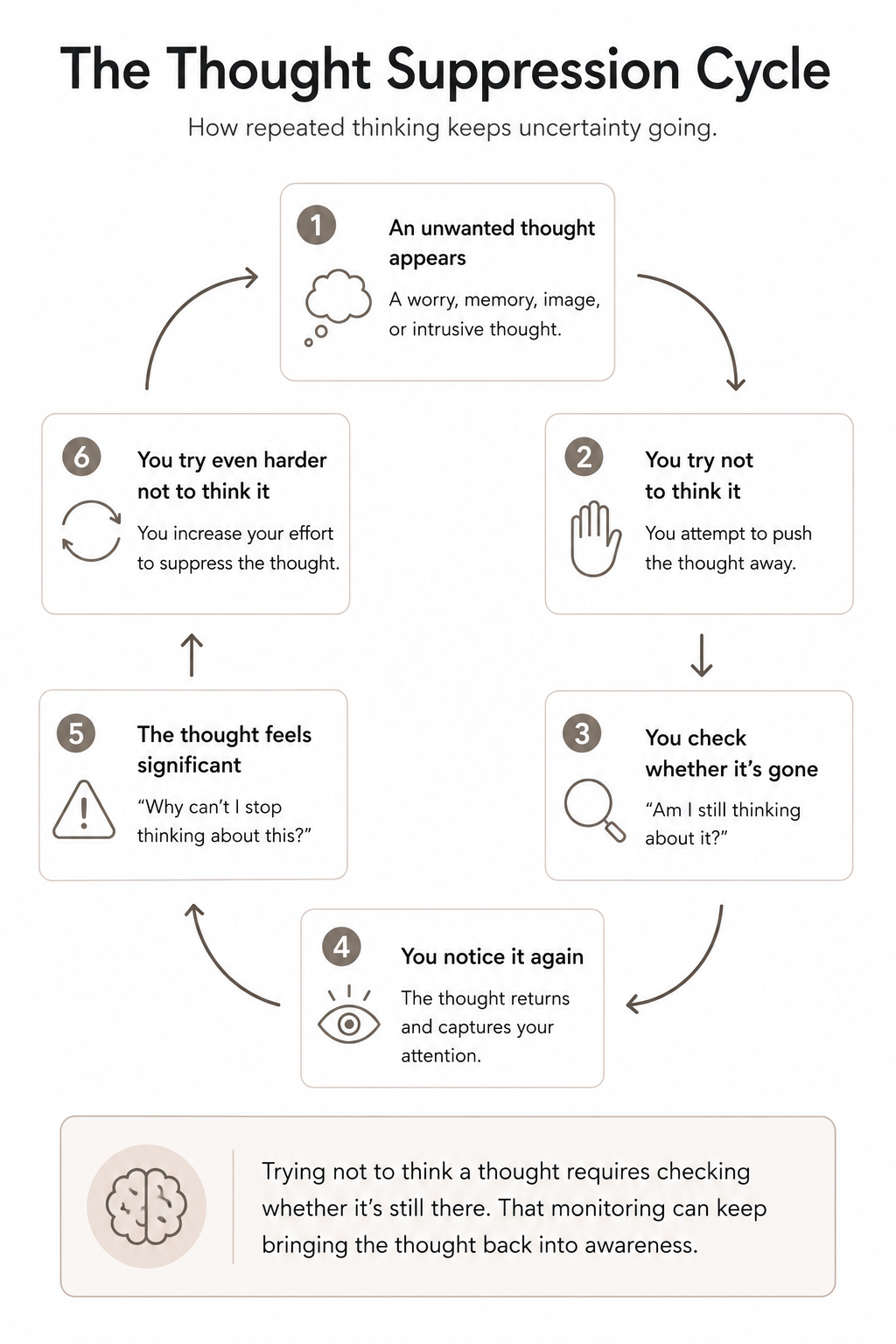
Psychologists refer to this process as thought suppression, or attempts to deliberately avoid certain thoughts. At first glance, it seems like people should be able to simply stop thinking about something.
The problem is that in order to avoid a thought, the brain has to keep checking whether the thought is present. In other words, part of the mind is trying to push the thought away while another part is monitoring for its return. As a result, attention stays connected to the very thing the person is trying not to think about. The thought becomes more noticeable, more important, and often more distressing.
How This Shows Up in OCD
People with OCD are often frightened by intrusive thoughts and may respond by trying to eliminate, suppress, neutralize, analyze, or control them.
For example:
someone with harm OCD may try to push away violent thoughts
someone with POCD may try to block intrusive sexual thoughts
someone with religious OCD may try to eliminate blasphemous thoughts
someone with relationship OCD may try to get rid of relationship doubts
The problem is that these efforts often increase attention to the thought rather than making it disappear. The person may then conclude:
If the thought keeps coming back, it must mean something.
This interpretation often leads to even more monitoring, anxiety, and compulsive responding.
Many Compulsions Are Really Attempts to Control Thoughts
Many compulsions function as attempts to neutralize unwanted thoughts or achieve certainty about what they mean. A person may repeatedly analyze a thought, seek reassurance, mentally review memories, argue with the thought, replace it with a “better” thought, or pray compulsively in an attempt to feel certain.
These strategies may reduce anxiety briefly, but they often strengthen the belief that the thought is important, dangerous, or meaningful.
You Don’t Have to Solve Every Thought
Many people become trapped in a constant battle with their minds. They try to prove a thought is false, figure out what it means, replace it with a better thought, or force it to disappear. Unfortunately, these efforts often pull people deeper into the struggle. The more attention devoted to analyzing, monitoring, or controlling a thought, the more important and urgent it can begin to feel.
A different approach is learning that thoughts can exist without requiring immediate action. Rather than asking, “How do I get rid of this thought?” the question becomes, “Can I allow this thought to be here without treating it like a problem that must be solved right now?”
The goal isn’t to like the thought, agree with it, or believe it. The goal is to stop organizing your life around trying to achieve certainty about every unwanted thought that appears.
Acceptance Isn’t Approval
People sometimes worry that allowing a thought to exist means agreeing with it. That’s not the case.
A violent thought isn’t violence. A blasphemous thought isn’t blasphemy. An intrusive sexual thought isn’t the same thing as intent.
Thoughts can occur without requiring action, analysis, reassurance, or certainty. Recovery often involves learning to make room for unwanted thoughts and feelings rather than constantly fighting, analyzing, or trying to eliminate them.
ERP and Intrusive Thoughts
Exposure and Response Prevention (ERP) helps people change their relationship with intrusive thoughts. Instead of trying to force thoughts away, treatment helps people practice allowing thoughts to come and go while resisting compulsive responses such as reassurance-seeking, mental reviewing, avoidance, or analysis.
The goal isn’t to eliminate intrusive thoughts completely. Human minds naturally produce strange, random, and unwanted thoughts. The goal isn’t getting rid of intrusive thoughts. It’s becoming less trapped by them. Over time, intrusive thoughts often become less distressing when the brain stops treating them as threats that require constant monitoring and control.
OCD Treatment in Arlington, VA
I provide therapy for OCD, OCD-related disorders, and anxiety disorders in Arlington, including treatment for intrusive thoughts, compulsions, reassurance-seeking, rumination, and obsessive doubt. Services are available in person and through teletherapy.
Treatment focuses on helping people step out of compulsive cycles of fear, certainty-seeking, and mental struggle while developing a more flexible relationship with thoughts, uncertainty, and anxiety over time.
If you’re ready to spend less time fighting with OCD and more time focusing on what matters to you, contact me to schedule a consultation.
Related Articles
What Is Exposure and Response Prevention (ERP) Therapy?
Why Can’t I Stop Thinking About It? Understanding Rumination in OCD