
How Effective Is CBT-I?
If you’ve been lying awake night after night, you’ve probably wondered whether anything can actually help.
Maybe you’ve tried melatonin, over-the-counter sleep aids, prescription medication, meditation apps, magnesium, white noise, blackout curtains, or a new mattress. Perhaps some of these helped for a while, while others made little difference. After enough disappointing nights, it’s understandable to wonder whether chronic insomnia is simply something you’ll have to live with.
Does CBT-I Really Work?
The short answer is yes. Cognitive Behavioral Therapy for Insomnia is considered the first-line treatment for chronic insomnia by organizations such as the American Academy of Sleep Medicine, the American College of Physicians, and the U.S. Department of Veterans Affairs and Department of Defense, and decades of research have shown that it helps many people with persistent insomnia.
Why Is CBT-I Considered the Gold Standard?
Unlike treatments that focus primarily on making someone sleepy, CBT-I targets the factors that often keep chronic insomnia going.
Many people with insomnia eventually become caught in patterns such as spending extra time in bed, worrying about not sleeping, monitoring whether they’re falling asleep, changing bedtime from night to night, or trying harder and harder to make sleep happen. These reactions are understandable, but they can unintentionally increase wakefulness and strengthen insomnia over time.
CBT-I helps change these patterns while helping the brain return to more consistent, uninterrupted sleep. Rather than trying to force sleep, CBT-I helps remove the factors that often keep insomnia going and creates the conditions in which sleep is more likely to occur naturally.
What Does the Research Show?
CBT-I is one of the most extensively studied psychological treatments.
Research has consistently found that CBT-I can help people fall asleep more quickly, spend less time awake during the night, improve sleep quality and sleep efficiency, and feel more rested during the day. Many people also report feeling less anxious about sleep and more confident in their ability to manage occasional difficult nights.
Importantly, these improvements often continue after treatment ends because CBT-I teaches skills that people can continue using long after therapy is over.
That’s why organizations such as the American Academy of Sleep Medicine and the American College of Physicians recommend CBT-I as the initial treatment for chronic insomnia.
Does CBT-I Work Better Than Sleep Medication?
This isn’t always an either-or question.
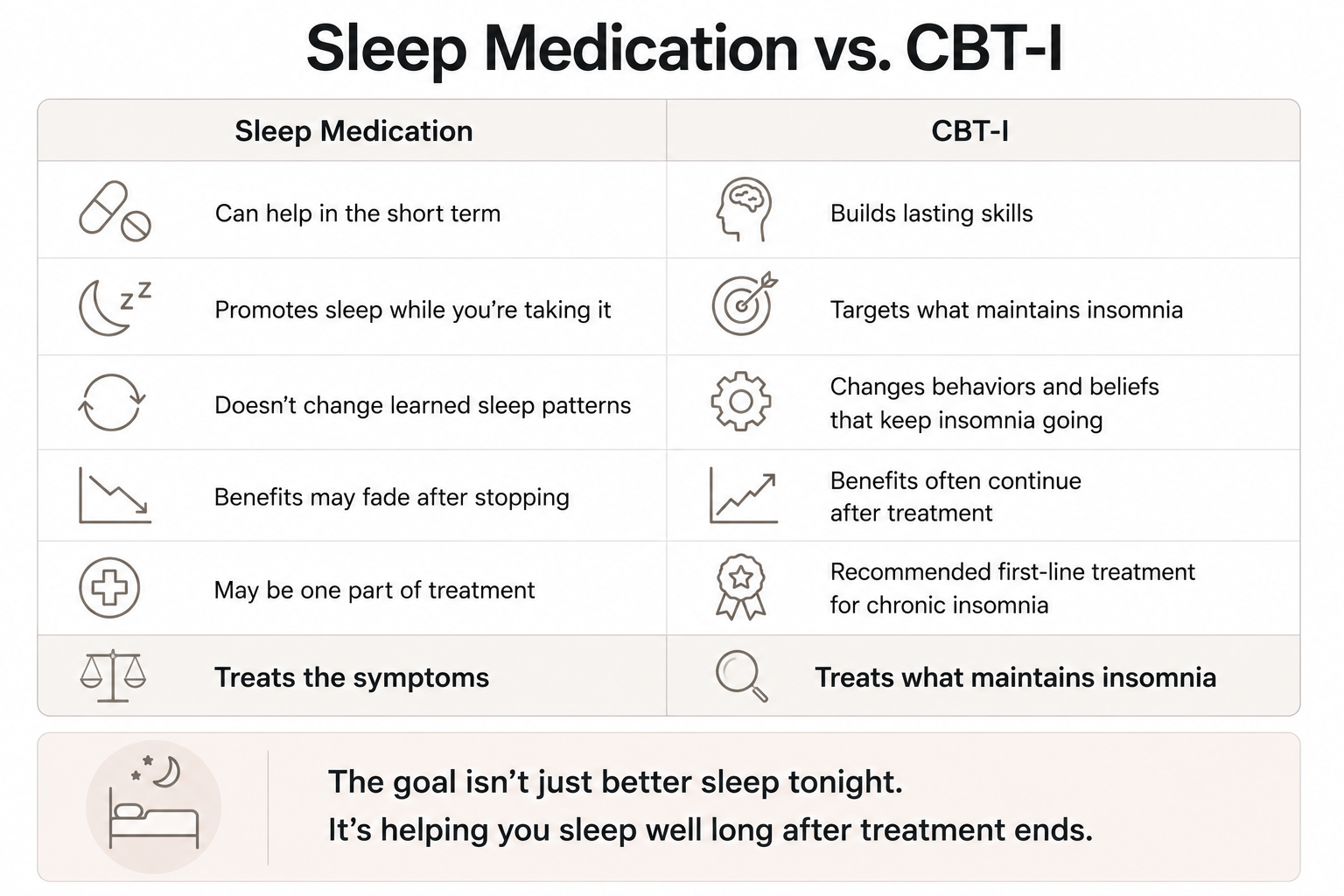
Sleep medication can be helpful for some people, particularly in certain situations or as part of a broader treatment plan. However, medication doesn’t directly address the behaviors, thought patterns, and conditioned wakefulness that often maintain chronic insomnia.
CBT-I focuses on those maintaining factors. For many people, the benefits continue after treatment ends, whereas sleep often becomes more difficult again when medication is discontinued if the underlying insomnia hasn’t been addressed.
Some people complete CBT-I while continuing sleep medication and later decide, together with the prescribing physician, whether reducing medication makes sense.
How Long Does CBT-I Take?
CBT-I is generally a relatively brief treatment. Many people complete treatment in about six to eight sessions, although the exact length depends on the person’s needs and progress. Some people notice improvements fairly quickly, while others experience more gradual progress as they consistently apply the strategies they learn.
It’s common for certain parts of treatment to feel challenging at first. For example, some interventions may temporarily increase fatigue before sleep begins improving. Understanding why these changes occur can make them easier to tolerate.
It’s also important to remember that progress isn’t always linear. Many people notice gradual improvement over time rather than waking up one morning sleeping perfectly. Occasional setbacks are a normal part of the process and don’t necessarily mean treatment isn’t working.
Does CBT-I Work for Everyone?
Like any treatment, CBT-I isn’t effective for everyone. For example, untreated sleep apnea, restless legs syndrome, certain medical conditions, medications, or inconsistent implementation of CBT-I strategies can all influence outcomes.
Some people improve substantially, while others experience more modest gains. Factors such as other sleep disorders, untreated medical conditions, medications, inconsistent participation, or significant life stress can influence outcomes.
A thorough evaluation helps determine whether CBT-I is likely to be an appropriate treatment and whether additional assessment or treatment may also be needed.
What Is the Goal of CBT-I?
Many people begin treatment hoping they’ll never have another sleepless night.
That’s not a realistic expectation for anyone. Even people who sleep well occasionally have difficult nights.
The goal of CBT-I isn’t perfect sleep. It’s helping people develop more consistent sleep, reduce the struggle around bedtime, feel less anxious about sleep, and become less dependent on strategies that unintentionally keep insomnia going. Over time, many people find that sleep becomes less of a nightly battle and more of a natural process again.
CBT-I for Insomnia in Arlington, VA
I provide Cognitive Behavioral Therapy for Insomnia (CBT-I) for adults struggling with chronic insomnia, difficulty falling asleep, nighttime awakenings, early morning waking, and sleep-related anxiety. Services are available in person and through teletherapy.
If you’re wondering whether CBT-I could help improve your sleep, contact me to learn more about treatment and whether it may be a good fit for your situation.
Related Articles
What Is CBT-I (Cognitive Behavioral Therapy for Insomnia)?
Why CBT-I Often Produces More Lasting Improvement Than Sleep Medication