
Why CBT-I Often Produces More Lasting Improvement Than Sleep Medication
When people have been struggling with insomnia for weeks, months, or years, sleep medication can understandably feel appealing. Many people are exhausted, frustrated, anxious about sleep, and desperate for relief.
Sleep medications can sometimes be helpful, particularly in the short term. Some people find that medication temporarily reduces nighttime anxiety or helps them fall asleep more quickly.
However, chronic insomnia is often maintained by more than the absence of sleep itself.
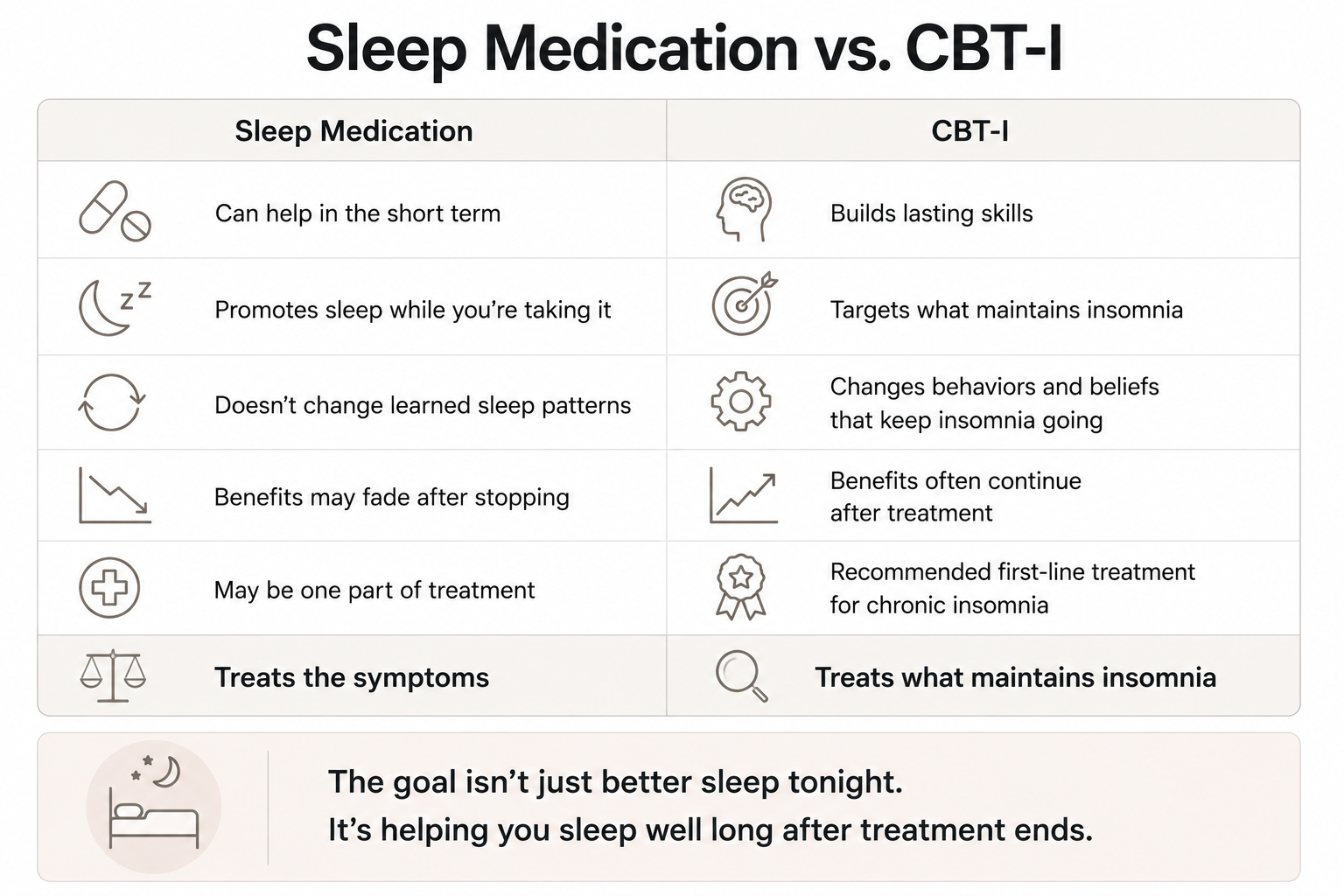
Chronic insomnia often becomes a self-reinforcing cycle involving sleep-related anxiety, hypervigilance, conditioned arousal, inconsistent sleep patterns, and behaviors that unintentionally keep insomnia going. CBT-I is designed to address these maintaining factors over time.
What Is CBT-I?
CBT-I, or Cognitive Behavioral Therapy for Insomnia, is an evidence-based treatment for chronic insomnia.
CBT-I is a structured behavioral treatment that targets the psychological and behavioral factors known to maintain insomnia over time.
Rather than simply trying to force sleep to happen, CBT-I focuses on changing the behavioral and psychological patterns that interfere with sleep and keep insomnia going.
Treatment may include improving sleep scheduling consistency, reducing excessive time awake in bed, addressing conditioned arousal, changing unhelpful sleep-related behaviors, reducing sleep-related anxiety and hyperfocus, and rebuilding confidence in the body’s ability to sleep.
CBT-I is considered the first-line treatment for chronic insomnia by multiple medical and sleep organizations.
Why Sleep Medication Sometimes Stops Helping
Sleep medication may temporarily improve symptoms without fully changing the underlying insomnia cycle.
Even while taking medication, a person may continue worrying excessively about sleep, spending long periods awake in bed, sleeping inconsistently, monitoring sleep constantly, and trying harder and harder to force sleep.
Over time, some people notice that medication becomes less effective, anxiety about sleep remains high, insomnia returns when medication is stopped, or fear of not sleeping increases.
This doesn’t mean medication has “failed.” It often means the processes maintaining chronic insomnia are still active underneath the surface.
Chronic Insomnia Is Often Maintained by Learned Patterns
One of the most important concepts in CBT-I is that chronic insomnia frequently becomes conditioned over time.
Many people gradually begin associating bedtime, the bedroom, and nighttime awakenings with frustration, alertness, anxiety, monitoring, and pressure to sleep.
The brain gradually learns:
Bed is a place where I struggle to sleep.
As this conditioned arousal strengthens, the nervous system may become increasingly activated at bedtime even when the person feels physically exhausted.
CBT-I works partly by helping reverse these learned patterns.
CBT-I Often Produces More Durable Improvement
One reason Cognitive Behavioral Therapy for Insomnia I often produces more lasting improvement is that treatment focuses on changing the patterns maintaining insomnia rather than only temporarily reducing symptoms.
Research has shown that CBT-I can improve sleep onset, nighttime awakenings, sleep efficiency, sleep quality, and confidence around sleep.
Importantly, many people continue benefiting after treatment ends because they have developed a different relationship with sleep itself. The goal isn’t perfect sleep every night. No one sleeps perfectly all the time.
Instead, treatment focuses on helping sleep become less effortful, less anxiety-driven, and less central to daily emotional functioning.
CBT-I and Sleep Medication Aren’t Always Opposed
Cognitive Behavioral Therapy for Insomnia and sleep medication aren’t necessarily mutually exclusive.
Some people participate in CBT-I while taking medication, and decisions about medication should always be discussed with the prescribing physician.
The goal of CBT-I isn’t to shame people for using medication. Instead, treatment focuses on helping people build more stable, sustainable sleep patterns and reduce the cycle of chronic insomnia over time.
CBT-I for Chronic Insomnia in Arlington, VA
I provide CBT-I for adults struggling with chronic insomnia, sleep anxiety, nighttime hyperarousal, and persistent sleep difficulties in Arlington, VA. Services are available in person and through teletherapy.
Treatment focuses on helping people gradually step out of cycles of sleep-related anxiety and frustration and build healthier, more sustainable sleep patterns over time.
If you’re tired of being tired, I’d be happy to discuss how CBT-I can help.
Related Articles
What Is CBT-I (Cognitive Behavioral Therapy for Insomnia)?
Why Can’t I Sleep Even When I’m Exhausted?
Why Sleep Hygiene Alone Isn’t Always Enough