
Why Early Evaluation for Learning Difficulties Can Matter
Parents sometimes wonder whether a child will simply “grow out of” academic struggles or whether difficulties with reading, writing, attention, organization, or school performance warrant a more comprehensive evaluation.
In many cases, students with learning difficulties are intelligent, motivated, and working very hard. Some compensate successfully for years before academic demands increase beyond what their coping strategies can support.
As a result, struggles are sometimes recognized later than expected.
Difficulties Aren’t Always Immediately Obvious
Learning disabilities don’t always look like failing grades.
Some students:
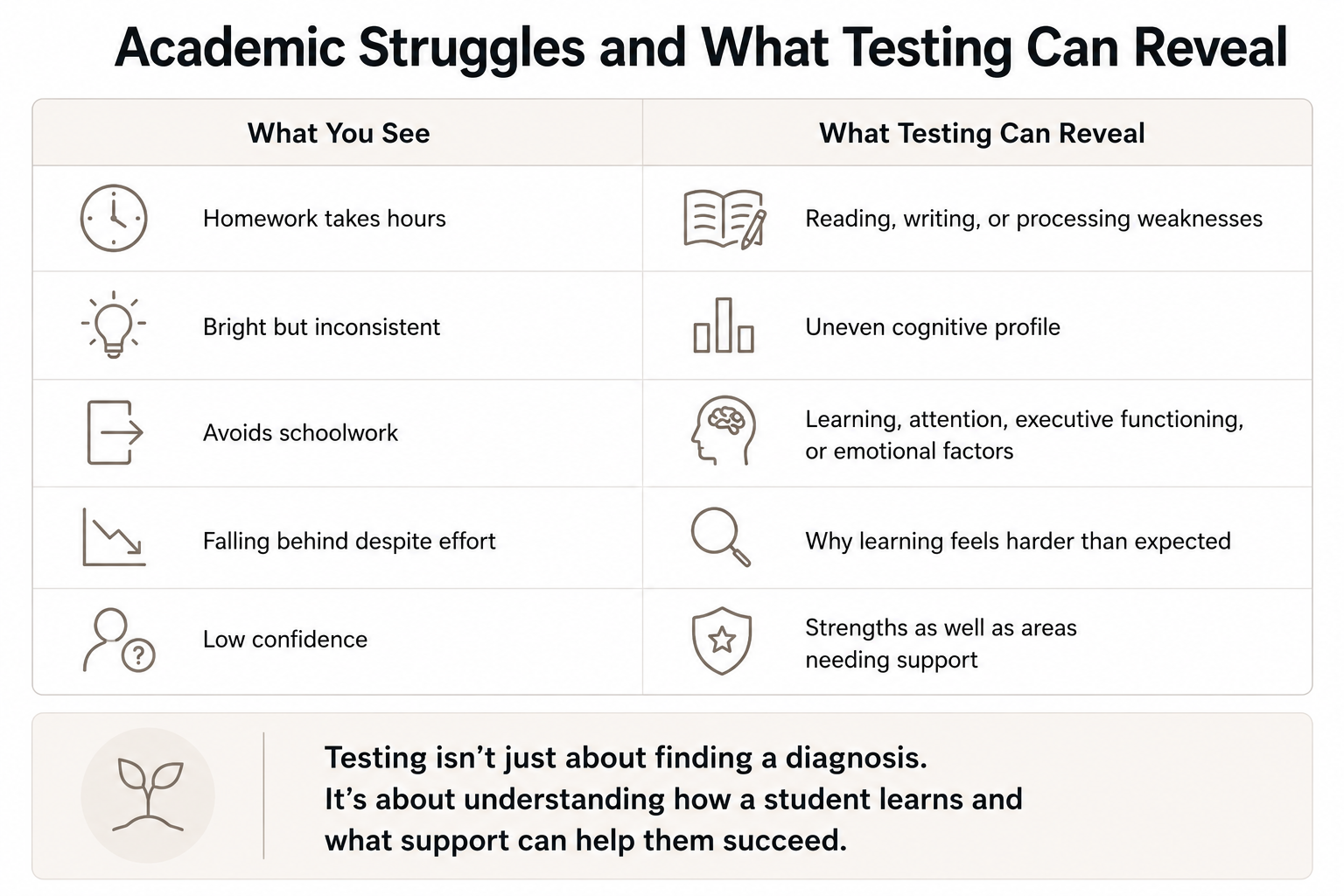
work extremely hard to maintain average performance
become overwhelmed by homework demands
avoid reading or writing tasks
experience increasing anxiety around school
appear inconsistent academically
struggle with organization and executive functioning
seem bright verbally but have difficulty demonstrating knowledge academically
Because many students compensate well initially, underlying difficulties may not become fully apparent until academic demands increase.
Earlier Understanding Can Reduce Confusion and Self-Blame
When students repeatedly struggle without understanding why, they may begin assuming:
Over time, repeated struggles without an explanation can contribute to anxiety, frustration, lowered self-esteem, school avoidance, and emotional distress.
Over time, this can contribute to:
frustration
lowered self-esteem
school avoidance
emotional distress
Comprehensive evaluation can provide a clearer understanding of how a student learns, where difficulties are occurring, which supports may be most helpful, and whether learning, attention, executive functioning, or emotional factors may be contributing.
Testing Isn’t Just About a Diagnosis
Psychoeducational testing isn’t about assigning labels.
The goal is usually to better understand patterns of strengths and weaknesses so that interventions and support can be more appropriately tailored to the individual student.
Results may help guide academic accommodations, intervention planning, executive functioning supports, school recommendations, standardized testing accommodations, and treatment recommendations.
Testing can also help identify important strengths that may otherwise be overlooked when difficulties become the primary focus.
Psychoeducational Testing in Arlington, VA
I provide comprehensive psychoeducational evaluations in Arlington, VA for children, adolescents, and young adults experiencing academic, attentional, executive functioning, emotional, or learning-related concerns.
Evaluations are designed to provide a nuanced understanding of how a student learns, where difficulties may be occurring, and what supports may be most helpful moving forward.
If your child is struggling and you’re unsure why, testing may help identify factors contributing to those difficulties. Get in touch to schedule a consultation.
Related Articles
Understanding Psychological and Psychoeducational Testing
What is Phonological Dyslexia?