
What Is Orthographic Dyslexia?
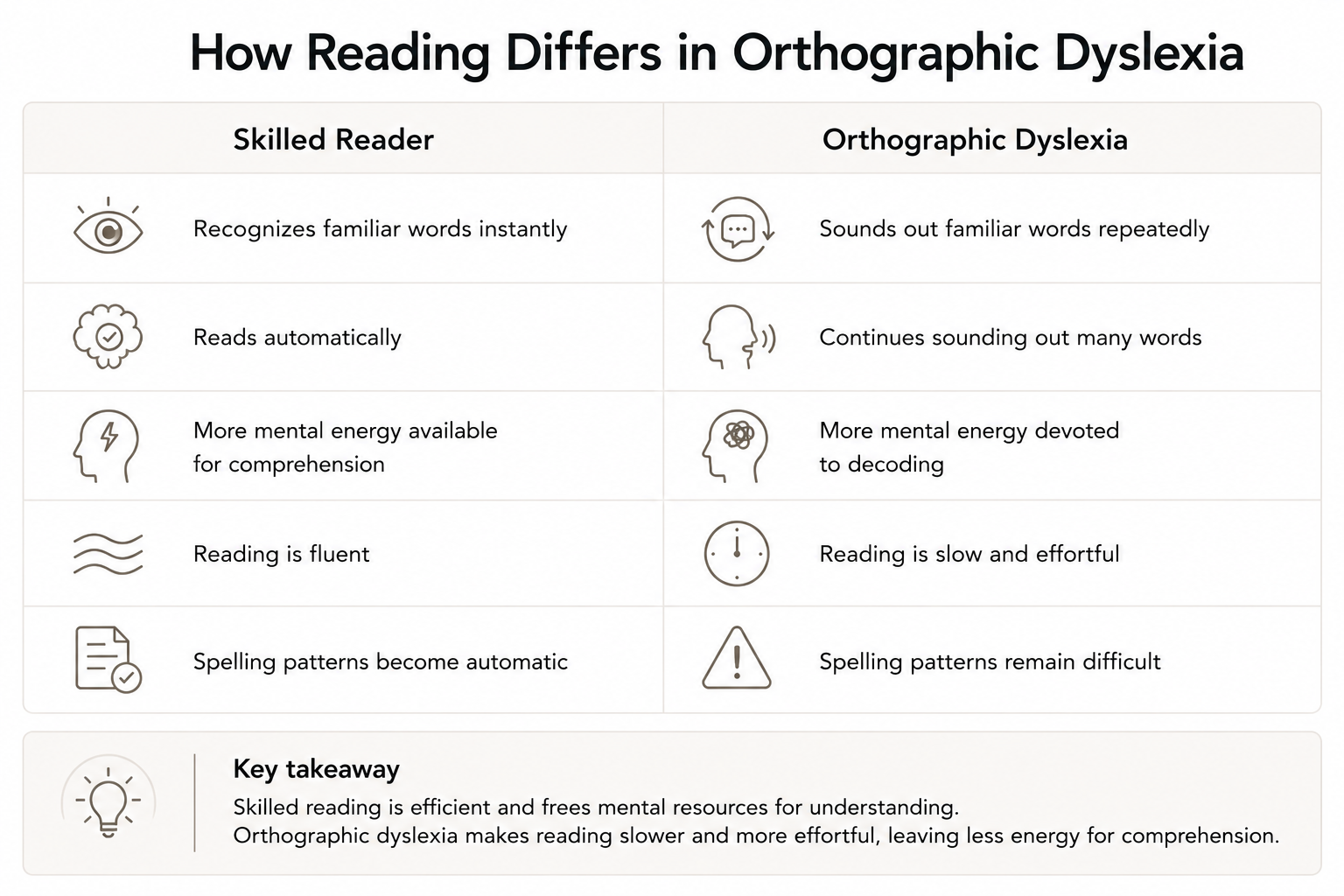
Some people with dyslexia can sound out words reasonably well but still read slowly, laboriously, or inconsistently. They may spend enormous effort decoding words one sound at a time, struggle to recognize familiar words automatically, or continue making spelling mistakes long after repeated exposure to the same words.
This pattern is sometimes referred to as orthographic dyslexia.
Individuals with orthographic dyslexia are often capable, intelligent learners who can eventually figure words out, but reading may remain inefficient, effortful, and mentally exhausting.
What Does “Orthographic” Mean?
Orthographic processing refers to the brain’s ability to recognize, store, and retrieve written word patterns efficiently.
As reading skills develop, most readers gradually build a large internal “library” of familiar word forms. This allows words to be recognized rapidly and automatically without needing to sound each one out letter by letter.
For example, skilled readers typically recognize familiar words such as because, enough, friend, and through almost instantly. They don’t consciously decode each sound every time they encounter these words. Individuals with orthographic weaknesses often have difficulty developing this automatic recognition system efficiently.
They don’t consciously decode every sound each time. Individuals with orthographic weaknesses often have difficulty developing this automatic recognition system efficiently.
What Is Orthographic Dyslexia?
Orthographic dyslexia is often used to describe a pattern of reading difficulty involving weaknesses in recognizing and retaining written word forms automatically.
Individuals with this pattern may:
rely heavily on sounding words out
read slowly and effortfully
struggle with rapid word recognition
have difficulty remembering spelling patterns
read accurately but inefficiently
expend substantial mental energy during reading
Reading may be accurate but feel exhausting and slow.
Common Signs of Orthographic Dyslexia
Signs may include:
slow reading speed
laborious reading
weak sight-word recognition
difficulty recognizing familiar words quickly
poor spelling
inconsistent spelling of the same word
needing repeated exposure to learn written words
fatigue during reading tasks
avoiding reading-heavy work
Some individuals read carefully and accurately but cannot achieve fluency or automaticity comparable to peers.
Parents and teachers often describe these students as working incredibly hard but reading much more slowly than expected. They may sound articulate and knowledgeable in conversation yet struggle with reading efficiency, understand material better when it is read aloud, and spend far longer than their peers completing reading assignments.
Why Reading Becomes So Exhausting
Reading fluency depends heavily on automatic word recognition. When written words do not become automatic efficiently, the brain must continue dedicating significant effort to decoding and identifying words individually.
As a result, reading often becomes slower and more mentally demanding. Fatigue accumulates quickly, comprehension may decline during longer reading assignments because so much effort is devoted to decoding, and keeping up with academic reading can become increasingly difficult. Over time, many students become frustrated and begin avoiding reading whenever possible.
The person may understand the material well but become overwhelmed by the amount of effort required to access it through reading.
Orthographic Dyslexia and Spelling
As a result, reading often becomes slower and more mentally demanding. Fatigue accumulates quickly, comprehension may decline during longer reading assignments because so much effort is devoted to decoding, and keeping up with academic reading can become increasingly difficult. Over time, many students become frustrated and begin avoiding reading whenever possible.
For example, a student may write:
“frend” for “friend”
“enuf” for “enough”
Even after repeated correction, the written pattern may be much slower to become automatic.
Orthographic Dyslexia vs. Phonological Dyslexia
Orthographic dyslexia and phonological dyslexia often overlap, but they involve somewhat different patterns of difficulty.
Individuals with phonological dyslexia typically struggle with sounding out words, manipulating sounds within words, and decoding unfamiliar words. Individuals with orthographic dyslexia may be able to sound out words adequately but have difficulty recognizing words quickly and automatically, remembering spelling patterns, and developing reading fluency.
Some individuals have weaknesses in both areas. A comprehensive evaluation can help clarify the specific reading processes involved and guide appropriate intervention.
A comprehensive evaluation helps clarify the specific reading processes involved. Two students may both carry a diagnosis of dyslexia while showing very different patterns of strengths and weaknesses. Understanding those differences can help guide intervention and accommodations.
Bright Students Often Compensate for Years
Orthographic dyslexia is sometimes missed because bright students can compensate effectively for a long time. They may memorize words through repeated exposure, rely heavily on context clues, use strong reasoning and language skills to support reading, and spend enormous amounts of extra time on reading tasks.
As a result, these students may appear successful academically while privately experiencing significant reading fatigue, slow homework completion, chronic frustration, avoidance of reading, or feelings of inadequacy despite strong intelligence and effort.
Difficulties often become more noticeable in middle school, high school, college, or graduate-level work as reading demands increase substantially.
Orthographic Dyslexia and ADHD
Orthographic dyslexia may co-occur with attention-deficit/hyperactivity disorder.
Attention and executive functioning weaknesses can further reduce reading stamina, interfere with sustained attention during reading, tax working memory, make it harder to complete lengthy assignments efficiently, and further reduce reading fluency. Some individuals have both dyslexia and ADHD, creating a more complex academic profile.
Some individuals have both dyslexia and ADHD, which can create a more complicated academic profile.
How Orthographic Dyslexia Is Evaluated
A comprehensive psychoeducational evaluation may assess:
reading fluency
decoding
word recognition
spelling
orthographic processing
phonological processing
cognitive functioning
attention and executive functioning
academic achievement
The goal isn’t simply to determine whether dyslexia is present, but to understand how reading is breaking down and which interventions are likely to help.
Supports for Orthographic Dyslexia
Interventions and supports may include:
structured literacy instruction
repeated practice with word patterns
fluency-building interventions
explicit spelling instruction
audiobooks or text-to-speech tools
extended time
reduced reading load in some situations
organizational and executive functioning supports when needed
standardized testing accommodations
Many individuals benefit substantially once their reading profile is properly understood and supported.
Psychoeducational Evaluations in Arlington, VA
I provide thorough psychoeducational evaluations in Arlington for children, adolescents, and adults with concerns related to dyslexia, ADHD, learning disorders, executive functioning, and academic difficulties.
Evaluations are designed to clarify patterns of strengths and challenges, identify factors contributing to reading and learning difficulties, and provide individualized recommendations to support long-term academic success and confidence.
If you’d like to learn more about testing or discuss whether I’d be a good fit, reach out to schedule a consultation.
Related Articles
Understanding Psychological and Psychoeducational Testing
Learning Disabilities: Signs, Testing, and Support
What is Phonological Dyslexia?
Why Early Evaluation for Learning Difficulties Can Matter
What Psychoeducational Testing Can Reveal About Learning and Attention