ADHD or Anxiety: How Can You Tell the Difference?
Many people wonder whether difficulties with focus, organization, restlessness, procrastination, or overwhelm are caused by ADHD, anxiety, or both.
Both can affect concentration, memory, task completion, sleep, emotional regulation, productivity, and performance at school or work. At the same time, the underlying reasons for these difficulties are often very different.
At the same time, the underlying reasons for these difficulties are often very different.
Understanding those differences can help guide more effective treatment and support.
How Anxiety Can Affect Attention
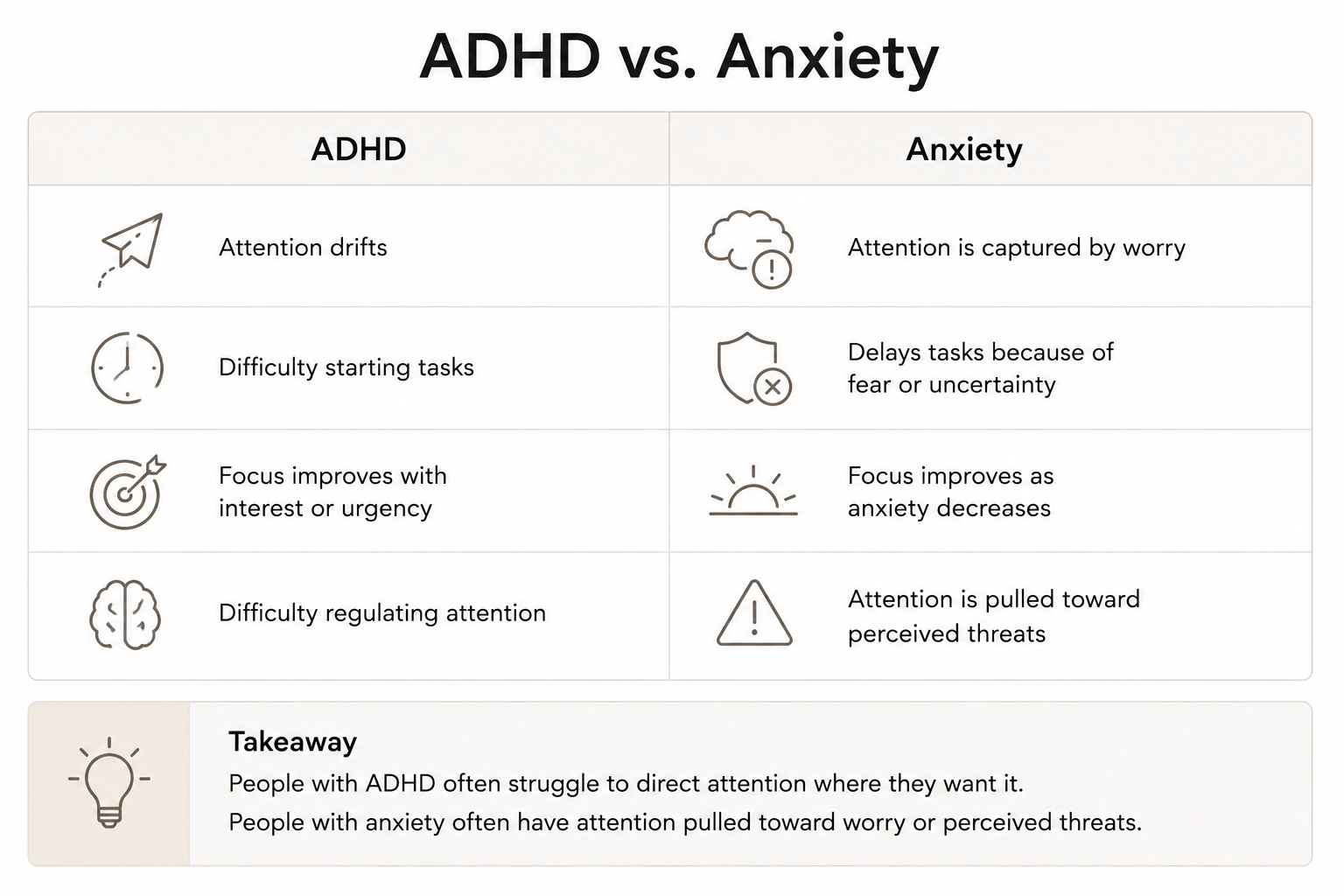
When someone is anxious, the brain often becomes highly focused on perceived threats, worries, uncertainty, or internal distress.
A person experiencing anxiety may overthink decisions, mentally rehearse conversations, become preoccupied with “what if” scenarios, struggle to disengage from worry, avoid tasks that feel overwhelming, or find it difficult to concentrate because attention is repeatedly pulled toward anxious thoughts.
Many anxious people describe:
I can focus, but my brain won’t stop worrying.
In these situations, attention problems may improve when anxiety decreases.
How ADHD Affects Attention
ADHD is generally not caused by excessive worry. Instead, it involves differences in executive functioning and self-regulation that affect the ability to consistently direct and sustain attention.
People with ADHD may have difficulty initiating tasks, staying organized, managing time, holding information in working memory, sustaining attention on less stimulating activities, regulating focus, and controlling impulsive behavior.
Interestingly, many people with ADHD can focus extremely well when a task is highly stimulating, urgent, emotionally engaging, novel, or fast-paced. The greatest difficulties often arise when tasks are repetitive, administrative, delayed, or offer little immediate reward.
People with ADHD often describe experiences such as:
I know what I need to do, but I can’t get myself to start.
ADHD and Anxiety Often Overlap
ADHD and anxiety frequently occur together.
Someone with ADHD may develop anxiety after years of missed deadlines, disorganization, inconsistent performance, academic struggles, negative feedback, and chronic overwhelm. At the same time, chronic anxiety can also create difficulties with concentration, memory, sleep, and executive functioning.
Over time, the two can become difficult to separate without a more comprehensive evaluation.
Why It Can Be Difficult to Tell the Difference
Looking only at surface behaviors can sometimes be misleading.
Looking only at surface behaviors can be misleading. For example, procrastination may reflect executive functioning difficulties, anxiety, perfectionism, avoidance, or some combination of these factors. Distractibility may stem from external stimulation, intrusive worry, sleep deprivation, or problems regulating attention. Likewise, restlessness may reflect hyperactivity, nervous system arousal, stress, or emotional distress.
This is one reason comprehensive psychological evaluation can sometimes be helpful.
How Psychological Testing Can Help
Comprehensive psychological or psychoeducational evaluation may help clarify:
attentional functioning
executive functioning
anxiety symptoms
emotional factors
cognitive patterns
behavioral patterns
Testing does not simply look at whether someone appears inattentive. Instead, the goal is often to understand:
why the difficulties are occurring
which factors may be contributing
how different areas of functioning interact with one another
This can help guide treatment recommendations, accommodations, and support strategies more effectively.
ADHD and Anxiety Evaluations in Arlington, VA
I provide comprehensive psychological and psychoeducational evaluations in Arlington, VA for children, adolescents, and adults experiencing attention difficulties, anxiety, executive functioning challenges, academic concerns, and related difficulties.
Evaluations are designed to provide a nuanced understanding of how cognitive, emotional, attentional, and behavioral factors may be interacting, with the goal of helping individuals better understand their strengths, challenges, and treatment needs over time.
If you’d like to learn more about treatment or discuss whether I’d be a good fit, reach out to schedule a consultation.
Related Articles
Understanding Psychological and Psychoeducational Testing
My Child Gets Good Grades. Could They Still Have ADHD?