
What is Dysgraphia?
Dysgraphia is a learning disorder that affects written output.
Writing difficulties can arise for different reasons. For some, handwriting and written production are the primary concerns. For others, weaknesses in spelling, language formulation, executive functioning, attention, or other underlying skills contribute to the difficulty. Understanding the source of the problem is often an important part of effective intervention.
The term dysgraphia is often used broadly to describe significant weaknesses in areas such as:
messy or slow handwriting
poor spelling
difficulty organizing thoughts in writing
difficulty translating ideas into written form
limited written output despite strong verbal skills
frustration, fatigue, or avoidance related to writing
People with dysgraphia often demonstrate a mismatch between their verbal abilities and their written output. For example, someone may explain ideas eloquently in conversation but struggle to produce those same ideas effectively in writing.
Common Signs of Dysgraphia
Dysgraphia can look different from person to person, but common signs may include:
messy or inconsistent handwriting
unusually slow writing speed
difficulty organizing thoughts in writing
poor spelling
incomplete sentences
limited written output despite strong verbal skills
difficulty getting ideas onto paper
avoidance of writing tasks
excessive frustration during writing
fatigue during written work
Parents and teachers often notice a mismatch between how sophisticated someone sounds verbally and how limited or disorganized their written work appears. For example, someone may explain ideas eloquently in conversation but produce only a few brief or poorly organized sentences when asked to write.
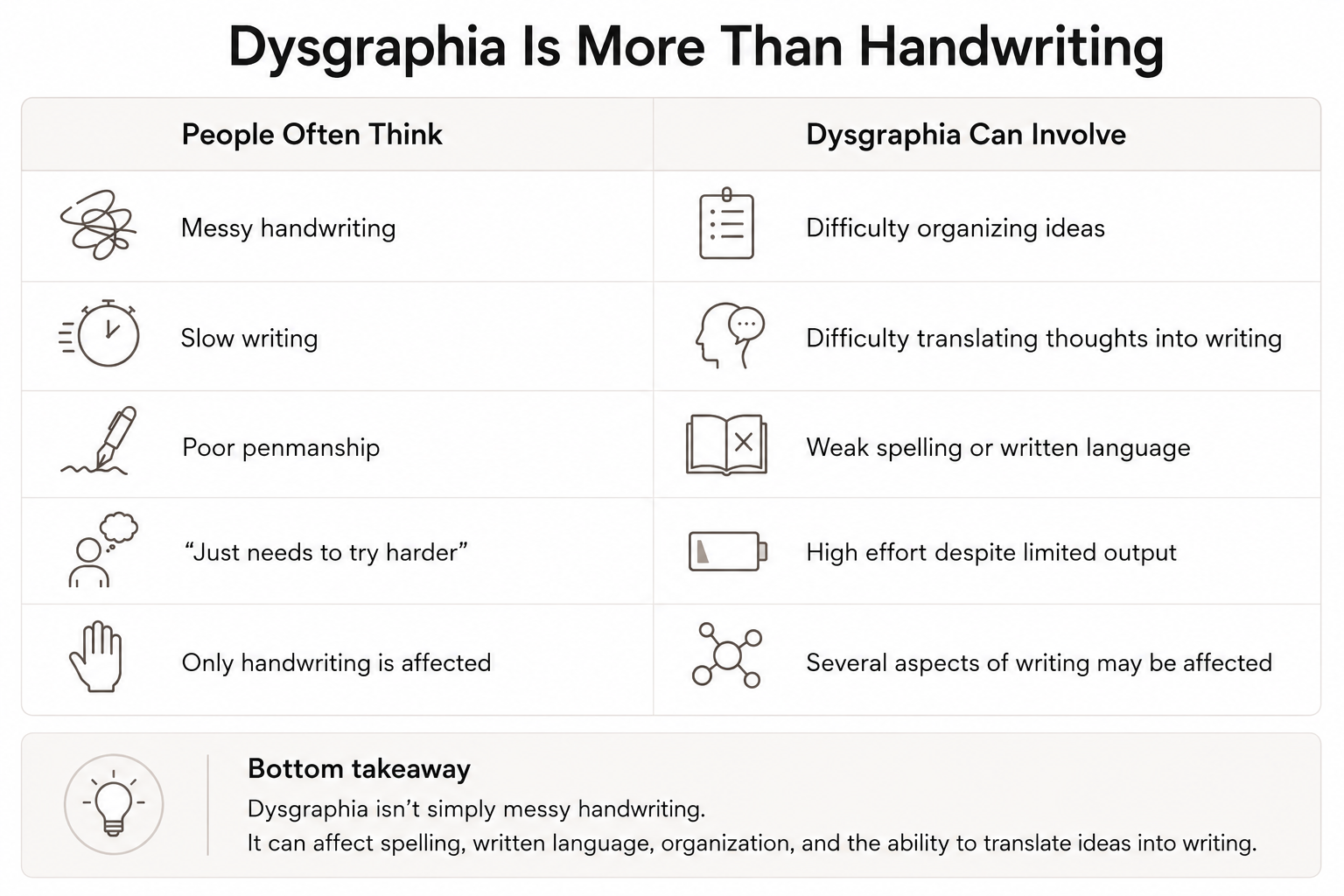
Dysgraphia Isn’t Just Bad Handwriting
Handwriting difficulties can be one part of dysgraphia, but dysgraphia is often broader than penmanship alone.
Some individuals primarily struggle with letter formation, spacing, legibility, or fine motor control. Others have relatively neat handwriting but continue to experience significant difficulty organizing ideas, generating written language, constructing sentences, sustaining written output, or managing spelling and grammar.
Someone may know exactly what they want to say but become overwhelmed by the process of translating thoughts into written form.
Why Writing Can Feel So Overwhelming
Writing places heavy demands on working memory and executive functioning. While writing, people may need to generate ideas, organize thoughts, remember spelling rules, form letters, structure sentences, monitor grammar, plan ahead, and maintain attention all at the same time.
For individuals with dysgraphia, these demands can overload cognitive resources quickly. As a result, writing may become painfully slow, mentally exhausting, emotionally frustrating, and increasingly avoided.
Some begin believing they are unintelligent simply because written work fails to reflect what they actually know.
Dysgraphia and ADHD
Dysgraphia frequently co-occurs with attention-deficit/hyperactivity disorder. Attention and executive functioning weaknesses can further affect planning, organization, sustained effort, working memory, task initiation, and editing or proofreading.
Individuals with both ADHD and dysgraphia may struggle not only with the mechanics of writing, but also with beginning writing tasks, maintaining focus, and organizing ideas coherently.
Dysgraphia and Dyslexia
Dysgraphia may also overlap with dyslexia. For example, a person with dyslexia may struggle with spelling, written word retrieval, and sentence fluency while also experiencing separate difficulties involving written expression or handwriting organization.
Comprehensive evaluation helps clarify which underlying processes are contributing to the writing difficulties.
Emotional Effects of Dysgraphia
Writing struggles often affect more than academics. People with dysgraphia frequently experience frustration, embarrassment, low confidence, anxiety about writing, and increasing avoidance of tasks that require written output.
Because writing is required across subjects, people may spend far more time completing assignments than their peers while still producing work that appears incomplete or disorganized.
Some begin avoiding advanced classes or opportunities simply because the writing demands feel overwhelming.
Many Bright People Compensate for Years
Many bright people compensate for dysgraphia for years. They may verbally explain ideas instead of writing them, memorize information rather than take notes, avoid longer writing assignments, rely heavily on support from others, or expend enormous effort to keep up with academic or workplace demands.
Because these strategies can be effective for a time, writing difficulties aren’t always recognized immediately. As demands increase, however, compensatory strategies may become less effective. Difficulties often become more apparent in middle school, high school, college, graduate school, or the workplace, when tasks require more independent organization, longer written responses, and greater written output.
How Dysgraphia Is Evaluated
A comprehensive psychoeducational or psychological evaluation may assess writing skills, including written expression, spelling, handwriting fluency, sentence construction, and organization of ideas. Evaluations also often examine cognitive functioning, attention, executive functioning, fine motor skills, and academic achievement.
If you’re considering an evaluation and aren’t sure where to start, I’d be happy to answer your questions and discuss the process.
Supports for Dysgraphia
Recommendations vary depending on the individual profile but may include:
assistive technology
structured writing instruction
extended time
executive functioning supports
occupational therapy
other interventions tailored to the individual’s needs
With appropriate support, individuals with dysgraphia are able to express their knowledge and ideas far more effectively.
Psychoeducational Evaluations in Arlington, VA
I provide comprehensive psychoeducational evaluations in Arlington for children, adolescents, and adults with concerns related to dysgraphia, dyslexia, ADHD, executive functioning, and academic difficulties.
Evaluations are designed to clarify patterns of strengths and challenges, identify factors contributing to writing and learning difficulties, and provide individualized recommendations to support long-term academic and functional success.
If you’re looking for answers rather than more guesswork, psychological testing may help. Contact me to learn more.
Related Articles
Understanding Psychological and Psychoeducational Testing
Learning Disabilities: Signs, Testing, and Support