
What Causes Chronic Insomnia?
At first, you assume it’s temporary. Maybe work has been unusually stressful, you’ve been sick, your schedule has changed, or you’re going through a difficult time. You expect that once life settles down, your sleep will return to normal.
But weeks or even months later, you’re still lying awake. Instead of worrying only about work, your health, or the stressful event that started it all, you find yourself worrying about sleep itself.
Now bedtime feels different. You watch the clock. You wonder how you’ll function tomorrow. You try harder to fall asleep, but the harder you try, the more awake you seem to become.
If this sounds familiar, you may wonder what causes chronic insomnia and why you still can’t sleep even though the original problem has passed.
Acute Insomnia vs. Chronic Insomnia
Most people experience short-term insomnia at some point. A stressful event, illness, travel, or major life change can temporarily disrupt sleep. Once the situation improves, sleep often returns to normal without treatment.
Chronic insomnia is different.
Instead of resolving after the original problem has passed, difficulty falling asleep, staying asleep, or waking too early continues for months or even years. The question is no longer, “What started this?” but “What’s keeping it going?”
Medical conditions, certain medications, and other sleep disorders can also contribute to insomnia. A comprehensive evaluation can help determine whether additional assessment or treatment is needed alongside CBT-I.
The Three Factors That Contribute to Chronic Insomnia
Researchers now understand that chronic insomnia usually isn’t caused by a single factor. Instead, it often develops through a combination of vulnerabilities, life events, and learned patterns that keep sleep problems going.
Researchers often explain chronic insomnia using the 3P Model, which describes three types of factors that influence sleep.
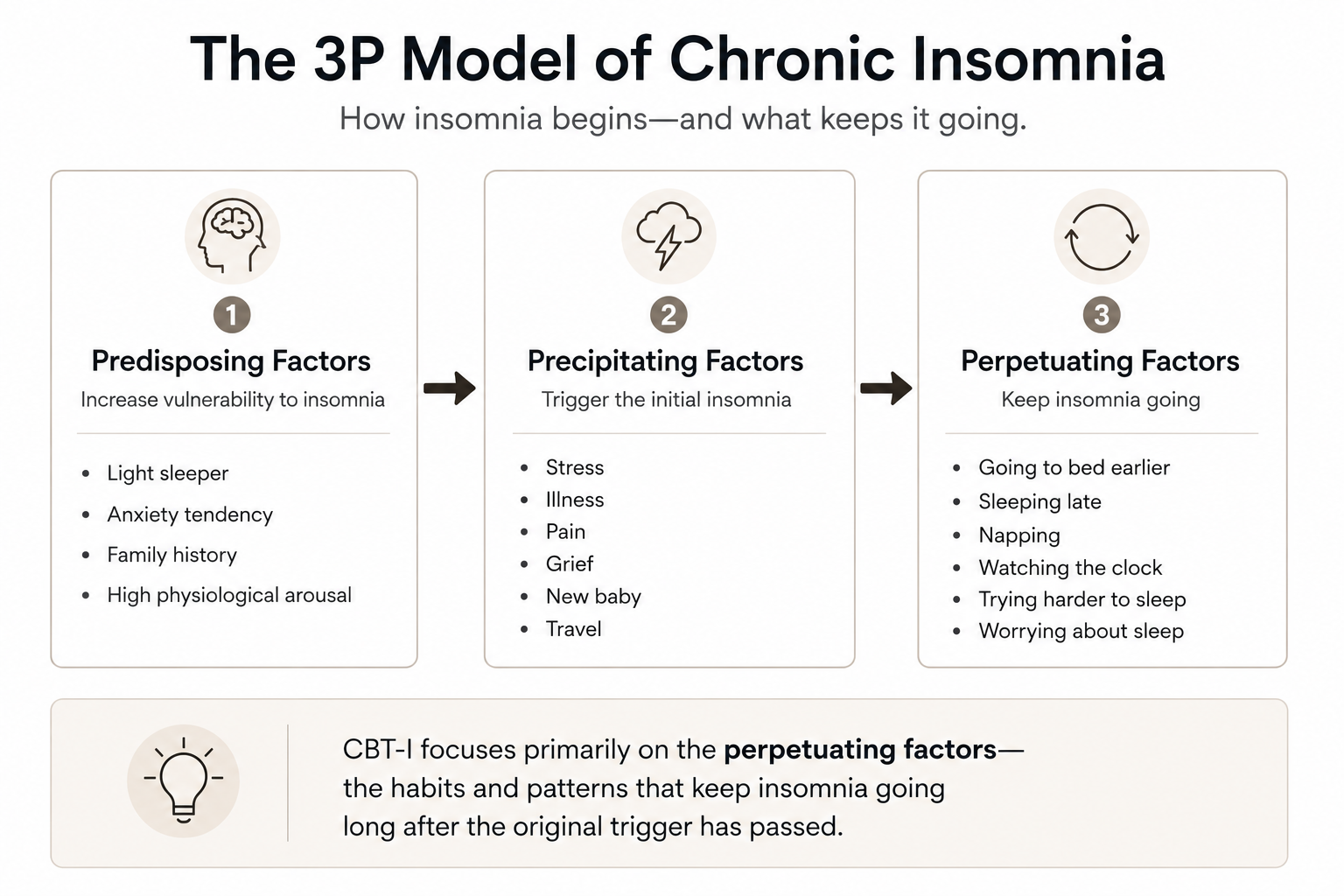
Predisposing Factors
Some people are naturally more vulnerable to developing insomnia than others.
For example, a woman who has always been a light sleeper may be more likely to develop insomnia after a stressful life event than someone who sleeps soundly under almost any circumstances. A man with a tendency toward anxiety may also be more sensitive to temporary disruptions in sleep.
Predisposing factors don’t cause chronic insomnia by themselves, but they can make someone more susceptible when stress occurs.
Precipitating Factors
A precipitating factor is the event that triggers the initial sleep problem.
Common examples include:
Work stress
Anxiety or depression
Medical illness or pain
Pregnancy or caring for a newborn
Grief or loss
Travel or jet lag
Changes in work schedule
During these situations, sleeping poorly is a normal response. Most people expect that once life returns to normal, sleep will too.
Usually it does. Sometimes it doesn’t.
Perpetuating Factors
This is where chronic insomnia often develops.
After several nights of poor sleep, many people understandably begin changing their behavior in an effort to get more rest. They may go to bed earlier, sleep later in the morning, spend extra time awake in bed hoping to fall asleep, cancel evening activities because they’re tired, or nap during the day. Some people also begin sleeping in on weekends or after a particularly bad night in an effort to “catch up” on lost sleep.
They may also begin monitoring sleep closely. Every awakening feels like evidence that something is wrong with their sleep. They calculate how many hours remain before morning, wonder how they’ll function the next day, or become frustrated that sleep isn’t happening.
These reactions are completely understandable.
Unfortunately, many of them unintentionally teach the brain to associate the bed with wakefulness, frustration, effort, and worry rather than sleep. Over time, the original trigger becomes less important than the habits and learned associations that now keep insomnia going.
Why Trying Harder to Sleep Often Backfires
Sleep is unusual because it isn’t something we can force.
Most people have experienced drifting off while reading or watching television without trying to fall asleep. In contrast, actively trying to make sleep happen often increases alertness. It’s similar to trying to force yourself to fall asleep on an airplane after deciding you absolutely have to sleep. The effort itself often keeps you awake.
The more important sleep begins to feel, the more closely many people monitor whether they’re succeeding. Ironically, this increased effort can make sleep even more difficult.
This doesn’t mean insomnia is “all in your head.” It means that the brain’s natural sleep system works best when it isn’t being closely monitored or forced.
Does Stress Cause Chronic Insomnia?
Stress is one of the most common triggers for insomnia, but it isn’t always what keeps insomnia going.
Many people can identify exactly when their sleep problems began, yet months later the original stressor has resolved while the insomnia remains. By that point, the brain may have learned to associate bedtime itself with wakefulness, frustration, and effort rather than sleep.
Understanding this distinction helps explain why treating the original stressor alone doesn’t always resolve chronic insomnia.
How CBT-I Addresses Chronic Insomnia
Cognitive Behavioral Therapy for Insomnia (CBT-I) focuses on the factors that maintain insomnia rather than simply the event that started it.
Treatment helps people rebuild a strong association between bed and sleep, reduce behaviors that unintentionally interfere with sleep, and gradually restore confidence in the body’s natural ability to sleep. Rather than teaching people to force sleep, CBT-I helps restore the conditions under which sleep is most likely to occur naturally.
Rather than continuing to search for the original cause of insomnia, CBT-I focuses on changing the factors that are keeping it going today.
CBT-I for Chronic Insomnia in Arlington, VA
I provide Cognitive Behavioral Therapy for Insomnia (CBT-I) for adults experiencing chronic insomnia. Services are available in person and through teletherapy.
If you’ve been struggling with insomnia that isn’t improving on its own, contact me to learn more about evidence-based treatment.