
What Is Sensorimotor OCD? (Somatic OCD)
It started with something you normally never noticed.
Maybe you suddenly became aware of your breathing and couldn’t stop paying attention to it. Perhaps you noticed yourself swallowing, blinking, or the feeling of your tongue resting in your mouth. Now it seems impossible not to notice.
You keep wondering:
What if I never stop paying attention to this?
What if this used to happen automatically and now it doesn’t?
Will I have to think about my breathing for the rest of my life?
The more you try to ignore it, the more noticeable it becomes.
Many people first search for phrases like “breathing OCD” or “I can’t stop noticing my breathing” before learning that this experience is often called sensorimotor OCD, or somatic OCD.
For people with sensorimotor OCD, also called somatic OCD, ordinary bodily sensations or automatic bodily processes become the focus of obsessive attention. The problem isn’t the bodily sensation itself. It’s becoming trapped in the awareness of it and fearing that you’ll never be able to stop noticing it.
What Is Sensorimotor OCD?
Sensorimotor OCD, sometimes called somatic OCD, is a subtype of obsessive compulsive disorder in which a person becomes intensely aware of bodily sensations or automatic bodily functions that most people notice only occasionally.
Common examples include:
breathing
swallowing
blinking
saliva
the position of the tongue
eye movements
the feeling of clothing against the skin
awareness of heartbeat
floaters in vision
the feeling of saliva in the mouth
Everyone notices these sensations from time to time. In sensorimotor OCD, however, the person becomes preoccupied with the awareness itself.
The sensations themselves are normal bodily experiences. What changes is the person’s relationship to them.
Sensorimotor OCD is one of many OCD themes. Although the obsessions focus on normal bodily sensations and automatic bodily processes, obsessive compulsive disorder can also center on contamination, harm, relationships, health, morality, or many other topics. Learn more in Types of OCD: Understanding Different OCD Themes.
Why Does It Become So Distressing?
At first, the awareness often seems harmless.
Then a question appears.
What if I can’t stop noticing this?
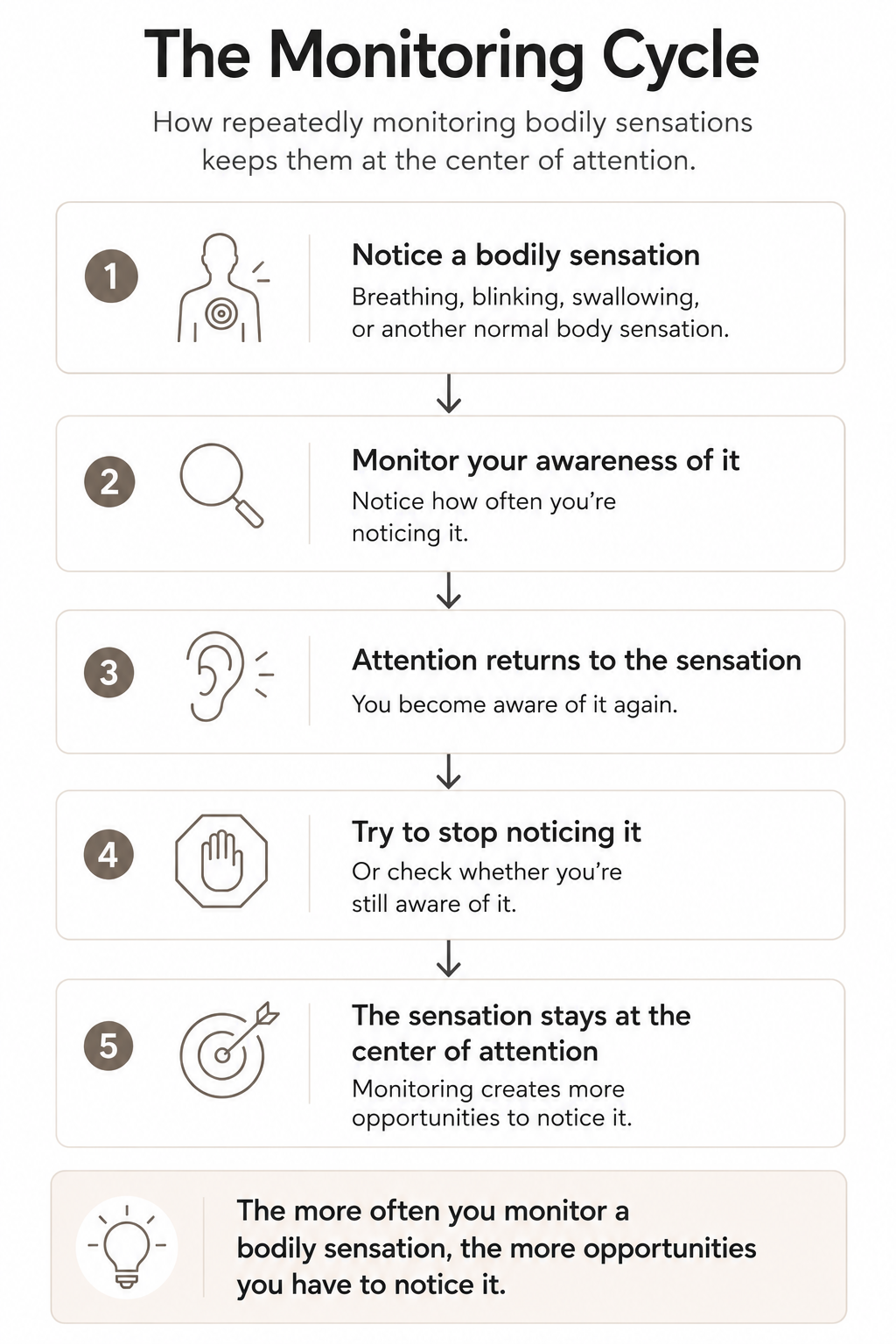
The person may begin monitoring the sensation to see whether it’s still there, testing whether he can ignore it, or checking whether it’s becoming more noticeable.
Ironically, those efforts usually have the opposite effect.
The more attention someone gives a sensation, the more prominent it becomes. That increased awareness convinces the brain the sensation must be important, making it even harder to let go.
Common Compulsions
Unlike some other forms of obsessive compulsive disorder, many compulsions in sensorimotor OCD happen mentally.
Someone may:
monitor whether the sensation is still present
repeatedly check whether she’s still aware of her breathing
test whether she can stop noticing a sensation
compare how noticeable the sensation feels from one moment to the next
search online to find out whether other people experience the same thing
seek reassurance that the awareness will eventually disappear
mentally monitor whether the sensation feels normal
These behaviors are understandable because they seem like they should solve the problem. Instead, they teach the brain that the awareness requires ongoing attention.
Some people also become preoccupied with finding the perfect distraction or constantly checking whether they’ve finally stopped noticing the sensation. Although understandable, these strategies can become compulsions that keep the cycle going.
Doesn’t Everyone Notice Their Breathing Sometimes?
Yes.
The difference isn’t whether someone notices a bodily sensation. Everyone does.
The difference is what happens next.
Most people naturally shift their attention to something else. Someone with sensorimotor OCD may begin wondering what the awareness means, whether it will ever stop, or whether normal automatic functioning has somehow been permanently disrupted.
Some people also become preoccupied with whether constant awareness will interfere with concentration, enjoyment, or daily life.
Why the Cycle Continues
Trying not to notice something is surprisingly difficult. The more someone checks whether he’s paying attention to his breathing, the more attention he gives it. The more he tries to force himself to stop noticing it, the more important the brain assumes it must be.
Over time, the person can become trapped in a cycle of awareness, monitoring, temporary relief, and renewed awareness.
Like other forms of obsessive compulsive disorder, the cycle is maintained not by the bodily sensation itself but by the compulsive attempts to achieve certainty or make the awareness go away.
How ERP Helps
Exposure and Response Prevention (ERP) is one of the most effective treatments for sensorimotor OCD.
Rather than trying to eliminate awareness of bodily sensations, ERP helps people gradually stop responding to the urge to monitor, test, or check whether they’re still noticing them. Treatment focuses on allowing the sensations to come and go naturally without treating them as problems that need to be solved.
The goal of treatment isn’t to stop noticing normal bodily sensations forever. Everyone notices them occasionally. Instead, the goal is to stop treating the awareness itself as a problem that has to be solved. As people spend less time monitoring, testing, and trying to eliminate the awareness, attention often begins to shift naturally again.
OCD Therapy in Arlington, VA
I provide therapy for obsessive compulsive disorder and anxiety disorders in Arlington, including sensorimotor OCD and other OCD themes, using Exposure and Response Prevention (ERP). Services are available in person and through teletherapy.
If awareness of bodily sensations has become exhausting or difficult to ignore, contact me to learn more about evidence-based treatment for obsessive compulsive disorder.
Related Articles
Types of OCD: Understanding Different OCD Themes
What Is Exposure and Response Prevention (ERP) Therapy?