
What Is Checking OCD?
You know you locked the front door.
You remember turning off the stove.
You’ve already checked the garage door, unplugged the curling iron, and made sure the coffee maker is off.
So why does it still feel like you should check one more time?
Maybe you walk back inside after getting to the car. Perhaps you take pictures of the stove before leaving the house, only to find yourself wondering later whether the picture was taken today. You might reread an email repeatedly before sending it or return home after work because you suddenly can’t remember whether you locked the door.
The problem isn’t that you’re forgetful.
The problem is that checking never seems to produce enough certainty.
What Is Checking OCD?
Many people use the term checking OCD to describe a pattern of obsessive compulsive disorder in which compulsive checking is the primary symptom. Although checking isn’t an official subtype of obsessive compulsive disorder, it’s one of the most common compulsions people experience.
Checking is usually driven by an obsession, which is an intrusive thought or doubt that creates anxiety. The checking itself is the compulsion, or the behavior performed in an attempt to reduce anxiety or become completely certain that nothing is wrong.
Checking OCD is one of the most common OCD themes. Although the focus is checking, the same underlying OCD cycle occurs across many different presentations. Learn more in Types of OCD: Understanding Different OCD Themes.
What Do People Check?
The specific things people check vary from person to person.
Someone may repeatedly check:
locks, windows, or garage doors
the stove, oven, or other appliances
light switches or electrical outlets
whether an alarm has been set
emails or text messages before sending them
homework or work assignments for mistakes
if faucets have been turned off
whether medication was taken
Although the objects being checked are different, the underlying goal is often the same: achieving complete certainty that nothing bad has happened and nothing bad will happen.
Why Doesn’t Checking Make the Anxiety Go Away?
Checking usually provides relief, but only briefly.
After checking the stove, a woman may feel confident that it’s off.
A few minutes later, another thought appears.
But what if I looked without really paying attention?
So she checks again.
The second check may bring relief for a moment, but before long another doubt appears.
What if I checked the wrong burner?
The problem isn’t poor memory. In many cases, people remember checking perfectly well. The problem is that obsessive compulsive disorder demands a level of certainty that checking can’t provide.
The More You Check, the More You Doubt
It seems logical that checking more carefully should increase confidence.
Ironically, the opposite often happens.
Each time someone checks, the brain learns that the doubt must have been important enough to require another inspection. Instead of resolving the uncertainty, repeated checking teaches the brain that certainty is something that must continually be verified.
Over time, people often become less confident in what they already know and more dependent on checking to feel safe.
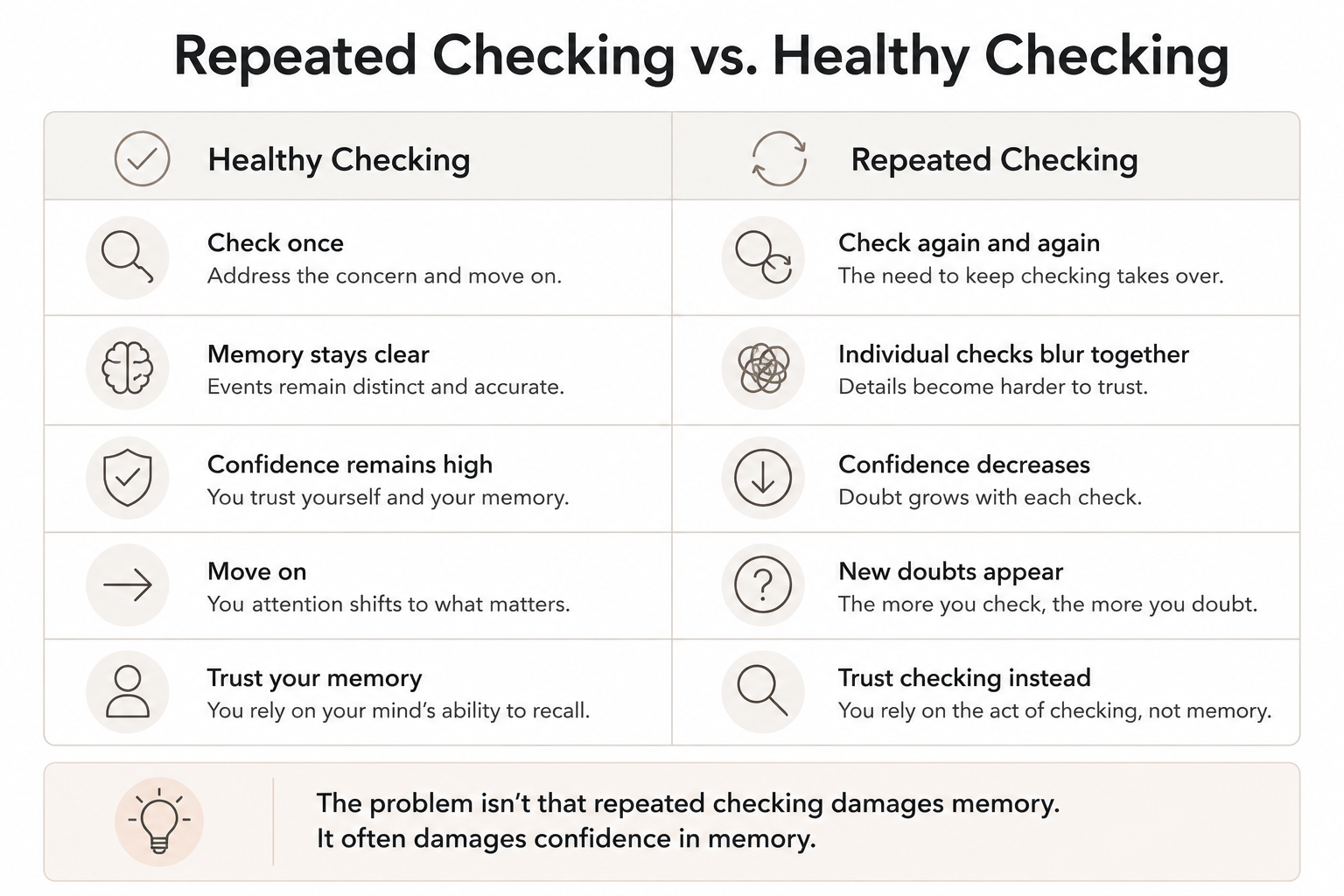
Isn’t It Responsible to Double-Check?
Sometimes it is.
Most people perform ordinary safety behaviors as part of their routine without becoming preoccupied by them. They lock the door as they leave, turn off the stove when they’re finished cooking, or take medication as planned, then move on with the rest of the day.
The difference isn’t whether someone performs those ordinary actions. The difference is whether obsessive compulsive disorder creates persistent doubt afterward, leading to repeated checking in an attempt to become completely certain that nothing was missed.
How ERP Helps
Exposure and Response Prevention (ERP) is one of the most effective treatments for obsessive compulsive disorder, including checking compulsions.
Rather than trying to achieve complete certainty, ERP helps people gradually resist the urge to check repeatedly while learning that uncertainty can be tolerated without performing compulsions.
The goal isn’t to become careless. The goal is to respond appropriately to real situations without allowing obsessive compulsive disorder to determine how much checking is “enough.”
Over time, many people find that they become more confident in what they already know and less dependent on checking to feel certain.
OCD Therapy in Arlington, VA
I provide therapy for obsessive compulsive disorder and anxiety disorders in Arlington, including checking compulsions and other OCD themes, using Exposure and Response Prevention (ERP). Services are available in person and through teletherapy.
If repeated checking has begun taking up your time, interfering with daily life, or making it difficult to trust your own memory, contact me to learn more about evidence-based treatment for obsessive compulsive disorder.
Related Articles
Types of OCD: Understanding Different OCD Themes
What Is Exposure and Response Prevention (ERP) Therapy?
Can You Have OCD and Know Your Fear Doesn’t Make Sense?