
Why Repeated Checking Can Make You Trust Your Memory Less
People who struggle with checking compulsions often assume that if they check enough times, they’ll eventually feel certain. The logic seems reasonable. If you’re worried you left the stove on, forgot to lock the door, sent the wrong email, or made a serious mistake, checking should help resolve the doubt.
But research on OCD has found that repeated checking has the opposite effect. In many cases, the more people check, the less they trust their memory.
Checking Feels Like It Should Create Certainty
People check because they’re trying to feel confident that something was done correctly. Someone may check whether the door is locked, whether the stove is off, whether an email was sent correctly, or whether they accidentally made a mistake. Checking usually reduces anxiety temporarily.
The problem is that the relief rarely lasts. A new doubt appears: What if I missed something? What if I checked incorrectly? What if I only think I remember checking? The person checks again, hoping to feel certain.
Over time, what began as an attempt to resolve doubt can become a cycle of repeated checking.
What the Research Has Found
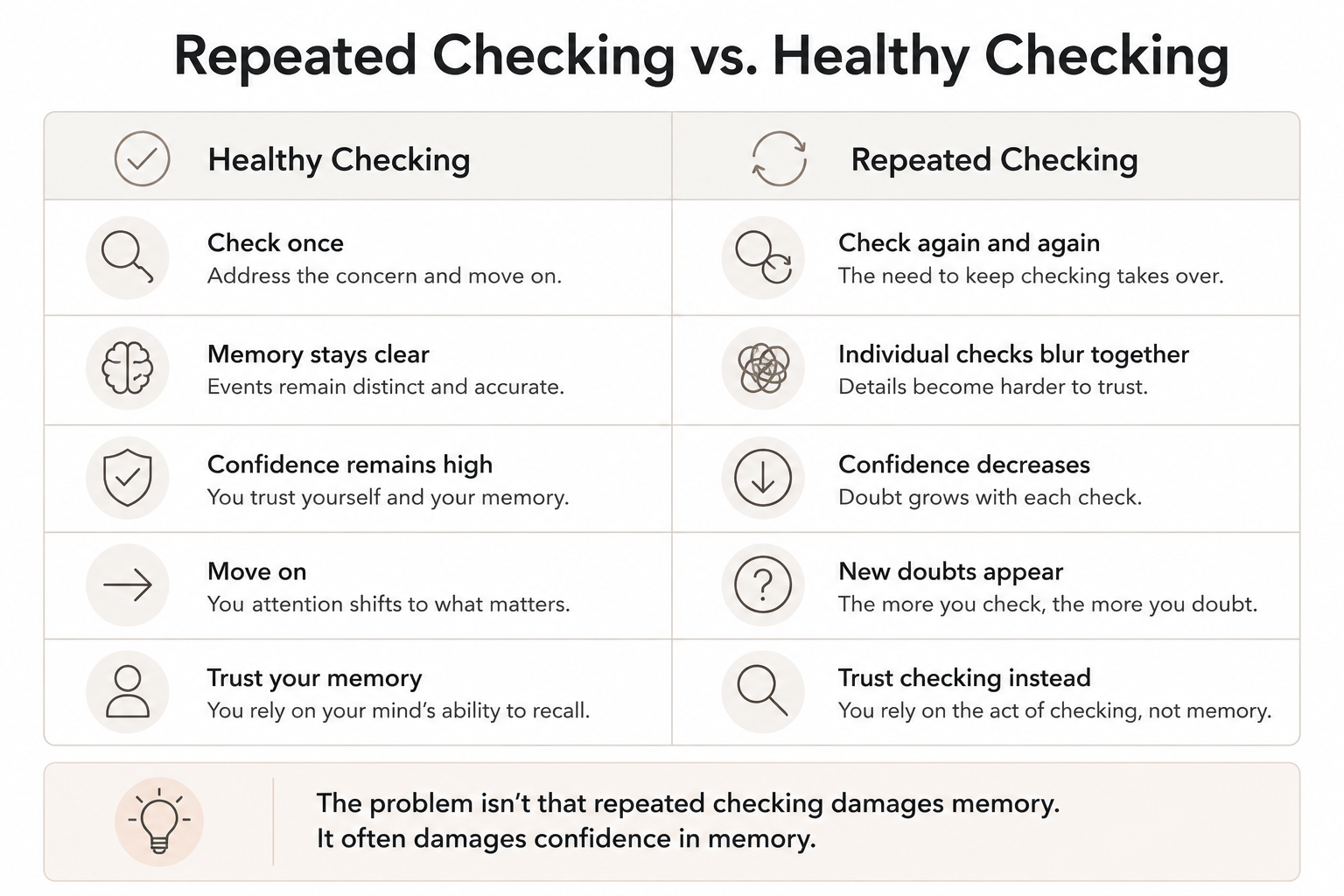
Research on checking compulsions has found that repeated checking tends to reduce memory confidence, memory vividness, and the sense that memories feel clear or trustworthy. Yet, memory accuracy often remains largely intact. In other words, people frequently remember correctly but become less confident that they do.
Researchers refer to this phenomenon as memory distrust.
This finding is important because many people with checking OCD assume they have a memory problem. In reality, the issue is often not memory accuracy itself, but a growing lack of confidence in memory.
Why Does This Happen?
Researchers believe that repeated checking may cause individual checking episodes to blur together. After checking something many times, it can become harder to distinguish one specific check from another. Instead of remembering a particular moment clearly, the person remembers checking repeatedly.
Rather than thinking, “I clearly remember locking the door,” the person may find themselves thinking, “I remember checking the door, but maybe I’m remembering one of the other times.”
Ironically, checking intended to create certainty can end up creating more uncertainty.
How This Shows Up in OCD
This process often occurs when obsessive compulsive disorder involves repeated checking. A person may repeatedly check locks, appliances, emails, assignments, health concerns, driving routes, or other situations where they fear making a mistake or causing harm.
The same pattern can occur with mental checking. Someone may repeatedly review a memory, analyze an interaction, examine their intentions, or search for certainty about whether they did something wrong. Although these compulsions happen internally, they often serve the same purpose as physical checking: trying to achieve certainty.
The goal is usually the same: to feel sure. However, repeated checking often makes certainty feel harder to achieve.
Breaking the Cycle
One of the goals of Exposure and Response Prevention (ERP) is helping people reduce compulsive checking and learn to tolerate uncertainty. Rather than checking until they feel completely certain, people gradually practice allowing doubt to be present.
The goal isn’t recklessness or carelessness. The goal is helping people rely less on compulsive checking and more on their ability to tolerate uncertainty and trust their memory.
Many people find that reducing compulsive checking helps them become more confident in their ability to tolerate uncertainty and rely on their memory.
OCD Treatment in Arlington, VA
I provide therapy for OCD and anxiety disorders in Arlington, VA, including treatment for checking compulsions, reassurance-seeking, intrusive thoughts, rumination, and obsessive doubt. Services are available in person and through teletherapy.
Treatment focuses on helping people step out of compulsive cycles of fear, checking, and certainty-seeking while developing a more flexible relationship with uncertainty, memory, and anxiety over time.
Schedule a consultation today for help with intrusive thoughts, compulsions, and uncertainty.
Related Articles
Types of OCD: Understanding Different OCD Themes
What Is Exposure and Response Prevention (ERP) Therapy?