
3 Common Misconceptions About OCD
Obsessive-compulsive disorder (OCD) is one of the most widely misunderstood mental health conditions.
Many people associate OCD primarily with cleanliness, organization, or being very detail-oriented. While those symptoms can occur, OCD is often much more complex and distressing than the stereotypes people commonly see portrayed online or in popular culture.
Misunderstandings about OCD can sometimes delay treatment, increase shame, or make it harder for people to recognize what they are experiencing.
1. OCD Isn’t Just About Cleanliness or Organization
Although contamination fears and cleaning compulsions are well-known forms of OCD, many people with OCD have no contamination symptoms at all.
OCD can involve fears of harming others, taboo or unwanted sexual thoughts, religious or moral obsessions, relationship doubts, existential fears, compulsive checking, reassurance-seeking, mental rituals, and fears of making mistakes or causing harm.
The core issue in OCD isn’t generally “liking things neat” or being highly organized. More often, OCD involves intrusive thoughts, intense doubt, distress, and compulsive attempts to reduce uncertainty or anxiety.
2. Compulsions Aren’t Always Visible
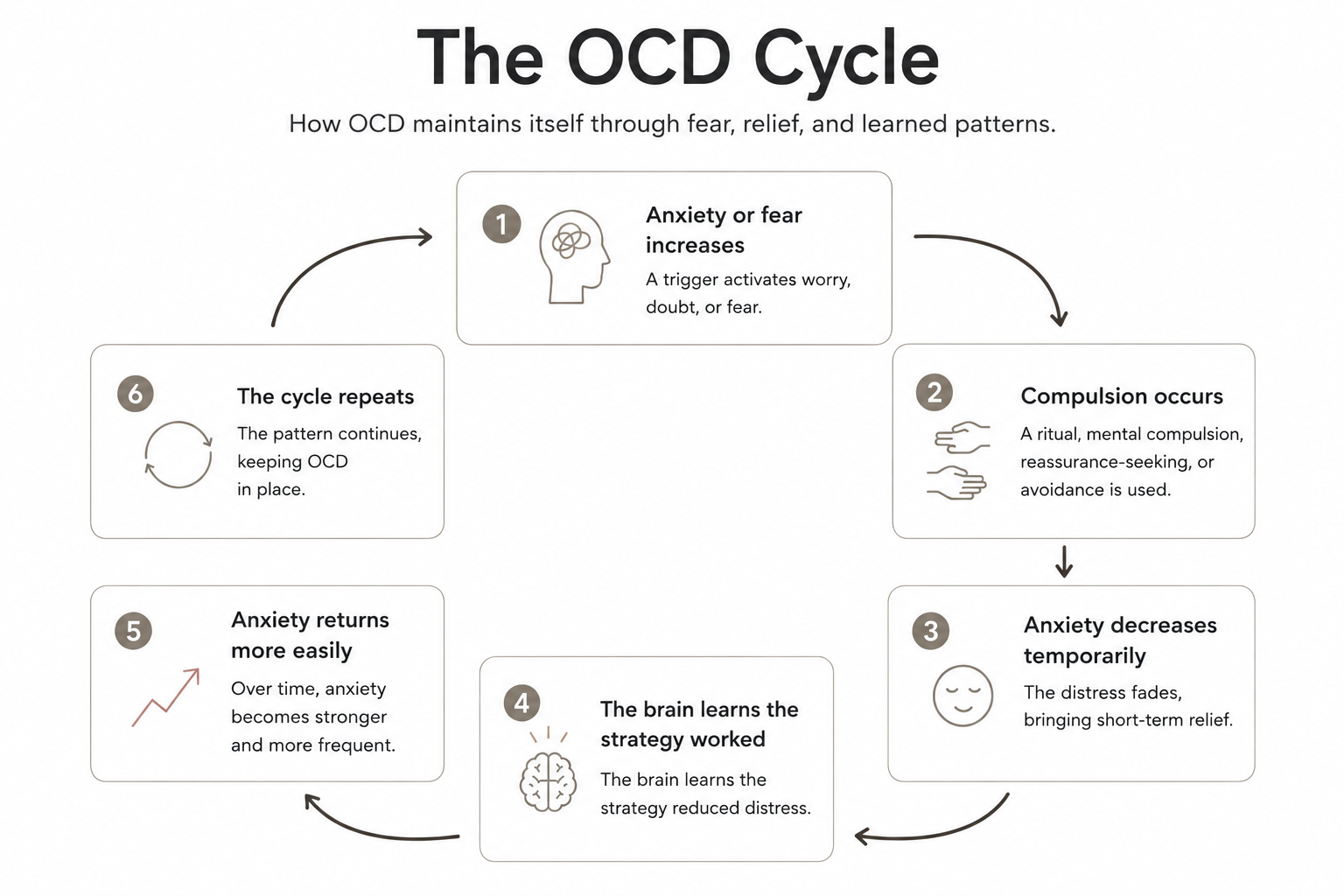
Visible compulsions may include handwashing, checking locks, arranging objects, or repeating actions However, many compulsions happen internally and may not be visible to other people.
Mental compulsions may involve reviewing conversations, analyzing thoughts repeatedly, checking emotional reactions, silently repeating phrases, seeking certainty, or trying to prove something to oneself.
Because these compulsions are internal, many people with OCD worry:
What if this isn’t really OCD?
This is especially common in forms of OCD that center around intrusive thoughts, rumination, or mental rituals.
3. People With OCD Usually Know Their Fears May Not Make Sense
A common misconception is that people with OCD fully believe their fears are rational or realistic.
In reality, many people with OCD recognize on some level that their fears may be exaggerated, unlikely, or irrational. However, the doubt still feels emotionally urgent and difficult to dismiss completely.
OCD often creates a powerful drive for certainty - certainty that no harm will occur, that intrusive thoughts don’t mean anything, that relationships are “right,” that contamination is impossible, or that one is safe, moral, and responsible.
Unfortunately, the more a person tries to eliminate uncertainty completely, the more trapped they often become in compulsive cycles of checking, reassurance-seeking, rumination, and avoidance.
OCD Is Treatable
OCD is highly treatable, and many people improve significantly with evidence-based treatment.
Treatment often involves Exposure and Response Prevention (ERP), a specialized form of therapy that helps people gradually respond differently to intrusive thoughts, anxiety, uncertainty, and compulsive urges over time.
ERP doesn’t focus on eliminating intrusive thoughts completely. Instead, treatment helps people reduce compulsive behaviors and develop a different relationship with uncertainty, fear, and distress.
OCD Treatment in Arlington, VA
I provide therapy for OCD and anxiety disorders in Arlington, VA, including treatment for intrusive thoughts, compulsions, reassurance-seeking, rumination, and obsessive doubt. Services are available in person and, when appropriate, through teletherapy.
Treatment focuses on helping people gradually step out of compulsive cycles and build greater flexibility in responding to difficult thoughts, emotions, and uncertainty over time.
If OCD is interfering with your life and you’d like to learn more about treatment, reach out to schedule a consultation.
Related Articles
Types of OCD: Understanding Different OCD Themes
What Is Exposure and Response Prevention (ERP) Therapy?
How Reassurance Makes Anxiety Worse