
Symptoms of Adult ADHD Often Look Different Than People Expect
Many people associate ADHD with obvious hyperactivity, disruptive behavior, or difficulty sitting still in school.
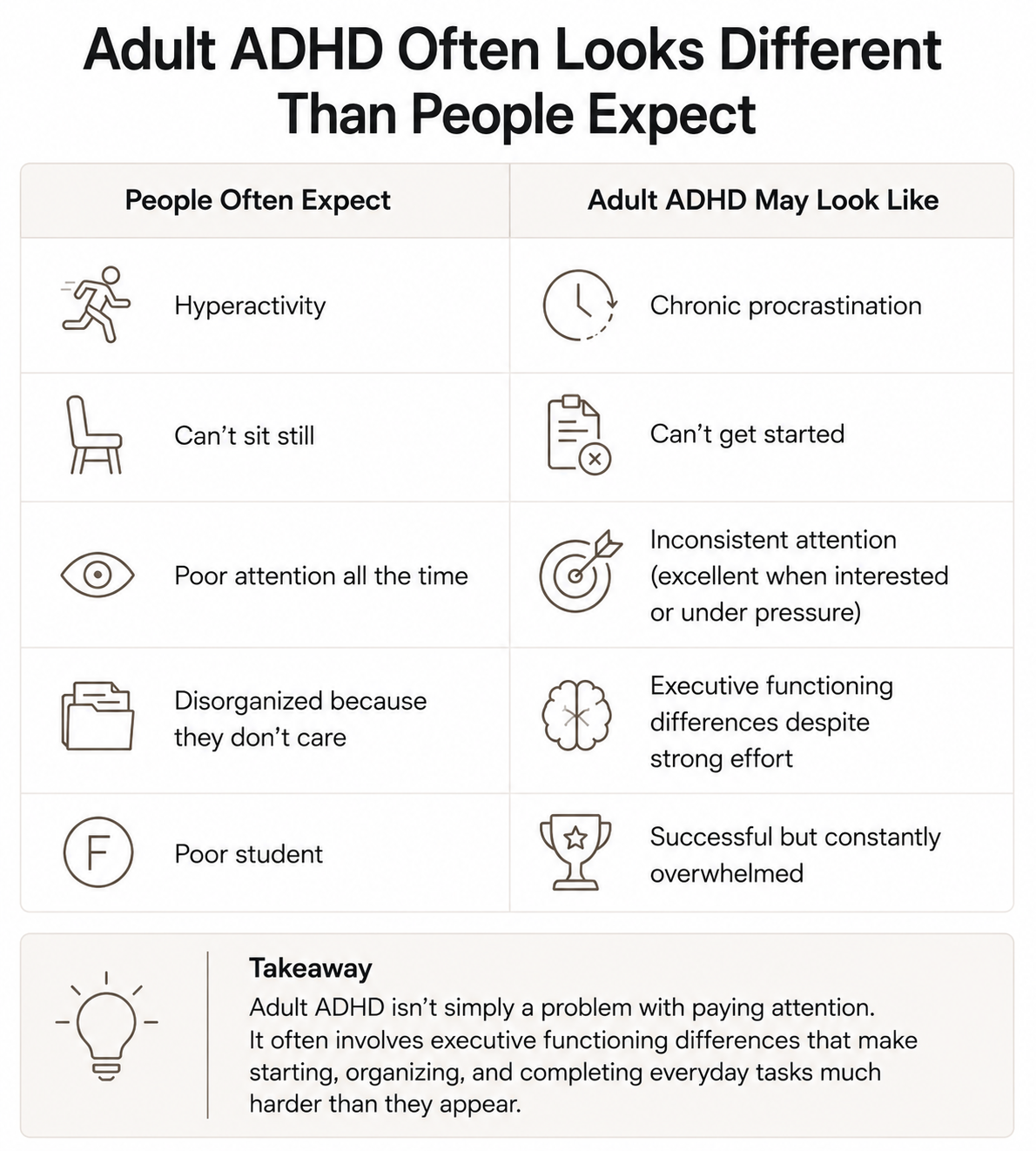
However, adult ADHD often presents much differently.
Many adults with ADHD are intelligent, capable, hardworking, and outwardly successful. Some were never identified in childhood because they performed well academically, developed strong compensatory strategies, or internalized their difficulties rather than acting out behaviorally.
As a result, many adults don’t recognize ADHD until years later, often after increasing work, academic, parenting, or organizational demands begin overwhelming the systems they previously relied on.
Adult ADHD Is Often More About Executive Functioning Than Hyperactivity
ADHD isn’t simply a problem with attention.
For many adults, the core difficulties involve executive functioning skills such as organization, task initiation, prioritization, working memory, time management, emotional regulation, and sustaining effort consistently.
Many adults describe knowing exactly what needs to do but struggling to begin, procrastinating until urgency creates enough stimulation to focus, forgetting appointments or deadlines, becoming overwhelmed by multistep tasks, having difficulty transitioning between activities, and feeling frustratingly inconsistent despite genuine effort.
These difficulties are often mistaken for laziness, lack of motivation, or poor discipline.
ADHD Can Coexist With Anxiety and Perfectionism
Many adults with ADHD also develop anxiety over time.
Years of missed deadlines, disorganization, inconsistent performance, overwhelm, negative feedback, and feeling perpetually “behind” can create chronic stress and self-doubt.
can create chronic stress and self-doubt.
Some adults compensate by becoming highly perfectionistic or overworking to avoid mistakes. Others rely on urgency, panic, or last-minute pressure to complete tasks.
As a result, adults with ADHD may appear highly functioning, intelligent, anxious, perfectionistic, and driven while struggling privately with everyday executive functioning demands.
Hyperfocus and Inconsistency
One confusing aspect of ADHD is that attention is often inconsistent rather than absent.
Many adults with ADHD can focus extremely well on activities that are stimulating, urgent, emotionally engaging, novel, or highly interesting. The greatest difficulties often arise when tasks are repetitive, administrative, require sustained organization, involve delayed rewards, or simply aren’t very interesting. This inconsistency often leads people to question whether they “really” have ADHD.
Why Adult ADHD Is Sometimes Missed
Adult ADHD is frequently underrecognized, particularly among high-achieving individuals, women, people with anxiety, and those who developed strong compensatory systems or never displayed obvious childhood behavioral problems. Many conclude that they’re simply lazy, careless, unmotivated, or “not living up to their potential,” when executive functioning differences may better explain the pattern.
Adult ADHD Evaluations in Arlington, VA
I provide comprehensive ADHD evaluations in Arlington, VA for adolescents and adults experiencing attention difficulties, executive functioning challenges, chronic procrastination, disorganization, academic struggles, and related concerns.
Evaluations are designed to help clarify how attentional, cognitive, emotional, and behavioral factors may be interacting, with the goal of providing a more nuanced understanding of strengths, difficulties, and appropriate treatment recommendations over time.
Psychological testing can often provide clarity when questions have gone unanswered for years. If you’d like to learn more, reach out to schedule a consultation.
Related Links
Understanding Psychological and Psychoeducational Testing
What is Executive Functioning?
ADHD or Anxiety: How Can You Tell the Difference?