
How Therapy Can Change the Way You Respond to Anxiety
Many people come to therapy hoping they can get rid of anxiety completely.
In reality, therapy often focuses less on eliminating anxiety altogether and more on changing the way people respond to anxious thoughts, feelings, uncertainty, and discomfort over time.
For many individuals, anxiety gradually begins shaping daily decisions, behaviors, relationships, and routines. People may start organizing life around trying to prevent distress, avoid uncertainty, or feel completely “safe” before taking action.
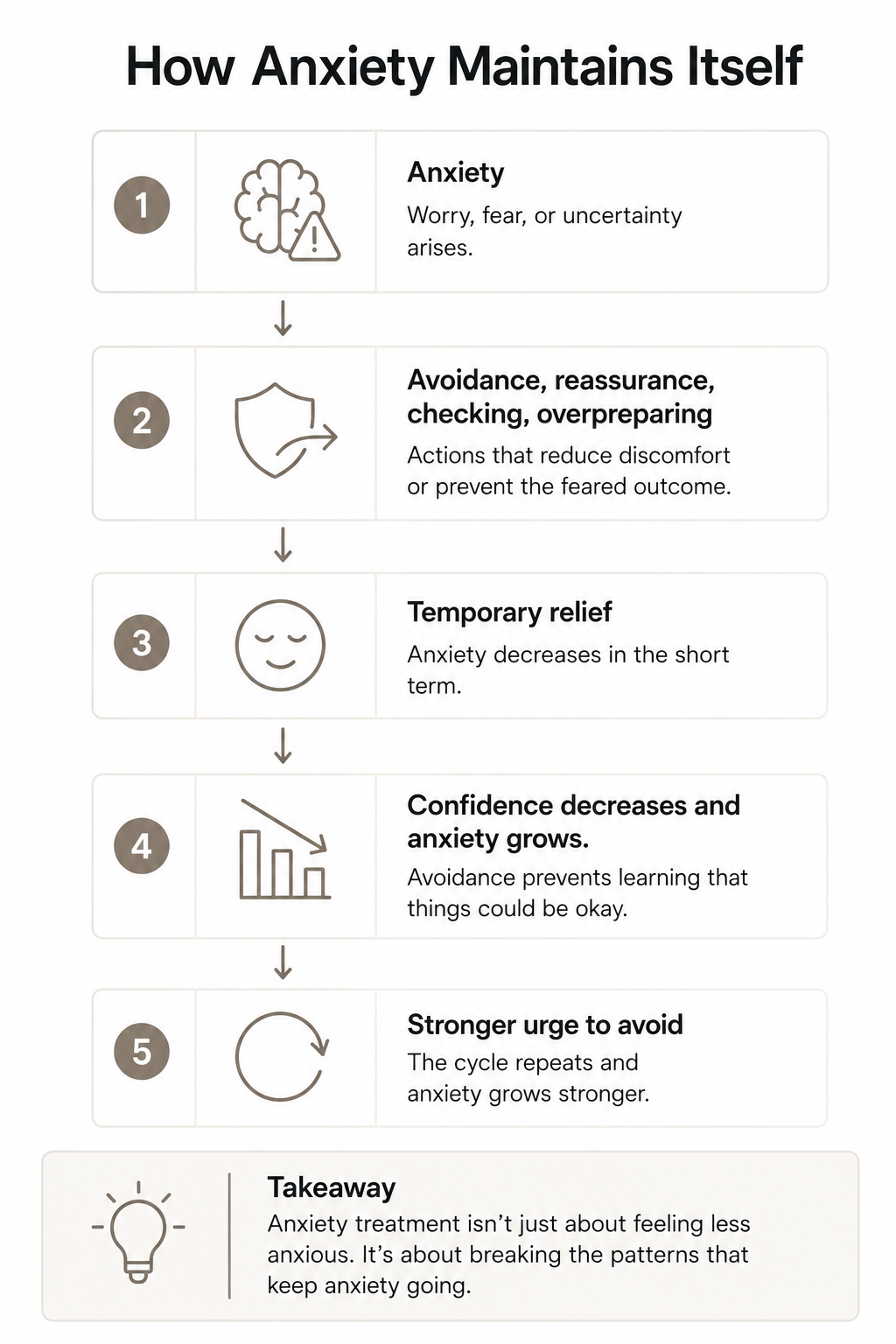
Although these strategies often provide temporary relief, they can unintentionally keep anxiety going long-term.
1. Therapy Often Helps Reduce Avoidance
Avoidance is one of the most common ways anxiety maintains itself.
People may avoid difficult conversations, uncertainty, social situations, decision-making, feared physical sensations, or situations associated with discomfort or embarrassment.
In the short term, avoidance often reduces anxiety temporarily.
The problem is that the brain never has the opportunity to learn:
I can tolerate discomfort.
Anxiety itself is not dangerous.
I can function even when I feel uncertain.
Over time, life can gradually become narrower around fear and avoidance.
Therapy helps people slowly re-engage with situations, activities, and experiences that anxiety has made increasingly difficult.
2. Therapy Can Help People Respond Differently to Anxious Thoughts
Many people experiencing anxiety become caught in repetitive patterns such as overthinking, mental review, reassurance-seeking, catastrophizing, excessive self-monitoring, and trying to achieve complete certainty.
Often, the goal becomes:
How do I stop feeling anxious?
But struggling aggressively against anxiety can sometimes increase hypervigilance and emotional exhaustion.
Therapy may help people develop a different relationship with anxious thoughts by learning how to:
tolerate uncertainty more effectively
disengage from repetitive mental loops
reduce reassurance-seeking
recognize unhelpful thinking patterns
respond more flexibly to fear and discomfort
3. Therapy Focuses on Building Flexibility Rather Than Perfect Calm
Many people enter therapy believing success means never feeling anxious again.
In reality, anxiety is a normal human emotion. The goal is usually not to eliminate anxiety permanently, but to reduce the extent to which fear and avoidance control daily life.
Over time, many people notice greater confidence handling uncertainty, less avoidance, reduced emotional overwhelm, increased willingness to take appropriate risks, improved functioning despite anxiety, and less time trapped in worry or rumination.
Therapy often helps people build a life that feels less organized around fear, even if anxiety still appears at times.
Anxiety Therapy in Arlington, VA
I provide therapy in Arlington, VA for adults and adolescents experiencing anxiety disorders, OCD, tinnitus, insomnia, and related concerns. Services are available in person and through teletherapy.
Treatment focuses on helping people step out of cycles of avoidance, reassurance-seeking, hypervigilance, and chronic worry so they can spend less energy managing anxiety and more energy engaging with the things that matter to them.
Anxiety can be exhausting. If you’d like support, reach out to schedule a consultation.
Related Articles
What Is Cognitive Behavioral Therapy (CBT)?
What Is Exposure and Response Prevention (ERP) Therapy?
How Reassurance Makes Anxiety Worse