
What Anxiety Therapy Actually Focuses On
Many people think anxiety therapy is primarily about learning how to “calm down” or eliminate anxious thoughts completely.
In reality, anxiety treatment often focuses less on getting rid of anxiety altogether and more on changing the patterns that keep anxiety going over time.
Anxiety isn’t simply a feeling. It also affects behavior, attention, decision-making, habits, and the way people respond to uncertainty and discomfort.
Over time, anxiety can gradually begin organizing a person’s life around avoiding distress.
Anxiety Often Creates Short-Term Relief Cycles
Many behaviors associated with anxiety provide temporary relief in the moment.
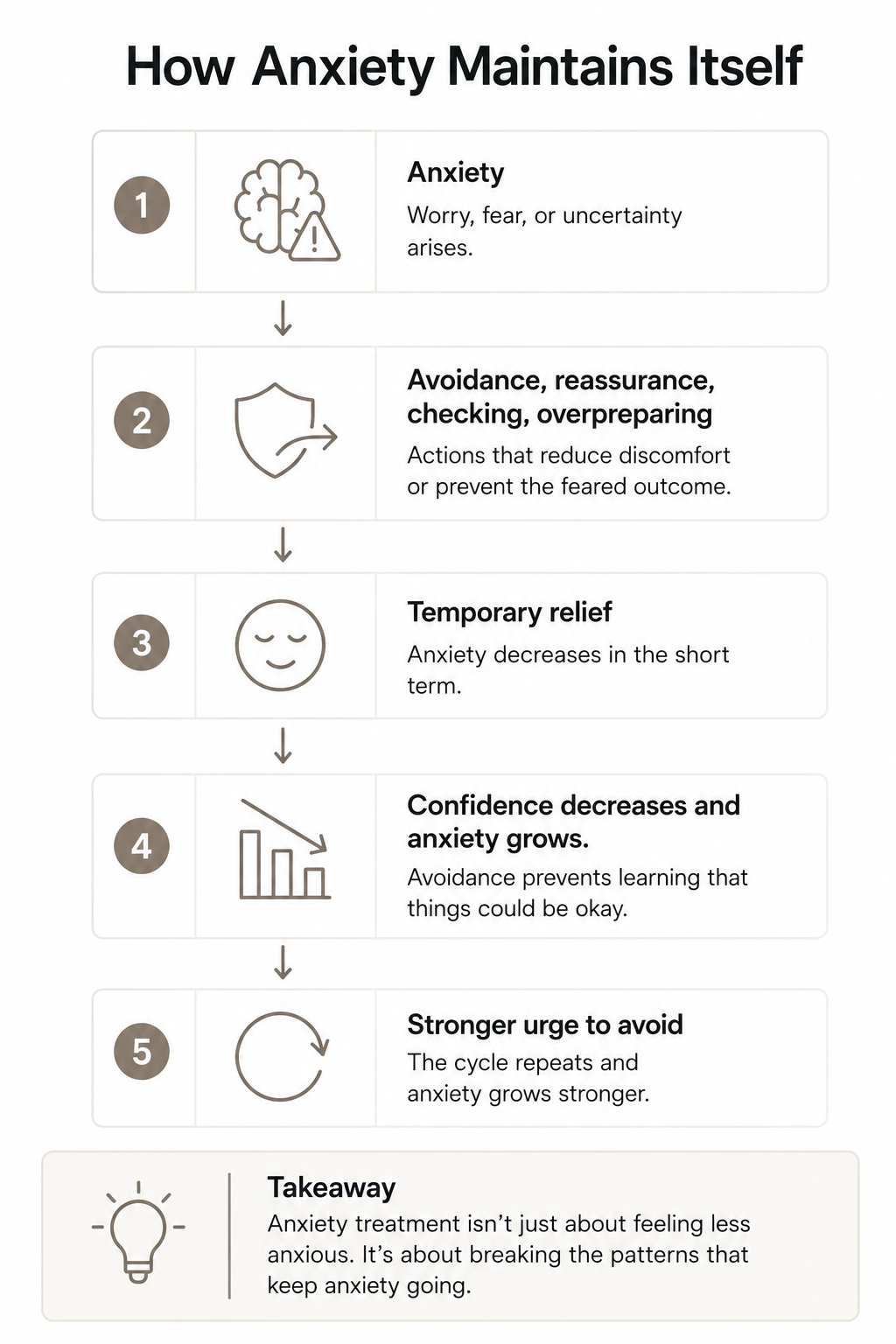
People may avoid situations that feel uncomfortable, seek reassurance repeatedly, overprepare, mentally review conversations, research fears online, procrastinate, check repeatedly, or try to achieve complete certainty before acting. Although these strategies often reduce anxiety temporarily, they can unintentionally strengthen anxiety over time.
These strategies often reduce anxiety temporarily.
The problem is that short-term relief can unintentionally strengthen anxiety long-term because the brain never has the opportunity to fully learn:
I can tolerate uncertainty.
I can handle discomfort.
I don’t need complete certainty to function.
Anxiety itself isn’t dangerous.
Over time, anxiety often becomes increasingly tied to avoidance, reassurance-seeking, and hypervigilance.
Anxiety Can Gradually Narrow a Person’s Life
One of the most painful aspects of anxiety is that life can gradually become smaller around it.
As anxiety grows, people may begin avoiding situations, delaying decisions, withdrawing socially, monitoring themselves more closely, limiting activities, or feeling they need increasing certainty before taking action.
Sometimes these changes happen so gradually that people don’t fully notice how much anxiety has started shaping daily life.
The goal of therapy is often not to force people into frightening situations immediately, but to gradually help them build greater flexibility, confidence, and tolerance for discomfort over time.
Anxiety Therapy Often Focuses on Relationship to Anxiety, Not Eliminating It Completely
Many people enter therapy hoping to stop feeling anxious altogether.
However, anxiety is a normal human emotion. The goal is usually not to eliminate anxiety permanently, but to reduce the extent to which fear, avoidance, and uncertainty dominate decision-making and daily functioning.
Treatment often focuses on reducing avoidance and reassurance-seeking, increasing tolerance for uncertainty, identifying unhelpful thinking patterns, reducing hypervigilance, re-engaging with meaningful activities, and responding differently to anxious thoughts and physical sensations.
Over time, many people find that anxiety becomes less consuming when they stop organizing their lives around trying to eliminate it completely.
Therapy Isn’t About “Thinking Positively” All the Time
People sometimes worry that therapy will involve forcing themselves to be optimistic or convincing themselves that nothing bad could ever happen.
Evidence-based anxiety treatment is generally much more nuanced than that.
Rather than trying to guarantee certainty or eliminate all possible risk, therapy often focuses on helping people develop greater psychological flexibility and a different relationship with uncertainty, discomfort, and fear.
Anxiety Therapy in Arlington, VA
I provide therapy in Arlington, VA for adults and adolescents experiencing anxiety disorders, OCD, insomnia, tinnitus, and related concerns. Services are available in person and through teletherapy.
Treatment focuses on helping people gradually step out of cycles of avoidance, reassurance-seeking, hypervigilance, and chronic worry while building healthier ways of responding to anxiety and uncertainty over time.
If you’re ready to spend less time fighting anxiety and more time focusing on what matters to you, let’s talk.
Related Links
What Is Exposure and Response Prevention (ERP) Therapy?