
What Are the Three ADHD Presentations?
Many people think of ADHD as one single condition that always looks the same.
In reality, Attention-Deficit/Hyperactivity Disorder can present in different ways. Some individuals primarily struggle with attention and organization. Others are more impulsive and physically restless. Many experience a combination of both.
This is why ADHD is divided into three presentations (sometimes informally called “subtypes”).
Understanding these presentations can help explain why ADHD may look very different from person to person — and why some individuals go unrecognized for years.
ADHD Is More Than “Being Distracted”
ADHD is a neurodevelopmental condition involving difficulties with attention regulation, executive functioning, impulse control, activity level, and self-management. These challenges often affect areas such as sustaining attention, organization, task initiation, working memory, time management, emotional regulation, follow-through, and managing competing demands.
ADHD isn’t simply a lack of effort, intelligence, motivation, or discipline.
Many people with ADHD work extremely hard just to maintain everyday functioning.
The Three ADHD Presentations
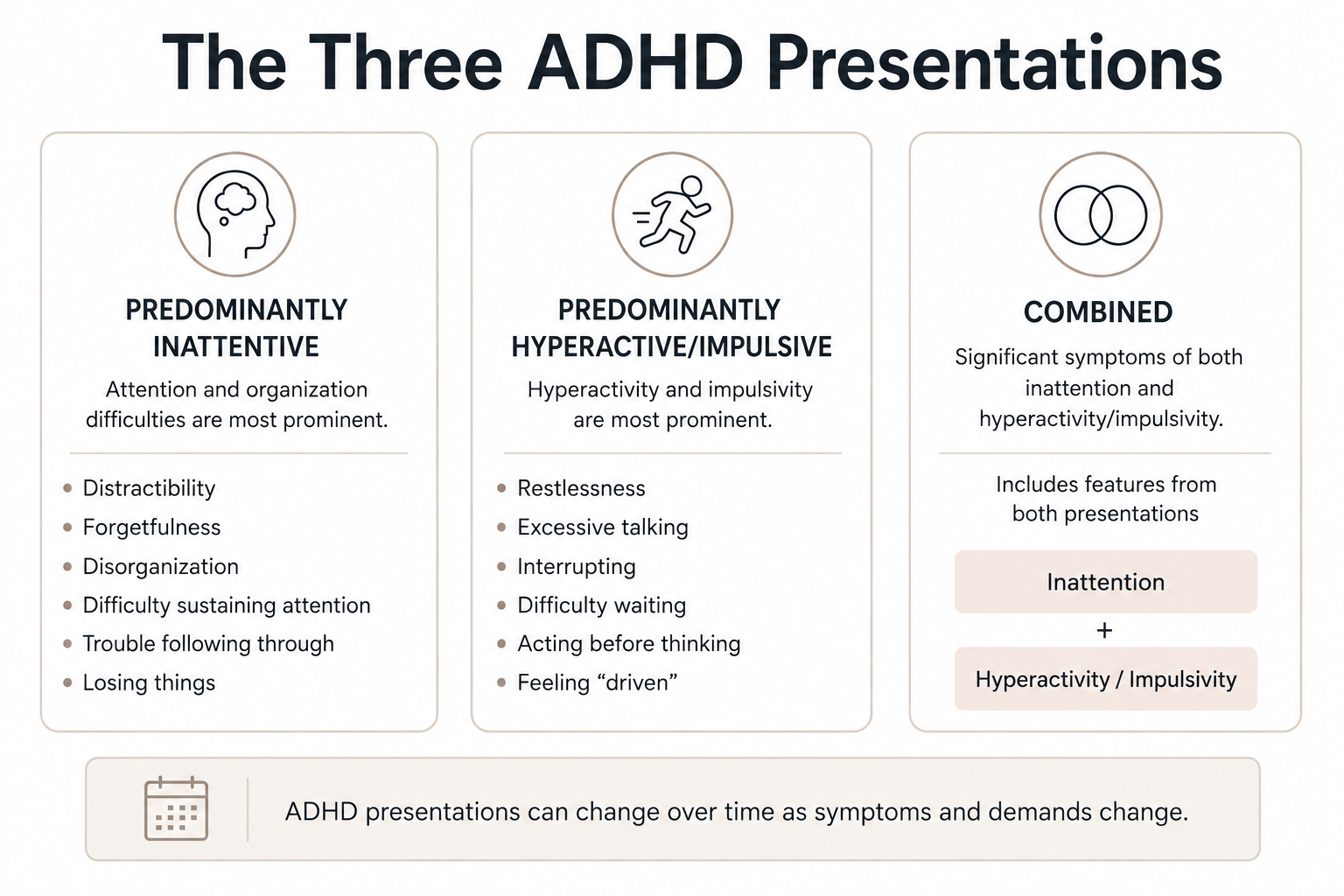
The current diagnostic system describes three ADHD presentations:
Predominantly Inattentive Presentation
Predominantly Hyperactive/Impulsive Presentation
Combined Presentation
These presentations describe the symptom pattern that is most prominent at a given point in time.
Predominantly Inattentive Presentation
This presentation is sometimes what people mean when they refer to “ADD,” although that term is no longer an official diagnosis. Individuals with Predominantly Inattentive Presentation often struggle with distractibility, forgetfulness, disorganization, task initiation, sustaining attention, following through on tasks, losing items, and mental drifting or zoning out.
Common experiences include rereading the same paragraph repeatedly, missing details, forgetting appointments, struggling to start tasks, feeling mentally overwhelmed by organization, and procrastinating until deadlines become urgent.
These individuals aren’t necessarily physically hyperactive. In fact, many appear quiet or internally distracted rather than outwardly disruptive. Because they may not cause behavioral problems, Inattentive ADHD is often overlooked, particularly in girls and women, high-achieving students, adults, and individuals with strong compensatory skills.
Predominantly Hyperactive/Impulsive Presentation
This presentation involves more prominent hyperactivity and impulsivity. Common features include excessive talking, interrupting, restlessness, difficulty sitting still, blurting things out, acting before thinking, impatience, difficulty waiting turns, and feeling internally “driven.”
In children, hyperactivity may look like constant movement, excessive climbing, or difficulty remaining seated. But in many adults, hyperactivity becomes more internalized.
Adults may describe racing thoughts, constant mental activity, difficulty relaxing, chronic restlessness, a need for constant stimulation, or impulsive decision-making. People sometimes assume hyperactivity disappears with age, but it often changes form rather than fully disappearing.
Combined Presentation
Individuals with Combined Presentation experience significant symptoms of both inattention and hyperactivity/impulsivity. Common challenges may include sustaining attention, organization, task initiation, working memory, time management, emotional regulation, impulsivity, follow-through, and managing competing demands. Combined presentation often creates difficulties across multiple areas of life because both attentional and impulsive symptoms interfere with functioning.
ADHD Can Change Across the Lifespan
ADHD symptoms often evolve over time. For example, young children may appear highly physically hyperactive, adolescents may struggle more with organization and increasing academic demands, and adults may experience chronic overwhelm, procrastination, emotional dysregulation, or burnout.
Many adults no longer appear outwardly hyperactive but still experience internal restlessness, impulsivity, executive functioning difficulties, and chronic difficulty managing daily responsibilities.
This is one reason ADHD can be missed or misunderstood later in life.
ADHD Doesn’t Always Look Like Poor Performance
Some people assume ADHD always causes failing grades or obvious dysfunction. In reality, many individuals with ADHD are intelligent, creative, high-achieving, verbally strong, and highly motivated. Some compensate through perfectionism, overworking, anxiety-driven urgency, rigid organizational systems, or reliance on last-minute adrenaline. From the outside, they may appear successful while privately feeling chronically overwhelmed and exhausted.
ADHD Frequently Co-Occurs With Other Conditions
ADHD frequently co-occurs with other conditions, including anxiety disorders, depression, learning disorders, autism spectrum disorder, OCD, and sleep difficulties. Sometimes these overlapping concerns make ADHD harder to recognize clearly.
A comprehensive evaluation helps determine which factors are contributing to current difficulties.
ADHD Evaluations Focus on the Whole Picture
A thorough ADHD evaluation typically examines developmental history, attention patterns, executive functioning, emotional functioning, academic or occupational performance, behavior across settings, cognitive strengths and weaknesses, and the possibility of overlapping conditions.
The goal isn’t simply to assign a label, but to better understand the individual’s overall profile and identify effective supports and recommendations.
ADHD Evaluations in Arlington, VA
I provide comprehensive ADHD evaluations in Arlington for adolescents and adults struggling with attention, executive functioning, organization, emotional regulation, academic difficulties, and chronic overwhelm.
Evaluations are designed to clarify patterns of strengths and challenges, identify factors contributing to difficulties with attention and functioning, and provide individualized recommendations to support long-term success and well-being.
Related Articles
Understanding Psychological and Psychoeducational Testing
What is Executive Functioning?
My Child Gets Good Grades. Could They Still Have ADHD?
What Psychoeducational Testing Can Reveal About Learning and Attention