
Can Monitoring Tinnitus Make It More Noticeable?
People with tinnitus often find themselves constantly checking the sound.
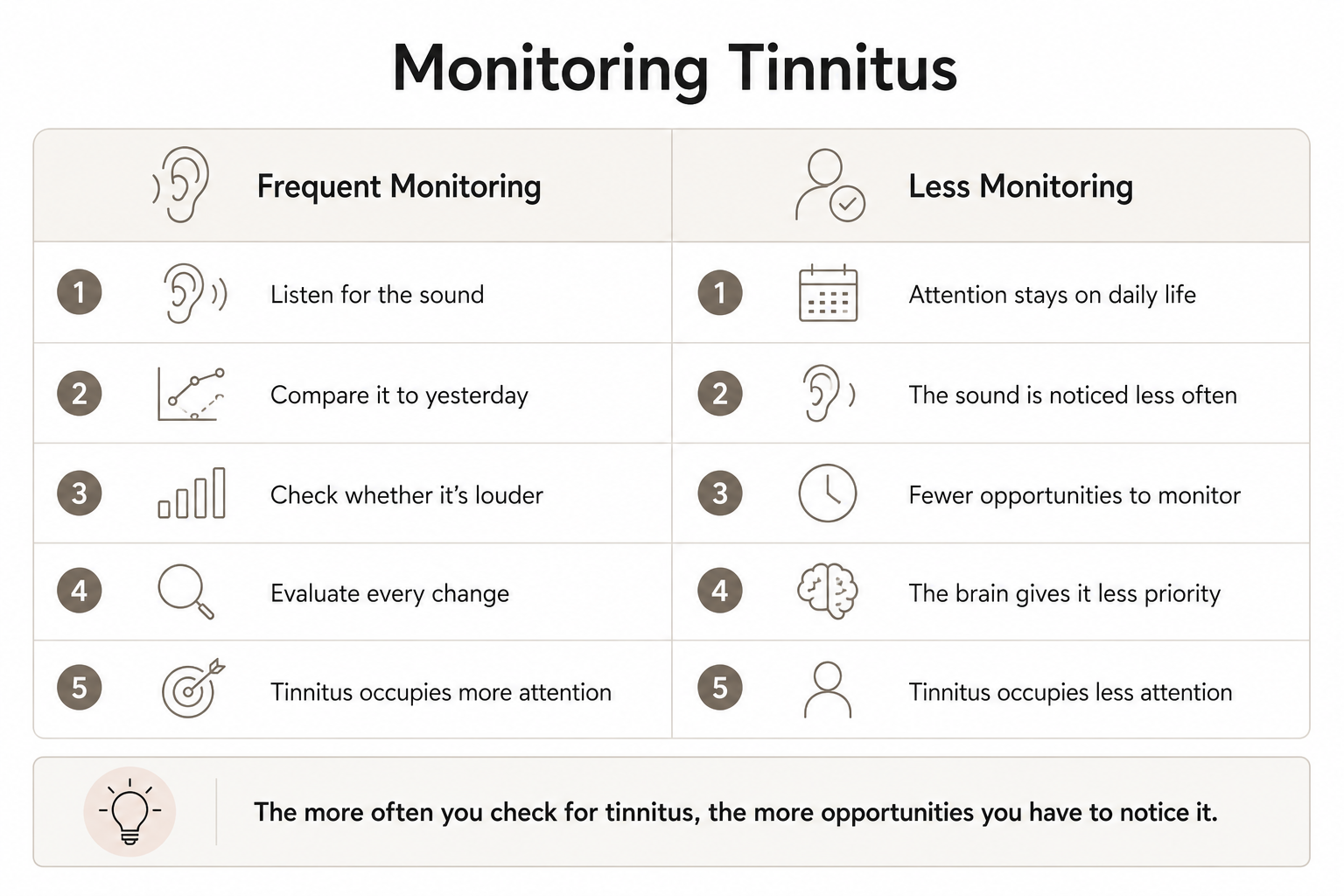
They may compare today’s tinnitus to yesterday’s. They may check whether their tinnitus is getting better, whether it’s getting worse, whether treatment is helping, or whether they’re noticing it more than they were a week ago. Often, this happens automatically.
No one wants to obsess about tinnitus. People just want to understand what’s happening.
Checking Starts for a “Good Reason”
When tinnitus first appears, paying attention to it makes sense. It’s a new symptom and monitoring feels responsible and practical. The problem is that what begins as gathering information can gradually turn into repeatedly checking the tinnitus in ways that keep attention focused on the sound.
The More You Monitor Tinnitus, the More Opportunities You Have to Notice It
Consider someone who steps on a scale ten times a day. The frequent checking doesn’t necessarily provide better information, but it does keep weight front of mind.
Tinnitus often works in a similar way. The more time spent listening for the sound, evaluating it, comparing it, and monitoring it, the more opportunities there are to notice it.
Many people interpret this increased awareness as evidence that the tinnitus is worsening. But that’s not necessarily true. Sometimes people are simply noticing something more because they’re paying closer attention to it.
Checking Often Doesn’t Produce the Certainty People Want
Many people check tinnitus because they’re looking for reassurance.
They want evidence that the sound is improving, stabilizing, or at least not getting worse. But that’s not really how tinnitus works. Some days it seems quieter. Some days it seems louder. Some days it seems unchanged. As a result, checking often creates more questions than answers and may leave people feeling just as concerned as they were before they checked.
The Goal Isn’t Ignoring Important Information
This doesn’t mean people should never pay attention to tinnitus.
Medical symptoms sometimes require evaluation. Changes in hearing or tinnitus should be discussed with appropriate healthcare professionals when warranted. The issue is repeatedly checking for reassurance, certainty, or information that cannot actually be obtained through continued monitoring.
CBT for Tinnitus
Cognitive Behavioral Therapy (CBT) for tinnitus doesn’t focus on convincing people that the sound isn’t real or that they should simply ignore it.
Instead, treatment helps people recognize patterns that may be unintentionally keeping tinnitus at the center of awareness. This includes examining monitoring, checking, reassurance-seeking, avoidance, and other responses that develop around tinnitus over time.
Most people find that as they spend less time evaluating the sound, tinnitus occupies less of their attention and emotional energy.
CBT for Tinnitus in Arlington, VA
I provide Cognitive Behavioral Therapy for tinnitus for adults experiencing tinnitus-related distress, hypervigilance, sleep difficulties, and anxiety. Services are available in person and through teletherapy.
Treatment focuses on helping people reduce tinnitus-related distress, decrease monitoring and hypervigilance, and learn to live a fulfilling life even in the presence of tinnitus. If you’re struggling with tinnitus-related distress and would like to learn more about treatment, contact me to schedule a consultation.
Related Articles
Understanding Tinnitus: Why It Happens and Why It Becomes So Distressing
Why Does My Tinnitus Seem Louder When I’m Stressed?
Why Trying Not to Think About Something Makes It Stick Around